
articles
Software powers switch to cheaper electricity consumption
Energy management specialist GridEdge has trialled advanced software through the Diatomic Digital Accelerator to allow commercial buildings to use greener and cheaper electricity – and recently secured £3.4 million investment.

Volatility with energy prices due to geopolitical tensions is causing concern among businesses that rising electricity costs could hit hard.
In an effort to help office occupiers keep rising costs under control – and improve their sustainability credentials – a project in the West Midlands is introducing automatic control of heating and cooling systems to maximise renewable energy use.
GridEdge, an SME supported by Connected Places Catapult through the Diatomic Digital Accelerator, is working with Aston University to trial its new platform Flex.

The software identifies when best to draw electricity to take advantage of times when more energy is generated by renewable sources – a practice called carbon load shifting.
“Diatomic has allowed us to prove how more carbon load shifting can be achieved in an easier way with automation, compared to manual control.”Paul McCorquodale, Chief Executive, GridEdge
He adds that clients are increasingly embracing the idea of monitoring the sustainability impact of energy use, as well as focusing on reducing cost. “Carbon load shifting predicts a spike in demand, and automation developed through Diatomic works out how to quickly make changes to consumption.”
Diatomic shows future potential
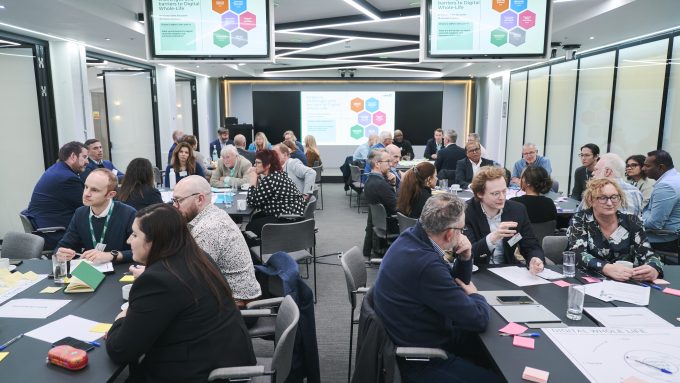
GridEdge was one of eight companies to join the Diatomic Digital Accelerator last November, and Connected Places Catapult teamed them up with Aston University to explore how the software could dynamically adjust energy use at the university library.
Chief Financial Officer, Richard Moore says the programme also connected GridEdge with other companies on the cohort, “helping us to hear some of their not too dissimilar challenges”, such as how best to access data to improve building performance.
Richard adds that the company’s technology can predict the temperature within commercial spaces one day ahead, and forecast what impact making a change to consumption patterns will likely have on occupier comfort.
“We can control the building’s systems to make the changes dynamically, but the real hurdle is bringing people on the journey so they want it to happen,” he explains. “Without the Diatomic programme, we wouldn’t have been able to take these steps.”
GridEdge is currently used in around 180 buildings in the UK to provide ‘energy visualisation’ to customers; showing electricity consumption in near real time, and to identify any unusual patterns in usage.
Well-known buildings using its systems include the Bullring shopping centre in Birmingham and the Royal Opera House in London. Clients also include several schools run by the Oasis Multi Academy Trust, real estate investment trust Hammerson and global infrastructure consultancy and operations partner Amey.
At present, the product helps building operators to understand and take actions to make a building run more sustainably; focusing on improving both occupier experience and energy performance by switching to more efficient lighting and sustainable heating, ventilation and air conditioning systems.
What the Diatomic programme is doing is helping GridEdge to investigate how building operators can take the next step in their energy management journey: dynamically controlling consumption based on renewable energy availability, helping customers use more renewable electricity and less fossil fuelled electricity
Last year, GridEdge received £3.4 million investment in three funding rounds to grow the business. The largest share of £2.5 million came from venture capital firm Mercia Ventures, with the remainder from original investors BP, Centrica and a syndicate of angel investors.
Tackling the UK’s ‘energy gluttony’
Paul adds that “energy gluttony has been accepted for too many years and is now a big issue; not just because we're all spending more money, but because the grid can't cope with all this energy use”.
He says energy suppliers understand that capacity is a problem, but the only way that blackouts can be avoided is by changing consumer behaviour too. The issue will also become more pressing, he predicts, with the continued rollout of electric vehicle chargers and heat pumps.
“If we don’t start thinking differently, it will only be a matter of time before we have blackouts. For years, the answer has been said to be adding capacity to the grid, but we can’t do that quickly enough.”
Residential customers are starting to be offered dynamic pricing to encourage consumption of electricity at times of lower demand, and Paul predicts this will soon happen in the commercial space too.
GridEdge estimates that customers could typically save 30% in costs and see a 20% reduction in their carbon footprint this way.
“We want our technology to be in as many buildings as we can, so they can start to have an impact on the UK grid – especially in big cities. Rather than spending millions of pounds upgrading a substation, we could help manage demand to a point where only small scale upgrades are necessary.”
Read more about the Diatomic Digital Accelerator and find out about the most recent cohort.