
Innovation Accelerators
Turn your biggest challenge into solutions that work in the real world.
Finding promising innovation is only the beginning. The real challenge is identifying the right solutions, proving they work and creating a route to adoption.
We design and deliver accelerator programmes that help infrastructure owners, operators, places and government organisations solve strategic challenges, reduce the risk of innovation and accelerate adoption.
From defining the challenge and scouting the market to real-world trials, commercialisation and impact measurement, we bring together the expertise, networks and delivery capability needed to move innovation to proven impact.

Innovation that delivers measurable results
We combine challenge discovery, innovation scouting, rigorous selection, real-world testing, tailored business support and impact measurement in a single end-to-end service.
£50m
Cost savings enabled
Through accelerator-supported innovation on HS2.
£18m
Savings potential identified
From a National Highways innovation trial.
150+
Real-world trials delivered
Helping organisations test before they invest.
85+
Industry partners engaged
Bringing challenge owners and innovators together around real-world problems.
Infrastructure owners, operators & places
For infrastructure owners, operators and places
Solve strategic challenges faster
Whether you’re looking to improve productivity, reduce costs, accelerate decarbonisation, improve safety or enhance services, we help turn your priorities into innovation programmes with measurable outcomes.
Speak to us about your challenge-
Access solutions beyond your existing supply chain
Our extensive innovator networks and specialist scouting capability give you access to emerging technologies and innovative businesses with solutions capable of addressing your challenge.
-
De-risk innovation before procurement
Structured pilots, trials and demonstrations allow you to evaluate solutions in real-world environments and build the evidence needed for procurement, investment and adoption decisions.
-
Reduce the burden on your organisation
We can manage the accelerator journey end-to-end, from challenge definition and market engagement through selection, trials, business support and impact evaluation.
-
Create a route from trial to adoption
We work with innovators and challenge owners to address commercial, procurement and implementation barriers and create clearer pathways towards adoption and scale.
Innovative businesses
For innovative businesses
Get your solution in front of real customers
Work directly with infrastructure owners, operators, local authorities, government organisations and industry partners seeking solutions to real challenges.
Explore current opportunities-
Prove your technology in the real world
Test and demonstrate your solution in operational environments, building evidence and credibility that can support future customer conversations.
-
Build commercial readiness
Receive tailored support around commercialisation, procurement readiness, investment and growth, focused on the barriers preventing your solution from reaching the market.
-
Turn trials into commercial opportunities
Our programmes are designed to create routes beyond the accelerator, helping businesses build relationships, partnerships, investment opportunities and potential routes to contract.
Innovation doesn’t happen in isolation. It takes the right challenge, the right solution and the right people around the table.
Connected Places Catapult brings them together, combining expertise, networks and delivery capability to move innovation from testing to real-world adoption and scale.
Challenge owners
- Government & places
- Infrastructure owners
Connected Places Catapult
Innovators
- SMEs & technology
- Investors & partners
From challenge to adoption
- Define the challenge
- Find the right innovators
- Select the strongest solutions
- Test in the real world
- Build the route to adoption
- Measure the impact
Success stories
-

Birmingham accelerator leads software firm to contract win
Novoville secured contracts with Birmingham City Council and WMCA after Accelerator programme participation.
Read the story: Birmingham accelerator leads software firm to contract win -

Article
Bus software contract awarded to scaling Catapult-backed company
Alchera Technologies secured a local authority contract following participation in the Rural Accelerator programme.
Read the story: Bus software contract awarded to scaling Catapult-backed company -

Article
Multi-year contract for firm behind new airport digital assistant
Hello Lamp Post expanded adoption through contracts with multiple UK airports.
Read the story: Multi-year contract for firm behind new airport digital assistant
Featured Innovation Accelerators
From infrastructure productivity and sustainable construction to freight, rail and aviation, we’ve designed and delivered accelerator programmes that turn industry challenges into real-world innovation and measurable outcomes.
-
HS2 Accelerator
Driving productivity and cost savings
Connecting HS2 with technologies capable of improving construction productivity, reducing cost and transforming infrastructure delivery.
Read more about HS2 Accelerator£30m
cost savings enabled
-
Freight Innovation Fund
Accelerating cleaner, more efficient freight
Supporting freight innovators to develop and test solutions addressing decarbonisation, efficiency and logistics challenges.
Read more about Freight Innovation Fund -
Station Innovation Zone
Improving passenger and station performance
Testing innovative solutions in live rail environments and building evidence for wider adoption.
Read more about Station Innovation Zone -
Connected Airport Living Labs
Transforming the airport experience
Testing new technologies in live airport environments to improve operations, passenger experience and accelerate adoption.
Read more about Connected Airport Living Labs -
Clean Futures
Driving clean growth in the West Midlands
Accelerating clean transport technologies while creating jobs, attracting investment and strengthening regional supply chains.
Read more about Clean Futures
For infrastructure owners, operators & places
Do you have a strategic challenge?
Work with us to design an accelerator that finds, tests and scales the right solutions.
For SMEs & innovators
Do you have a solution to test?
Find open calls and get your technology in front of real customers.
Clean Transport Accelerator: Maritime
Marketing Pack
Congratulations on being part of the Clean Transport Accelerator: Maritime! Along with our programme partners, we’re delighted to be working with you.
This marketing pack is designed to:
- help you shout about your participation in this programme
- speak confidently about the programme externally
- provide you with useful marketing and PR assets
To find out more about the programme, visit the closed opportunity page:
For any general questions about the programme, please email Iwona Wilk,
Programme Manager, iwona.wilk@cp.catapult.org.uk
or Rebecca Goulding, Head of Enterprise Support – Transport, rebecca.goulding@cp.catapult.org.uk
Logos and images
You may want to share the fantastic news that you have been selected for this programme on your website, via email or on social media. Please use the assets below to support your announcement.
Logos
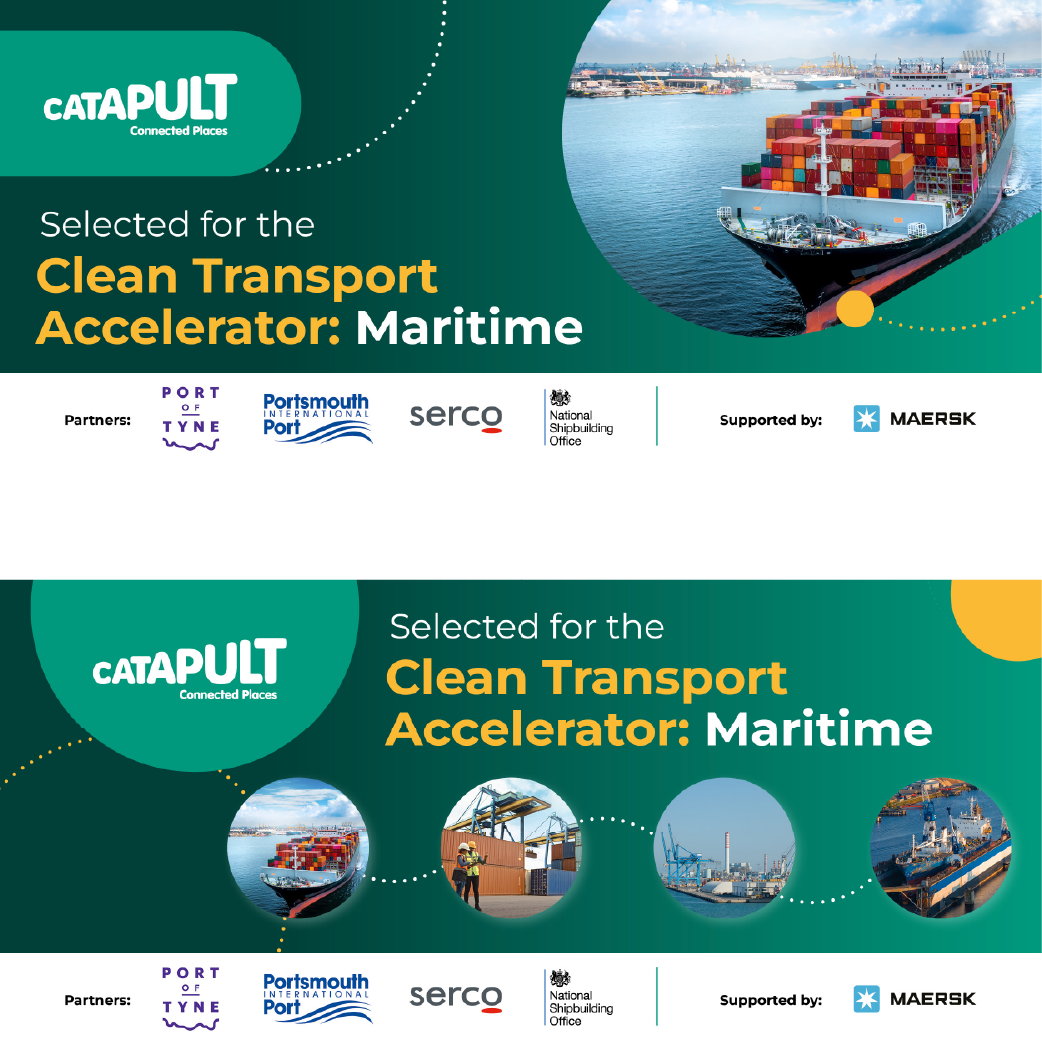
Email banner
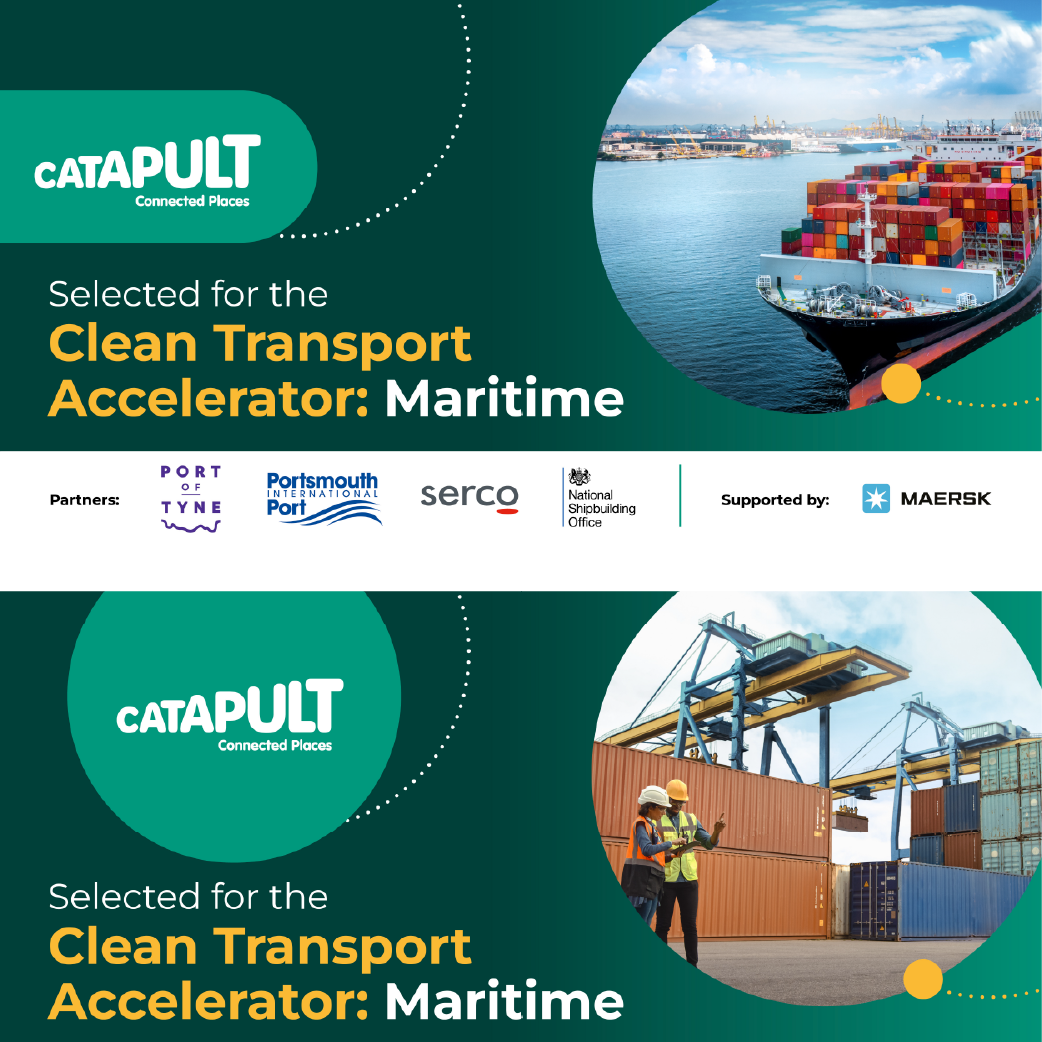
Images for social media
Messaging guidance
Here are some key messages about the programme that can be shared externally, on their own or as a whole. Please scroll to the bottom of this page for FAQ’s.
- The Clean Transport Accelerator: Maritime is delivered by Connected Places Catapult in collaboration with a consortium of partners including Serco, Port of Tyne, Portsmouth International Port and the National Shipbuilding Office, with support from Maersk.
- The Clean Transport Accelerator: Maritime builds on four years of success from the Catapult’s previous Maritime Accelerator programme, which has so far supported 29 SMEs and delivered 11 trials.
- The programme focuses on decarbonisation, future fuels, electrification and other technologies that support the sector’s transition to cleaner operations.
Some Do’s and Don’ts
When talking about the programme…
Do:
- Announce your programme selection on LinkedIn once you’ve received confirmation from us that communications can be shared
- Throughout the programme, please share photos, updates and exciting news with us. We’d love to help celebrate your progress and share your successes across our channels.
- Describe your involvement accurately and proportionately
- Use the approved copy for describing the programme “The Clean Transport Accelerator: Maritime is delivered by Connected Places Catapult in collaboration with a consortium of partners including Serco, Port of Tyne, Portsmouth International Port and the National Shipbuilding Office, with support from Maersk.”
- Talk about expected benefits before or during trial delivery; delivered benefits and outcomes after and focus on evidence and outcomes
- Use programme assets from this toolkit
- Re-share the Catapult’s and programme partners programme announcements through your own channels
- Notify the Catapult when you receive media interest relating to the programme or when you’ve received funding outside the programme following completion – we’d love to help share your good news!
Don’t:
- Misrepresent your involvement
- Jump ahead of programme communications
- Use restricted assets, such as partner logos outside partners you are trialling with
- Reproduce presentation slides, internal documents or branded materials without authorisation.
- Share confidential information related to other participants –
- Don’t publish commercially sensitive information from workshops, meetings or trial discussions
- Don’t share quotes from emails, calls or meetings unless the relevant individuals have approved them
- Don’t disclose information about other organisations participating in the programme
- Overstate trial progress – Don’t describe a trial as “completed”, “proven” or “successful” until the relevant work has concluded and evidence supports the claim
FAQs
When can I start promoting my involvement in the programme?
What if I have a media opportunity?
Discover the Station Innovation Zone
Find out how the Station Innovation Zone is helping rail organisations test and explore innovative solutions in a live station environment.
Download our one-page overview to see how it works, the solutions already supported and how you can get involved.

Station Innovation Zone
Enabling the safe, scalable deployment of proven innovation across transport systems.
HADeS (High Assurance Detection Systems)
Marketing Pack
Congratulations on being part of the High Assurance Detection Systems (HADeS) Programme 2026 programme! Along with the Department for Transport (DfT), we’re delighted to be working with you.
This marketing pack is designed to:
- help you shout about your participation in this programme
- speak confidently about the programme externally
- provide you with useful marketing and PR assets
To refresh your knowledge about the programme, visit the closed open call page:
If you have any questions about the programme, please contact: Alexander Lamle, Innovation and Local Growth Consultant – alex.lamle@cp.catapult.org.uk

Logos and images
You may want to share the fantastic news that you have been selected for this programme on your website, via email or on social media. Please use the assets below to support your announcement.
Logos for website

Banners for email

Images for social media

Messaging guidance
Here are some key messages about the programme that can be shared externally, on their own or as a whole:
- The High Assurance Detection Systems (HADeS) Programme is managed by Connected Places Catapult on behalf of the Department for Transport (DfT). The Catapult will convene stakeholders, manage the competition, assist in the selection process and offer customised business support to the grant recipients. DfT will lead the selection process from the technical perspective and provide technical support to the projects.
- For HADeS 2026, the goal is to help DfT to understand whether deployment of new detection standards being developed by the Technology Alignment Group (TAG), and the capability against additional materials that results, for primary screening of cabin baggage and the associated alarm resolution capability is technically feasible and achievable within 3-5 years.
- The High Assurance Detection Systems (HADeS) Programme focuses on enhancing UK airports’ checkpoint security screening capability, focusing on alarm resolution and any operating concept that can enhance the performance of checkpoint systems to screen aviation passengers and their cabin baggage.
Some Do’s and Don’ts
When talking about the High Assurance Detection Systems (HADeS) Programme…
Do:
- Announce your programme selection on LinkedIn once you’ve received confirmation from us that communications can be shared
- Describing your involvement accurately and proportionately.
- Use the wording: “The High Assurance Detection Systems (HADeS) Programme is managed by Connected Places Catapult, on behalf of the Department for Transport (DfT).”
- Talk about expected benefits before or during trial delivery; delivered benefits and outcomes after and focus on evidence and outcomes
- Use programme assets from this toolkit
- Re-share the Catapult’s programme announcements through your own channels
- Notify the Catapult when you receive media interest relating to HADeS or when you’ve received funding, contracts or business growth opportunities outside the programme – we’d love to help share and celebrate your success!
Don’t:
- Misrepresent your involvement
- Jump ahead of programme communications
- Use restricted assets, such as partner logos outside partners you are trialling with
- Use logos of trial partners who have not signed trial plans or approved their inclusion
- Reproduce presentation slides, internal documents or branded materials without authorisation.
- Share confidential information related to other participants –
- Don’t publish commercially sensitive information from workshops, meetings or trial discussions
- Don’t share quotes from emails, calls or meetings unless the relevant individuals have approved them
- Don’t disclose information about other SMEs participating in the programme
- Overstate trial progress – Don’t describe a trial as “completed”, “proven” or “successful” until the relevant work has concluded and evidence supports the claim
FAQs
When can I start promoting my involvement in the programme?
What if I have a media opportunity?
Gender Equality Plan
Foreword
Message from the Chief Executive Officer
Connected Places Catapult (CPC) believes that the best innovation comes from a breadth of perspectives, experiences and ideas. Our ability to support businesses, public sector organisations and innovators across the UK depends on creating an equitable environment in which everyone can contribute and thrive.
Our Equality, Diversity and Inclusion Strategy 2026-2028 establishes a clear ambition to build an equitable and empowering culture, fuel innovation through diverse perspectives, and embed inclusion in how we work. This Gender Equality Plan translates that ambition into a focused programme of action to address structural barriers, improve representation, strengthen progression opportunities and create a workplace where everyone can succeed regardless of gender.
Our evidence shows that women are underrepresented in senior and higher-paid roles. This contributes to our gender pay gap and reinforces the need for sustained action on recruitment, progression, leadership development, pay and reward, and workplace culture.
The Gender Equality Plan demonstrates our commitment to transparent, evidence-led decision-making, leadership accountability and dedicated resources. Meaningful progress requires collective ownership across the organisation, supported by clear measures and public reporting.
I am pleased to endorse the Gender Equality Plan and CPC’s commitment to delivering the actions it contains.
Erika Lewis
Chief Executive Officer
Connected Places Catapult
Introduction
In 2022, the European Commission introduced Gender Equality Plans as an eligibility requirement for public bodies, research organisations and higher education institutions participating in Horizon Europe programmes. This Gender Equality Plan has been developed to meet those expectations while supporting Connected Places Catapult’s wider Equality, Diversity and Inclusion Strategy 2026-2028.
The Plan establishes a framework for advancing gender equality across our workforce, leadership, organisational culture and innovation ecosystem between 2026 and 2029. It consolidates evidence from the CPC EDI Strategy 2026-2028; Gender Pay Gap Analysis 2025 and EDI Targets Framework into a coordinated programme of action.
The Plan supports CPC’s ambition to:
- increase representation of women in leadership, senior and technical roles;
- target relevant structural drivers of the gender pay gap;
- improve equitable access to recruitment, progression and development opportunities;
- create an inclusive culture characterised by belonging, psychological safety and fairness;
- embed gender considerations into innovation, research and project delivery; and
- strengthen accountability through monitoring, governance and transparent reporting.
Our commitment
Connected Places Catapult is committed to advancing gender equality as an organisational priority and as a key component of inclusive innovation. Gender should not determine access to opportunity, progression, reward, participation or influence.
To achieve this, CPC aims to:
- increase representation of women in leadership, senior and technical roles;
- target and address the structural drivers of the gender pay gap;
- remove barriers affecting recruitment, retention, progression and reward;
- create an inclusive culture, characterised by psychological safety, belonging and fairness;
- embed gender equality into organisational strategy, business planning and leadership accountability;
- apply an intersectional approach that recognises the interaction between gender and other aspects of identity and experience;
- embed gender considerations into innovation, research and project delivery; and
- publish progress and review actions annually.
How Connected Places Catapult meets the mandatory Gender Equality Plan requirements
A formal and public published document
This Gender Equality Plan has been approved by CPC’s Senior Leadership Team and Senior Management Team, published in an accessible format on the organisation’s website. CPC will publish or formally report annual progress to support transparency and accountability.
Dedicated resources and expertise
Implementation is supported through Senior Leadership Team accountability; coordination by the Head of Equality, Diversity and Inclusion (EDI); oversight and challenge from the EDI Steering Group; delivery by HR, Talent Acquisition and Talent Management, Business Units and project teams; and communications support for accessible publication.
Data collection and monitoring
CPC collects and analyses gender-disaggregated workforce, pay, recruitment, progression, retention, culture and where available innovation data also . Monitoring will include quarterly oversight, annual reporting and confidentiality controls, including aggregation or suppression where small sample sizes could identify individuals.
Training and awareness
CPC will provide inclusive leadership, inclusive recruitment, gender equality and gender-bias learning for relevant leaders, managers, panel members and decision-makers. Evaluation will consider the application of learning as well as completion.
Evidence base
Workforce profile and gender pay evidence
| Indicator | 2025 baseline | What the evidence indicates |
| Workforce used for pay analysis | 287 employees: 135 women and 152 men | Maintain reliable gender-disaggregated workforce monitoring. |
| Women as a proportion of the analysed workforce | 47.0% | Overall representation is more balanced than representation at senior levels. |
| Mean hourly gender pay gap | 10.64% | Continue annual analysis and address structural representation. |
| Median hourly gender pay gap | 13.73% | Monitor progression into higher-paid roles and the experience of the typical employee. |
| Women in lower pay quartile | 59.72% | Women are overrepresented in the lowest-paid quartile. |
| Women in upper pay quartile | 30.99% | Women are underrepresented in the highest-paid quartile. |
| Women in Band 4 | 30.6% | Senior-band representation requires focused action. |
| Women in Band 5 | 37.5% | Progression and pipeline measures remain priorities. |
| Women in Bands 4-6 | 35% | A five-year ambition to increase the average to 50% is subject to formal approval and annual review. |
Key findings
- CPC’s gender pay gap is driven by the representation of women and men across the banding structure rather than differences in pay within bands. Women remain underrepresented in higher-paid bands and overrepresented in lower-paid bands, which contributes to the overall gap.
- Women are overrepresented in the lower pay quartile and underrepresented in the upper quartile, where higher-paid technical, leadership and bonus-eligible roles are concentrated.
- Recruitment pipeline diversity, equitable access to development, progression and succession opportunities, and scrutiny of pay and reward decisions are central to CPC’s response.
- Small-number data, including bonus information, will be interpreted carefully and reported only at a level that protects confidentiality.
Strategic alignment
The Gender Equality Plan is a focused delivery mechanism within CPC’s wider EDI architecture. It brings together strategic commitments, workforce evidence, targets and accountable implementation.
| EDI Strategy pillar | Contribution to gender equality |
| Our Culture | Inclusive policies and processes, Equality Impact Assessments, learning, colleague communities, psychological safety and action to address the gender pay gap. |
| Our People | Inclusive recruitment, a consistent employee experience, improved representation, development, progression and succession pathways. |
| Our Practice | Inclusive innovation by design, equality assessment across project lifecycles, accessible external processes, diverse engagement, data and reporting. |
Our priority themes and actions
CPC’s actions are organised under five thematic areas. Outcome ambitions are not quotas. Employment decisions will remain lawful, proportionate and merit based. Actions will be agreed through the approval process where implementation status or timing requires validation.
Theme 1: Work-life balance and inclusive organisational culture
CPC will create working conditions characterised by respect, belonging, psychological safety and equitable participation.
| Ref | Action | Lead / support | Timing | Measure / evidence |
| 1.1 | Review priority people policies, including flexible working, parental leave and workplace adjustments, through an EDI and gender lens. | HR / policy owners / Head of EDI | Phased | Policies assessed and actions tracked |
| 1.2 | Deliver inclusive leadership, gender equality and gender-bias learning for relevant leaders, managers and decision-makers. | Talent Management / Head of EDI | Annual | Completion, evaluation and application evidence |
Theme 2: Gender balance in leadership and decision-making
CPC will increase the representation and influence of women in senior, technical, leadership and decision-making roles.
| Ref | Action | Lead / support | Timing | Measure / evidence |
| 2.1 | Secure top-management agreement, publish the Plan and confirm executive sponsorship, resources, owners and the reporting calendar. | Board / SLT / Head of EDI | On approval | Signed plan, public link and responsibility record |
| 2.2 | Embed inclusive behaviours and at least one EDI objective within relevant senior leadership and management objective-setting. | SLT / HR / Leadership | Annual | Objectives recorded and reviewed |
| 2.3 | Track progression, development participation, acting-up, secondments and attrition by gender and other available characteristics. | Human Resources | From January 2027 | Dashboard and annual trend |
| 2.4 | Introduce, mentoring or development support for mid-level technical and leadership pipelines. | HR / Talent Management / Leadership | By mid-2027 | Participation and progression outcomes |
Theme 3: Gender equality in recruitment and career progression
CPC will ensure recruitment, development, progression, retention and recognition are accessible and fair.
| Ref | Action | Lead / support | Timing | Measure / evidence |
| 3.1 | Audit and standardise inclusive job descriptions, accessible application formats and proactive adjustment information. | HR / Talent Acquisition | Year 1 | Percentage of campaigns meeting the standard |
| 3.2 | Complete inclusive recruitment learning for hiring managers and panel members before participation. | Human Resources / Talent Acquisition | By 2027 | Completion rate |
| 3.3 | Use diverse panels where practical and introduce focused outreach for Band 4-6, senior and specialist pipelines. | Human Resources / Talent Acquisition / Business Units | Annual | Applicant, shortlist and appointment profile |
| 3.4 | Complete annual gender pay and reward analysis, including starting salary, promotion pay, allowances and bonus allocation. | Human Resources / Head of EDI | Annual | Mean and median gaps; quartile and reward analysis |
Theme 4: Integration of the gender dimension into research and innovation
CPC will integrate relevant gender considerations into research, innovation, programme and project activity.
| Ref | Action | Lead / support | Timing | Measure / evidence |
| 4.1 | Embed gender considerations into relevant project Equality Impact Assessments, inclusive innovation guidance and external data collection. | Business Units / project leads / EDI Steering Group | Phased | Relevant projects assessed and actions evidenced |
| 4.2 | Monitor engagement by women-led businesses and widen participation through targeted, accessible outreach and support where lawful data is available. | Business Units / programme leads | Annual | Participation evidence and learning |
Theme 5: Measures against harassment and gender-based violence
CPC will maintain effective prevention, reporting, response and support arrangements.
| Ref | Action | Lead / support | Timing | Measure / evidence |
| 5.1 | Review prevention, reporting, response and support arrangements relating to harassment, sexual harassment and gender-based violence. | Human Resources | Year 1 cycle | Review completed and actions tracked |
| 5.2 | Improve awareness of reporting routes, available support and expected workplace behaviours. | Human Resources / Talent Management /Leadership | Annual | Awareness and learning evidence |
Outcomes and measures of success
| No. | Strategic outcome | By 2029 CPC aims to |
| 1 | Representation | Increase the representation of women in senior, technical, leadership and decision-making roles. |
| 2 | Pay equity | Reduce the structural causes of the mean and median gender pay gaps. |
| 3 | Inclusive culture | Further develop our inclusive culture by promoting working environments that enable respect, belonging, psychological safety and equitable participation for all colleagues. |
| 4 | Equitable employment practice | Ensuring recruitment, development, progression, retention and recognition are accessible and fair. |
| 5 | Inclusive innovation | Integrate relevant gender considerations into research, innovation, programme and project activity. |
| 6 | Accountability | Use clear ownership, resources, data, governance and public reporting to sustain progress. |
Monitoring and reporting
CPC will establish an indicator set at approval, including definitions, baselines, data owners and confidentiality thresholds. Indicators will be interpreted in context and small-number data will be suppressed or aggregated where necessary.
| Area | Core indicators | Frequency | Accountability |
| Representation | Women overall and by band; senior, technical and decision-making representation. | Quarterly / annual | HR / Head of EDI / EDI Steering Group |
| Recruitment | Applicants, shortlists, appointments, conversion and process compliance by gender. | Quarterly / annual | HR / Talent Acquisition / Business Units |
| Progression and retention | Promotions, acting-up, secondments, development, high-profile projects and attrition. | Half-yearly / annual | HR / L&D / Leadership |
| Pay and reward | Mean and median gaps; quartiles; starting salary; promotion pay; allowances and bonus outcomes. | Annual | HR / Head of EDI |
| Culture | Psychological safety, belonging, fairness, flexible working and inclusion indicators by gender where sample size permits. | Annual / pulse cycle | HR / Leadership / Head of EDI |
| Capability | Completion and evaluation of relevant inclusive leadership, recruitment and bias learning. | Quarterly / annual | Talent Management / Head of EDI |
| Policy and safety | Priority policies assessed; EIAs; prevention and response arrangements; awareness of support routes. | Annual | HR / policy and governance owners |
| Research and innovation | Relevant project EIAs; participation data; engagement by women-led businesses where available. | Annual | Business Units / project and programme leads |
Reporting cycle
| Cycle | Purpose | Output |
| Quarterly | Review delivery, risks, recruitment and representation evidence where available. | EDI Steering Group dashboard and action log |
| Half-yearly | Review key workforce, pay and culture indicators where appropriate and supported by data. | Progress assessment and corrective actions |
| Annually | Assess outcomes, report progress publicly or formally, and refresh priorities and targets. | Annual GEP progress report |
| End of plan | Evaluate effectiveness and prepare the successor plan. | Impact evaluation and next GEP |
Governance and accountability
Strategic accountability rests with the Senior Leadership Team. The Head of Equality, Diversity and Inclusion coordinates implementation and reporting. The EDI Steering Group provides oversight and constructive challenge. Relevant functions and Business Units own delivery and evidence, with material risks escalated through agreed governance routes.
| Resource / role | Contribution |
| Chief Executive Officer and SLT | Approve and sign the Plan, confirm resources, review annual progress and hold owners to account. |
| Head of EDI | Coordinate delivery, maintain the action plan, advise owners, collate evidence, report progress and propose revisions. |
| EDI Steering Group | Provide strategic oversight, constructive challenge and quarterly review. Provides a formal channel for colleague community input. |
| HR, Recruitment, Reward, L&D and people-data leads | Deliver and evidence workforce, reward, policy, learning and employee-experience actions. |
| Business Unit and functional leaders | Own implementation in their areas and address identified barriers or underrepresentation. |
| Cross-Project Inclusion Group and project leads | Support integration of gender and wider inclusion considerations into relevant projects and innovation practice. |
| Communications | Support accessible publication and internal and external communication. |
| All colleagues | Engage with learning, uphold expected behaviours, provide feedback and support an inclusive culture. |
Public transparency
CPC is committed to public transparency and accountability in advancing gender equality. Following approval and signature by senior management, CPC will publish this Plan in an accessible format on its public website.
- publish the approved Gender Equality Plan and retain clear document control;
- continue annual statutory Gender Pay Gap reporting;
- publish or formally report progress against actions and agreed indicators each year;
- explain material changes to actions, measures, ownership or timing;
- protect confidentiality through aggregation and small-number suppression; and
- use evidence, insight into colleagues and stakeholder learning to update implementation priorities.
Conclusion
Gender equality is essential to achieving CPC’s ambition of becoming an equitable, inclusive, and innovative organisation. Through this Plan, CPC commits to measurable action, stronger accountability, improved representation and inclusive practice across its workforce and innovation ecosystem between 2026 and 2029. The Plan supports a workplace where colleagues of all genders can contribute, progress and thrive.
Annex A: Three-year implementation roadmap
| Year 1: 2026-27 | Foundation | Year 2: 2027-28 | Embed | Year 3: 2028-29 | Demonstrate |
| Approve, sign, and publish the GEP. | Review Year 1 progress and rebaseline actions. | Evaluate delivery, outcomes and impact. |
| Confirm resources, owners, data definitions and confidentiality thresholds. | Embed progression and attrition dashboards. | Assess representation trends in Bands 4-6, senior and technical roles. |
| Audit inclusive and accessible recruitment practice. | Deliver mentoring or development interventions. | Review progress in reducing structural drivers of the pay gap. |
| Deliver priority leadership and recruitment learning. | Strengthen policy review, EIAs and culture measures. | Consolidate gender considerations in relevant innovation practice. |
| Establish quarterly and annual reporting. | Expand inclusive innovation data and action. | Publish end-of-plan evaluation and prepare the successor GEP. |
Annex B: Principal risks and mitigations
| Risk | Mitigation |
| Targets are interpreted as quotas or conflict with merit-based decisions. | Use lawful, evidence-led ambitions and a comply-and-explain approach; obtain HR and legal review before implementation. |
| Data are incomplete, inconsistent or too small for reliable interpretation. | Agree definitions, improve collection, document limitations and apply confidentiality thresholds. |
| Actions lack consistent ownership or sufficient resource. | Assign named owners, confirm resources, review quarterly and escalate delivery risks. |
| Training activity does not translate into behaviour or outcomes. | Evaluate application and outcomes, not only attendance, and reinforce expectations through objectives and management practice. |
| Existing dates have passed or implementation status is unclear. | Complete an approval-stage status review and rebaseline transparently without weakening ambition. |
| The GEP becomes a compliance document rather than a change tool. | Maintain colleague engagement, leadership visibility, action-based governance and outcome reporting. |
Annex C: Source documents
- Connected Places Catapult Equality, Diversity and Inclusion Strategy 2026-2028
- Connected Places Catapult Gender Pay Gap Analysis 2025
- Connected Places Catapult EDI Targets Framework
- CPC workforce, recruitment, progression, pay, culture and innovation monitoring data, subject to agreed definitions and confidentiality thresholds
Annex D: Gender Equality Plan compliance mapping
| Requirement | CPC evidence and commitment |
| Formal public document | Approval by senior management, senior signatory, accessible publication and annual progress reporting. |
| Dedicated resources | Head of EDI coordination, SLT accountability, EDI Steering Group oversight and delivery by named functions and Business Units. |
| Data collection and monitoring | Gender-disaggregated workforce, pay, recruitment, progression, retention, culture and innovation indicators, with confidentiality controls. |
| Training and awareness | Inclusive leadership, inclusive recruitment, gender equality and gender-bias learning for relevant decision-makers. |
| Thematic action | Actions across work-life balance and culture; leadership and decision-making; recruitment and career progression; research and innovation; and prevention of harassment and gender-based violence. |
Scaling Innovation Programme
Marketing Pack
Congratulations on being part of Phase 2 of Scaling Innovation! Along with ncat and the entire consortium, we’re delighted to be working with you.
This marketing pack is designed to:
- help you shout about your participation in this programme
- speak confidently about the programme externally
- provide you with useful marketing and PR assets
To find out more about the programme, visit the programme page:
For any general questions about the programme, please email scaling.innovation@cp.catapult.org.uk
Logos and images
You may want to share the fantastic news that you have been selected for this programme on your website, via email or on social media. Please use the assets below to support your announcement.
Logos
LinkedIn banner
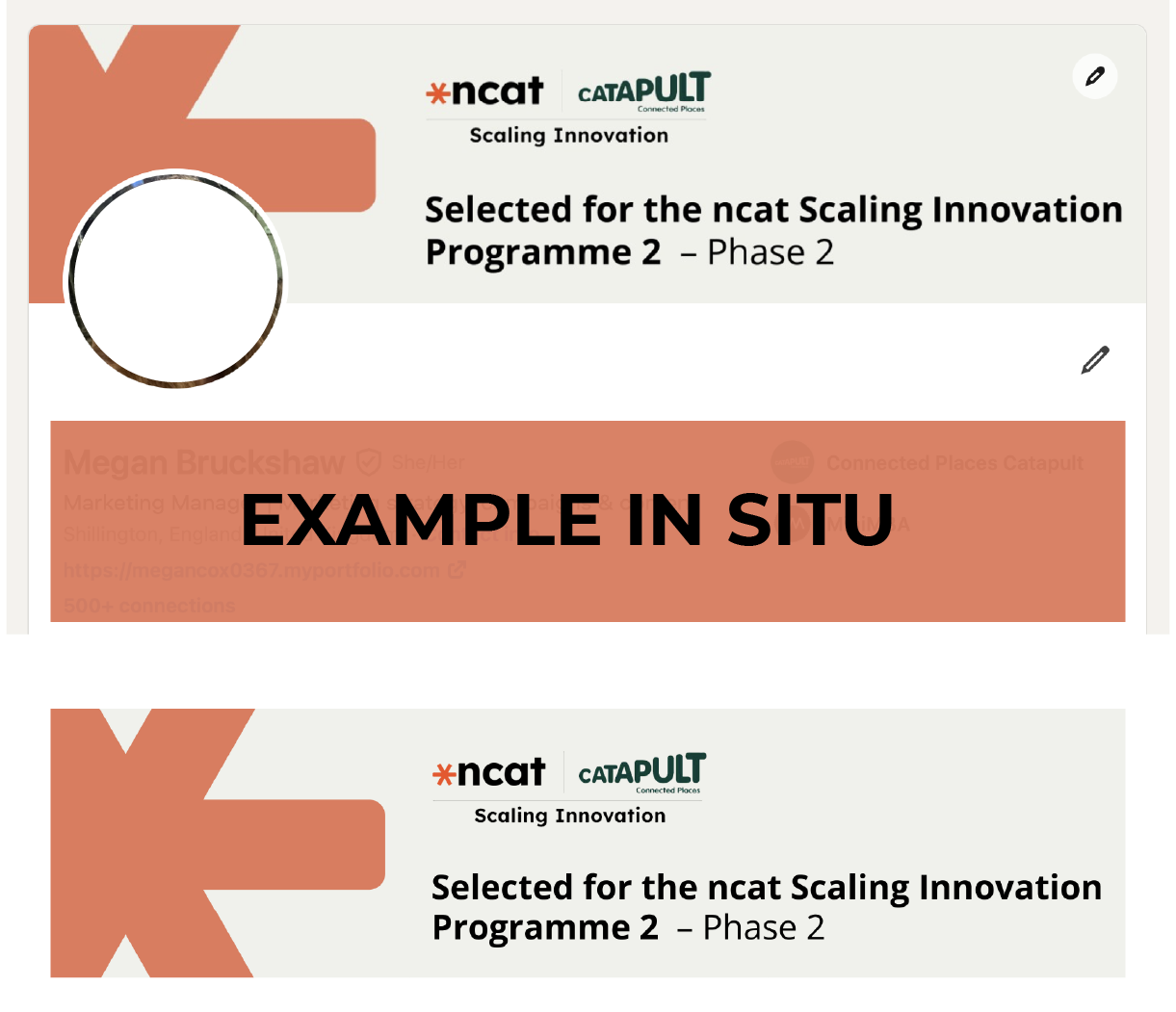
Images for social media
Messaging guidance
Here are some key messages about the programme that can be shared externally, on their own or as a whole. Please scroll to the bottom of this page for FAQ’s and guidance on using accessible language in your promotions.
- The Scaling Innovation programme is led by the National Centre for Accessible Transport (ncat) and delivered by Connected Places Catapult. It is a seven-year, multimillion-pound grant programme designed to fund and support small and medium-sized enterprises, academic institutions and charities to develop, test and scale solutions that address barriers to transport accessibility in collaboration with disabled people.
- The ncat consortium includes Coventry University, Designability, RiDC, Policy Connect, WSP, and Connected Places Catapult.
- The programme focuses on driving innovation and adoption across transport and travel, supporting innovators with existing products and services that address accessibility challenges.
- Through co-creation, evidence, testing and collaboration with industry, it helps innovators strengthen and develop their solutions while ensuring disabled people can contribute their lived experience and expertise throughout the process.
- The programme connects innovators with disabled people, transport experts, operators and industry partners, creating a stronger pathway towards the validation and adoption of accessible innovations across the transport sector.
Some Do’s and Don’ts
When talking about Scaling Innovation…
Do:
- Announce your programme selection on LinkedIn once you’ve received confirmation from us that communications can be shared
- Clearly state which phase you are participating in, describing your involvement accurately and proportionately
- Use the approved funding statement : “The National Centre for Accessible Transport (ncat) is funded by the Motability Foundation.”
- Use the approved copy for describing the programme “The Scaling Innovation programme is led by the National Centre for Accessible Transport (ncat) and delivered by Connected Places Catapult. “
- Talk about expected benefits before or during trial delivery; delivered benefits and outcomes after and focus on evidence and outcomes
- Use programme assets from this toolkit
- Re-share the Catapult’s and ncat’s programme announcements through your own channels
- Notify the Catapult when you receive media interest relating to Scaling Innovation or when you’ve received funding outside the programme following completion – we’d love to help share your good news!
- When using Hashtags in your promotions, please use CamelCase for hashtags by capitalising the first letter of each word, for example #ScalingInnovation and #AccessibleTransport. This makes hashtags easier for screen readers to interpret. Hashtags we recommend to use include – *Hashtags: #ScalingInnovation #AccessibleTransport #TransportInnovation #ncat #Accessibility #InclusiveTransport #DisabilityInclusion #TransportAccessibility
Don’t:
- Misrepresent your involvement
- Jump ahead of programme communications
- Use restricted assets, such as partner logos outside partners you are trialling with
- Reproduce presentation slides, internal documents or branded materials without authorisation.
- Share confidential information related to other participants –
- Don’t publish commercially sensitive information from workshops, meetings or trial discussions
- Don’t share quotes from emails, calls or meetings unless the relevant individuals have approved them
- Don’t disclose information about other organisations participating in the programme
- Overstate trial progress – Don’t describe a trial as “completed”, “proven” or “successful” until the relevant work has concluded and evidence supports the claim
FAQs
When can I start promoting my involvement in the programme?
What if I am planning media or PR activity whilst on the programme?
How can I ensure to use accessible language when promoting my involvement?
Station Innovation Zone
InnoTrans 2026 Marketing Pack
Congratulations on being part of the InnoTrans 2026 delegation! This pack contains everything you need to help promote your attendance, including social media assets, key messaging about the Station Innovation Zone and useful information. We encourage you to share your involvement before, during and after the event to maximise your visibility and help showcase your solutions and the programme to the wider rail industry.
This marketing pack is designed to:
- help you promote your attendance at InnoTrans 2026 as part of the
Station Innovation Zone - speak confidently about the programme externally
- provide you with useful marketing and PR assets
To find out more about the programme, visit the programme page:
For any stand and participation-related queries, please email monika.crawnson@cp.catapult.org.uk
For any questions about promotional content, please email megan.cox@cp.catapult.org.uk
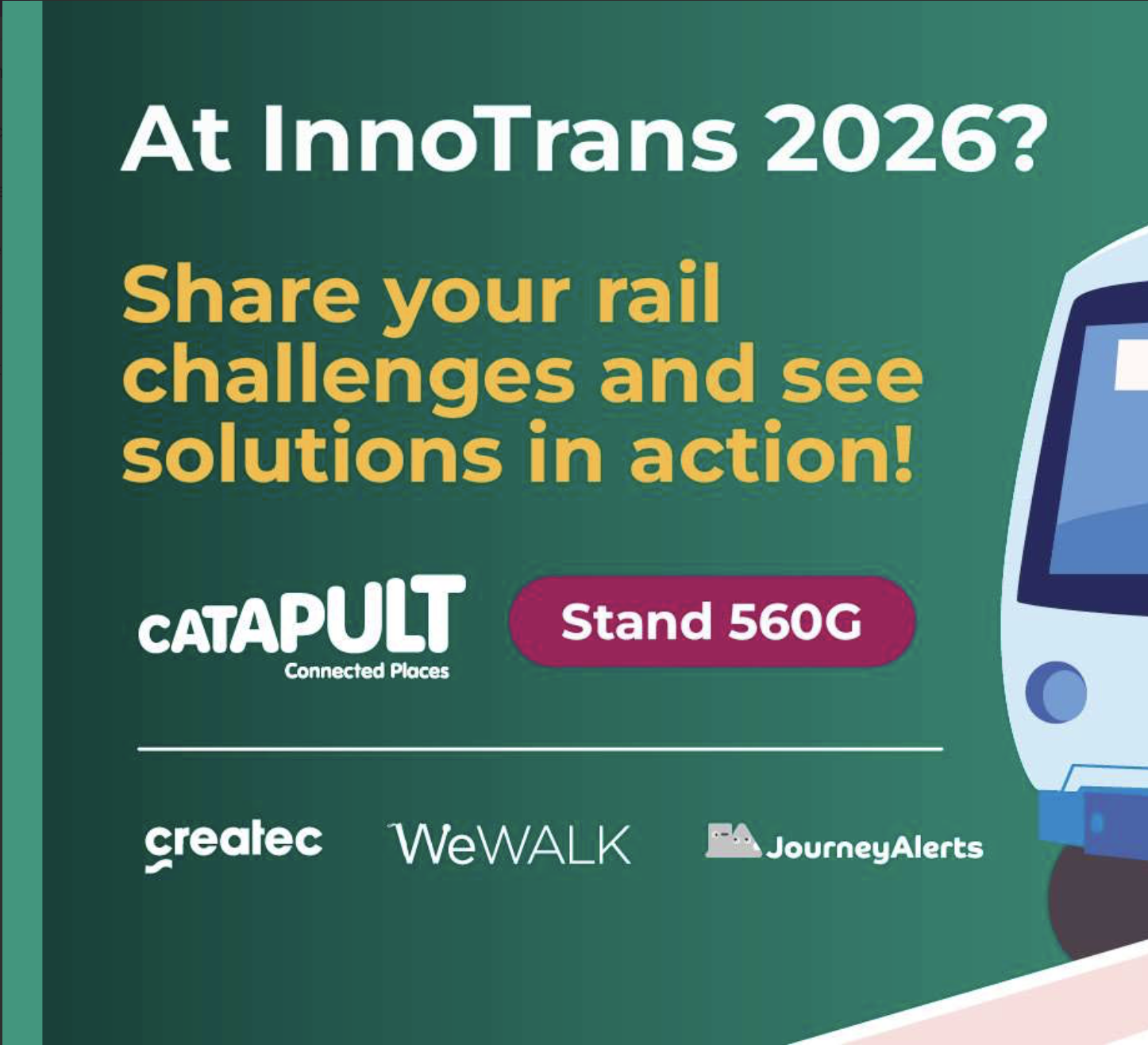
Logos and images
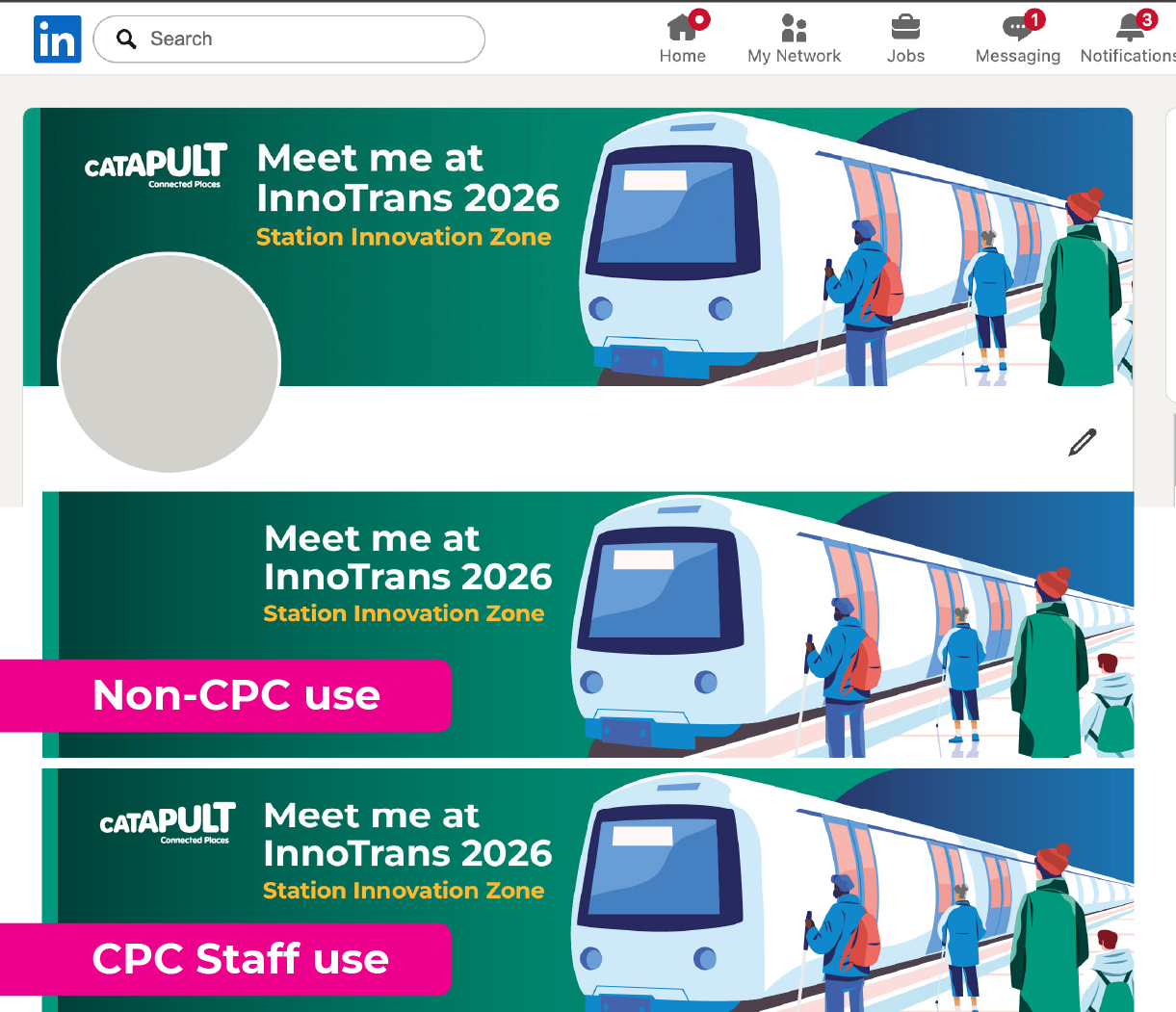
You may want to share the fantastic news that you will be attending the event on your website, via email or on social media. Please use the assets below to support your announcement. Please feel free to add your own logo to the ‘Non-CPC use’ LinkedIn banner.
Logos
Banner for LinkedIn
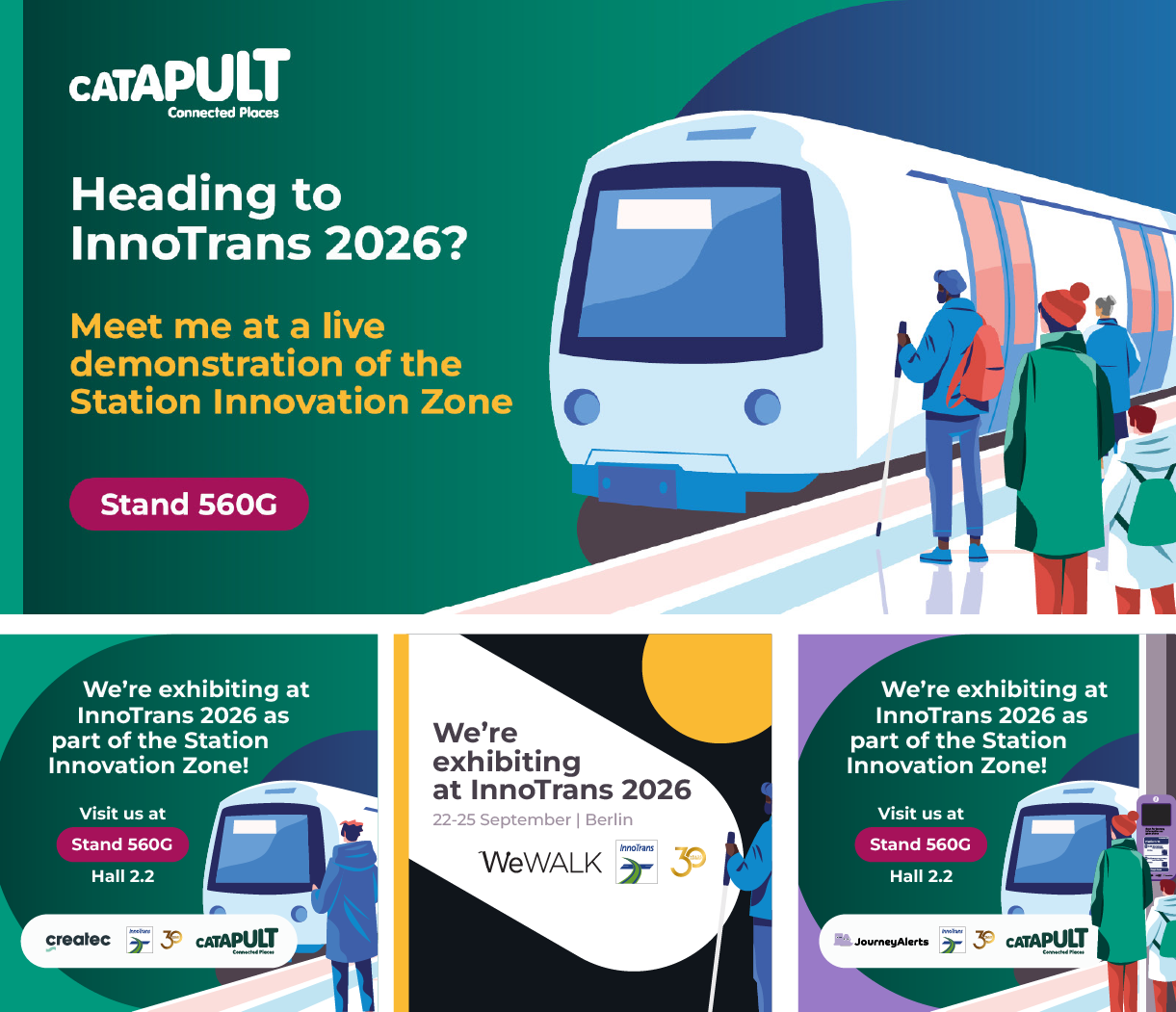
Images for social media
Messaging guidance
Here are some key messages and information that can be shared externally, on their own or as a whole:
- The Station Innovation Zone is delivered by Connected Places Catapult, in collaboration with Network Rail and funded by Innovate UK.
- When referencing your attendance at the event, please include the stand number (560G). You may also wish to mention that the stand is located in Hall 2.2 and that we are situated in the UK Pavillion.
- The Station Innovation Zone (SIZ) Scale-up Programme supports participants from the SIZ alumni community to progress promising innovations towards wider adoption in the rail sector.
- The programme provides tailored commercial support, high-value introductions to industry stakeholders, facilitated meetings and access to relevant industry events and market opportunities.
- The programme is designed to help participants build commercial momentum, develop industry relationships and accelerate the route to market for their innovations.
Some Do’s and Don’ts
When talking about attending InnoTrans 2026 and the Station Innovation Zone Programme…
Do:
- Announce your attendance on LinkedIn once you’ve received confirmation from us that communications can be shared.
- Describe your involvement accurately and reference the Station Innovation Zone programme.
- Tag ‘Connected Places Catapult’ in your social media promotions so that we can engage and support.
- Use promotional assets from this toolkit.
- Re-share the Catapult’s and Network Rail’s programme and event promotions through your own channels.
- Please let the Catapult know if you receive media interest related to the Station Innovation Zone (SIZ) or InnoTrans, or if attending the event leads to new funding, partnerships, or contract wins. We love hearing about your successes and the impact the programme has had on your business!
- If you’re one of the programme participants, you’re welcome to create your own promotional assets with your organisations branding. If you include the Connected Places Catapult logo, please share the materials with us for review before publishing or using them.
Don’t:
- Misrepresent your involvement.
- Use restricted assets, such as other CPC logos or CPC imagery that hasn’t been included in these assets.
- Please do not create or amend CPC-branded materials, including using AI to generate new materials featuring CPC branding, without first sharing them with us for approval. This does not apply to adding your company logo to existing approved materials.
- Share confidential information in your promotional communications.
- Don’t share quotes from emails, calls or meetings unless the relevant individuals have approved them.
- Don’t disclose information about other SMEs participating in the event without permission.
Freight Innovation Fund
Marketing Pack
Congratulations on being part of the Freight Innovation Fund! Along with the Department for Transport, we’re delighted to be working with you.
This marketing pack is designed to:
- help you shout about your participation in this programme
- speak confidently about the programme externally
- provide you with useful marketing and PR assets
To find out more about the programme, visit the programme page:
For any general questions about the programme, please email freightinnovationfund@cp.catapult.org.uk

Logos and images
You may want to share the fantastic news that you have been selected for this programme on your website, via email or on social media. Please use the assets below to support your announcement.
Logos for website

Banners for email

Images for social media
Messaging guidance
Here are some key messages about the programme that can be shared externally, on their own or as a whole:
- The Freight Innovation Fund is a UK programme delivered by Connected Places Catapult on behalf of the Department for Transport and uses real-world trials, a network of core stakeholders and bespoke scale-up support to accelerate the deployment and commercialisation of innovative freight and logistics solutions across the UK.
- The Freight Innovation Fund supports long term economic growth and enables freight decarbonisation.
- The Freight Innovation Fund focuses on delivering scalable innovation by addressing three pillars: modern integrated infrastructure, a greener freight system, and improved data and insights.
- The Department for Transport has dedicated nearly £10m to support SMEs through the Accelerator Programme and Freight and Logistics Innovation Network (formerly the Freight Innovation Cluster) from 2023-2036.
- To date, the Freight Innovation Fund Accelerator has supported 39 SMEs across four cohorts (2023 to 2026) to deliver 44 live trials, testing their solutions in real-world environments. Participating SMEs have raised £102m private investment and created 59 FTE jobs.
- The 2026 round of the Freight Innovation Fund includes the addition of a Venture Growth Programme, which will support SMEs to strengthen their commercial proposition, prepare for scale and unlock new growth opportunities.
- Delivered through the Department for Transport (DfT)’s Freight Innovation Fund, the Venture Growth Programme builds on Connected Places Catapult’s deep, existing sector expertise, trusted relationships across the freight and logistics industry and proven capability to support high-potential innovations to progress beyond validation and towards commercially viable, investable businesses.
Some Do’s and Don’ts
When talking about the Freight Innovation Fund…
Do:
- Announce your programme selection on LinkedIn once you’ve received confirmation from us that communications can be shared
- Clearly state which phase you are participating in, describing your involvement accurately and proportionately
- Refer to the correct work package your involved in – Accelerator, Network and/or Venture Growth
- Use the wording: “The Freight Innovation Fund is funded by the Department for Transport and delivered by Connected Places Catapult”
- Talk about expected benefits before or during trial delivery; delivered benefits and outcomes after and focus on evidence and outcomes
- Use programme assets from this toolkit
- Re-share the Catapult’s and DfT’s programme announcements through your own channels
- Notify the Catapult when you receive media interest relating to FIF or when you’ve received funding outside the programme
Don’t:
- Misrepresent your involvement
- Jump ahead of programme communications
- Use restricted assets, such as partner logos outside partners you are trialling with
- Use logos of trial partners who have not signed trial plans or approved their inclusion
- Reproduce presentation slides, internal documents or branded materials without authorisation.
- Share confidential information related to other SMEs –
- Don’t publish commercially sensitive information from workshops, meetings or trial discussions
- Don’t share quotes from emails, calls or meetings unless the relevant individuals have approved them
- Don’t disclose information about other SMEs participating in the programme
- Overstate trial progress – Don’t describe a trial as “completed”, “proven” or “successful” until the relevant work has concluded and evidence supports the claim
FAQs
When can I start promoting my involvement in the programme?
How can I share the news of my programme partner externally?
Welcome to the aviation dashboard. You can view the dashboard in full screen by clicking on the button in the bottom right.
Data Protection Complaints Procedure
1. Introduction
1.1 Purpose
This procedure sets out how Connected Places Catapult (CPC) receives, manages and resolves complaints relating to the handling of personal data.
It supports CPC’s Data Protection Policy and ensures that complaints are:
- handled consistently, fairly and transparently
- investigated in a proportionate and timely manner
- resolved in line with UK GDPR and Data Protection Act 2018 requirements
- used to inform continuous improvement in CPC’s data protection practices
1.2 Definitions
| Data Protection Complaint | A concern raised by an individual regarding how their personal data has been handled. |
| Data Subject | An identified or identifiable individual whose personal data is processed. |
1.3 Scope
This procedure applies to all data protection complaints received by CPC, including those raised by:
- employees
- customers and partners
- suppliers
- members of the public
- any individual whose personal data CPC processes
A data protection complaint is any expression of dissatisfaction relating to CPC’s handling of personal data.
This includes concerns about:
- collection or use of personal data
- data subject rights handling (e.g. DSARs)
- data accuracy
- data sharing or disclosure
- data retention
- data security or incidents
- fairness or transparency of processing
2. Procedure
2.1 How to make a complaint
Individuals may raise a complaint via any of the following channels:
- Email: dataprotection@cp.catapult.org.uk
- Website: Connected Places Catapult – The UK’s innovation accelerator for cities, transport & place leadership.
- Post: Data Protection, Connected Places Catapult, Unity Place, 200 Grafton Gate, Milton Keynes,1UP
Complaints may also be received through any CPC staff member. All staff must escalate such complaints promptly in line with this procedure.
Individuals are not required to use formal language or cite legal provisions.
Reasonable adjustments will be made where required to support accessibility.
2.2 Acknowledgement
CPC will acknowledge receipt of the complaint within 10 working days.
The acknowledgement will:
- confirm that the matter is being treated as a data protection complaint
- provide a reference number
- outline next steps and indicative timelines
- request further information where required
2.3 Assessment and Investigation
Responsibility for handling complaints sits with the Risk & Compliance / Privacy function, supported by Legal where necessary.
Investigations will be proportionate and risk-based, and may include:
- review of correspondence and internal records
- review of relevant systems and access logs
- engagement with relevant business units
- consultation with IT and Information Security
- engagement with third-party processors where applicable
CPC will assess:
- compliance with data protection legislation
- whether policies and procedures have been followed
- root causes and contributing factors
2.4 Timeframes
CPC will provide a response without undue delay, and typically within:
- 1 calendar month of receipt
Where a complaint is complex or requires external input:
- timescales may be extended where necessary
- the individual will be informed of the reason and kept updated
2.5 Outcome and Response
CPC will provide a written response setting out:
- the scope of the complaint
- findings and decision
- any actions taken or planned
- rationale where the complaint is not upheld
- available escalation routes
2.6 Remedies and Corrective Actions
Where appropriate, CPC may take actions such as:
- correcting inaccurate data
- deleting or restricting processing of personal data
- providing further information or clarification
- enhancing technical or organisational controls
- providing additional staff guidance or training
- updating policies or procedures
Corrective actions will be proportionate to risk and impact.
2.7 Escalation – Internal Review
If the complainant remains dissatisfied, they may request an internal review within 20 working days of the response.
The review will:
- be conducted by an individual not previously involved (where practicable)
- reassess the handling and outcome of the complaint
- provide a final internal response without undue delay
2.8 Escalation – Information Commissioner’s Office
Individuals have the right to raise concerns with the Information Commissioner’s Office (ICO) if they are dissatisfied with CPC’s response.
Details are available via:
https://ico.org.uk/make-a-complaint/
2.9 Non-Retaliation
CPC will not treat any individual unfairly or adversely for raising a data protection complaint.
2.10 Record Keeping and Assurance
CPC will maintain records of all data protection complaints to:
- demonstrate compliance with legal obligations
- support audit and assurance activity
- identify trends and systemic risks
- inform continuous improvement
Insights from complaints may be reported to CPC’s:
- Senior Leadership Team (SLT)
- Audit & Risk Committee (ARC), where appropriate

