
articles
West Mids wall-climbing robot firm charts global sales growth
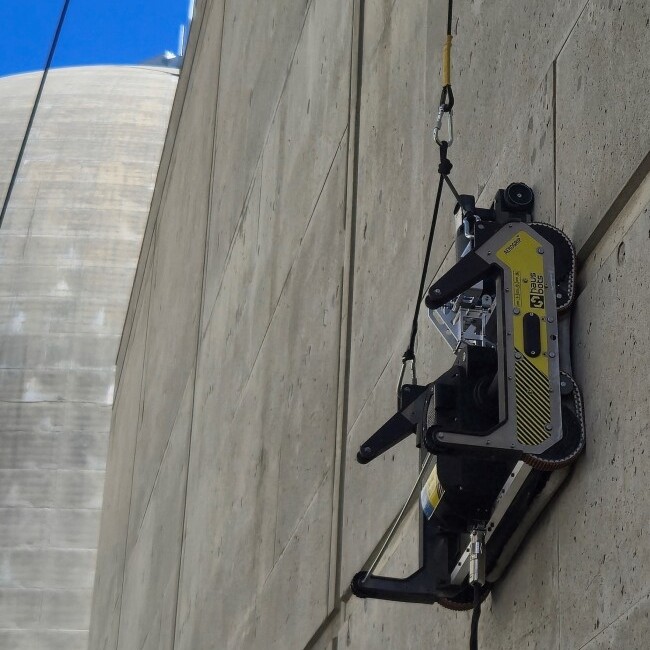
Wall-climbing robot developer HausBots is selling its product around the world and has entered several new sectors after participating in Catapult-led accelerators.
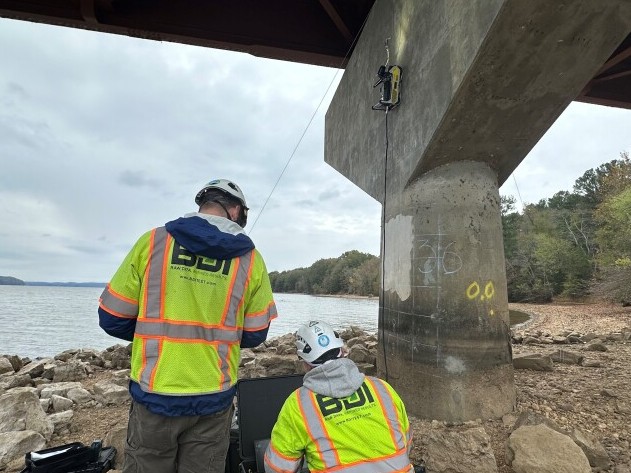
Within just five years HausBots has gone from demonstrating robots that climb road bridges in the UK to selling several million pounds’ worth of product to distributors as far afield as Australia and North America, for a multitude of applications.
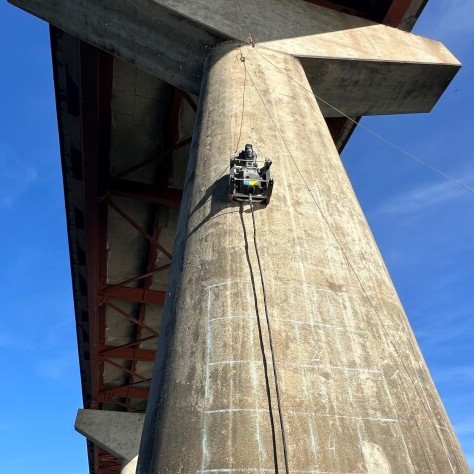
The scale-up company – supported by Connected Places Catapult through National Highways’ Accelerating Low Carbon Innovation programme – now deploys its robots to inspect structures at a greater height compared to bridges (up concrete chimneys) as well as in factories (to check sections of new wind turbines laid on the ground) and beneath the sea, inside oil rigs.
Fifty robots a year are manufactured and dispatched from the company’s Birmingham base to resellers – as well as to some clients directly – in countries that also include Japan, Singapore and South Korea.
HausBots also provides support to distributors and training to clients in getting the most out of their robots. This year, co-founder Jack Cornes, is focussed on growing its reseller network around the world to boost local market presence.
“We’ve just had our best year on record, with turnover up 300% from 2024 and signed over $2 million of new deals last year,” he says. “The plan is to build up our exports further, double our revenue and sign $4 million of new contracts this year.
“It can be very difficult to get technology such as ours to be trialled on a proving ground, so it was very helpful for us that Connected Places Catapult was able to arrange a pilot project, funded by National Highways.”Jack Cornes of HausBots
Pilot leads to commercial work
The project in question involved fitting sensors to a robot to carry out structural inspections on the motorway network, and led to its later use by Amey on the Avonmouth Bridge in Somerset.
“The accelerator allowed us to pitch to other customers and show what we had done; until then we had no real-world deployments,” he adds. “It really was the starting point for us as a company, and has had a positive snowball effect.”
HausBots is also profitable. “It means we can invest sensibly and allows us to keep more control over the company; making sure we make decisions that are sustainable and right for the long term,” says Jack, who is not currently seeking more funding beyond £1.5 million raised in venture capital in 2022.
Jack co-founded the business during Covid and now employs a team of 12 people. HausBots started out as a university research project looking at how a robot could be made to stick to and climb a variety of surfaces.
Early on, the company took part in three other Catapult-led programmes: a National Highways competition to apply anti-graffiti paint on structures; a Homes for Healthy Ageing project to apply waterproof paint to masonry; and an Advanced Construction Accelerator focused on encouraging new technology to improve site safety and efficiency.
“There were lots of magnetic robots in the marketplace, but we found nothing that could work on concrete or brick. So we developed the technology and tried to figure out what to do with it.”
The greatest market need, he found, came from the inspection of structures. “We provide the robot as a platform, and customers come to us with specific needs that we adapt the robot to.
“National Highways was brilliant in supporting our pilot project, but the UK generally lags behind other countries in adopting technology such as in America – where our robots have been used to survey around 30 bridges. We have also sold devices to Transport for New South Wales which uses our robots to inspect bridges, as part of its business as usual.”
Chimneys, wind turbines and oil rigs
Beyond highway structures, Jack’s three most interesting use cases last year involved robots surveying concrete chimneys, validating the quality of new wind turbines, and inspecting oil rigs beneath the sea.
In the first instance, a 200m tall chimney was about to be demolished but the inspector had to be absolutely certain of the condition of the structure before blowing it up, to make sure any weakness in the chimney wasn’t going to cause it to fall in an unwanted direction.
In the second case, wind turbine blades made from fibreglass needed to be inspected to ensure there were no signs of air gaps. A wind turbine blade factory uses the robot to inspect blades – lying down in sections on a factory floor – before they are erected; to remove the need for manual inspection.
The third use-case involved crawling robots inspecting the condition of 200m long concrete columns that reach into the seabed inside five oil rigs off the coast of Norway, on behalf of the oil and gas company Equinor.
“In the last year, we were able to afford to grow our sales and commercial team and build up our distributor base in different corners of the world,” Jack says. “We're growing at the fastest rate we can, and running under our own steam.”
From the archive: Read more about HausBots co-founder Jack Cornes from our Meet the Innovator series.