
articles
Slump no more: infrastructure clients adopt high-tech approach to concrete testing
Digital processes are overhauling the traditional means of testing concrete performance on major infrastructure projects, thanks to new systems championed by i3P.
For over 100 years, fresh batches of concrete arriving on construction sites have been tested by pouring samples from a bucket on to a board and waiting for them to settle. The so-called ‘slump test’ involves timing how long it takes for the concrete to – quite literally – slump.
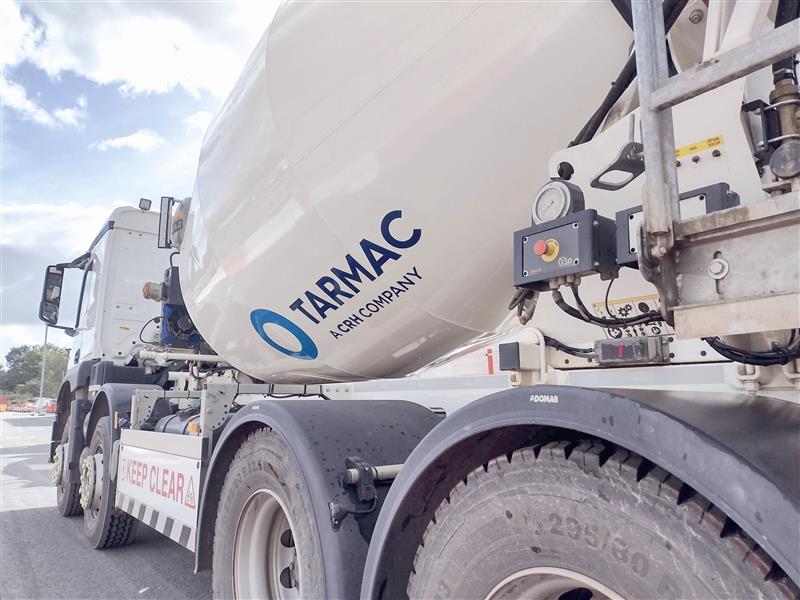
But the days of having to pour, wait and test samples of fresh concrete before allowing a batch to be used are numbered. The use of new digital monitoring and measurement tools fitted to modern concrete delivery vehicles to track the condition of concrete in real-time is now supported by i3P – the Infrastructure Industry Innovation Partnership. Both a British Standard and best practice guidance from the Concrete Society endorse the use of the digital technology.
Using digital tools to monitor the composition of concrete has been found to reduce truck waiting times by 80% and cut manual handling, exposure to cement and wastage by more than 90%.
Concrete delivery vehicle drivers using digital tools can monitor the condition of the concrete during the journey from batching plant to site; add water or admixtures as required; or increase the torque of the rotating mixing drum to keep the material within specification.
Members of i3P are encouraged to use the digital systems to monitor the performance of fresh concrete arriving on all new major infrastructure schemes in the UK. One year on since a project completed to explore the digital concrete monitoring, five client organisations – all members of i3P – have confirmed they expect the new approach to become business as usual. They are HS2, the Environment Agency, National Highways, National Grid and Sizewell C, with support for the new approach signalled by the Department for Transport.


But why change a process that has proven its worth for over a century?
i3P Senior Lead and Connected Places Catapult Consultant, Mike Moseley explains the traditional slump test involves “a lot of manual handling” which increases an operative’s exposure to potentially harmful cementitious materials, “and waiting around for a lorry sitting at the gate for the test to be done”.
If a batch is found to not meet the standard, the mixer lorry would usually have to turn around and return later with a fresh load, leading to waste, he adds. “We knew discussions were taking place within infrastructure client organisations that acknowledged it was not ideal to still be using a test which is over 100 years old.”
He says that digital monitoring and measurement systems for concrete have been used in America for many years and are being adopted at scale in the UK due to members of i3P agreeing to adopt the technology. “It’s a great example of what the construction sector can do if companies collaborate and work together; and it's not always easy to do that.
“But if it helps to make a site safer, why wouldn't you share that with your competitors? It works for infrastructure, because most major programmes involve joint ventures and people are used to working with their competitors, so there is a natural sense of sharing.”

Mike’s colleague, the i3P Delivery Lead and Catapult Consultant, Nick Sumption adds that HS2 first introduced testing of the digital systems at scale after the Balfour Beatty Vinci joint venture showed their use on part of the railway construction scheme achieved cost and efficiency savings, and allowed digital records to be produced showing the provenance of concrete poured on site.
According to calculations by Connected Places Catapult, the use of digital systems on the site could have an overall benefit of between £0.75m and £2.9m in terms of reducing testing and concrete wastage, after the cost of implementing and operating the technology are considered.
Nick says that HS2 contractors have now delivered over 1.4 million cubic metres of fresh concrete controlled by digital monitoring and measurement. “They brought the idea to i3P and said it should be scaled and adopted across the infrastructure industry,” he says.
“We convened concrete and technology providers at an HS2 site in Birmingham a few years ago and everyone there was in furious agreement of using the new approach. So we committed as a group to produce collaboratively a ‘how to’ technical guidance note aligned with the recently updated British Standard that specifically included digital testing from November 2024. We engaged with BSI during the course of the project who confirmed their support.
“Five of the largest UK suppliers of concrete and three suppliers of digital technology participated with the development of the technical guidance note (TGN),” he adds. “We engaged with The Concrete Society who agreed to ‘own’ and publish the TGN as part of their series of ‘Good Concrete Guides’.
“In the future, we want all concrete mixers to have this technology as standard. I hope the technology gets adopted on small projects too – such as for a housing developer building 20 houses – which will happen if all concrete suppliers install this digital technology on all mixer vehicles under their ownership.”i3P Delivery Lead and Catapult Consultant, Nick Sumption
On HS2, one particular digital monitoring and measurement tool being used is called Verifi. HS2’s Materials and Durability Lead, Jon Knights said: “I am very happy to support the proposal for integrating concrete production and placement data using the Verifi system, with maturity and insitu strength estimations. It is my opinion that a digital surveillance and compliance system should form a major part of the industry’s move towards greater optimisation in concrete construction in the future.”
Another client following developments with interest is the Environment Agency. Its Engineering Innovation Manager, Andy Powell said: “We recognise the significant opportunity that digital monitoring of fresh concrete properties (DMM) can bring to projects in quality improvements as well as associated sustainability and programme risk reductions for concrete pours.
“We have discussed the opportunity and benefits with our framework delivery partners and shared learning from uses to date. Together, we are targeting key projects for adoption of DMM on our programme and connecting with their concrete suppliers.”
Detail around the use of digital monitoring and measurement of concrete is available on the i3P website. Join the i3P community.