

articles
“Every entrepreneur should be thinking about exit”, serial innovator advises
Company founder Shweta Saxena successfully exited her first venture Machine Max and went on to build a second business, AI Gizmo – both supported by Connected Places Catapult-led programmes. Here she explains what a successful exit meant for her.
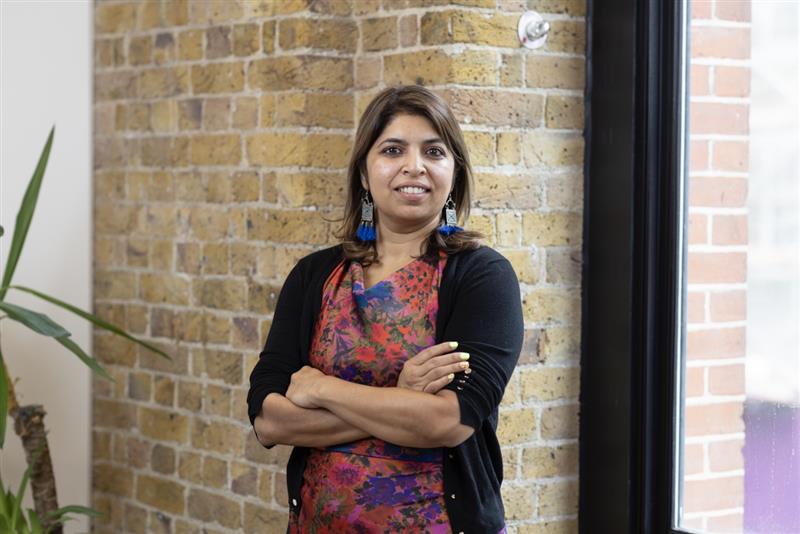
“People listen to me because I have credibility, having successfully exited as a company founder,” says entrepreneur Shweta Saxena. “It’s very different to when I’d just started my first company.”
Shweta left the Internet of Things specialist Machine Max in 2024 after majority shareholder Shell sold the business she had co-founded six years earlier to Vestas Software.
“It was good for my CV to show I’d founded a company and exited,” she says. “Machine Max has been tremendously helpful for my career, and led me to start my second company, AI Gizmo.”
Having a clear exit strategy
“Every entrepreneur should be thinking about exit, and getting market validation for what they’ve developed,” she explains.
“You need to ask: ‘What is next for me and the company?’ I have thought about my exit from AI Gizmo from day one. Within five to seven years, I will want to exit by either selling to a competitor or receiving private equity.”Shweta Saxena
With her new company, Shweta aims to secure several more commercial clients this year, grow her team and continue building the product. Experience of her exit from her first company has sharpened her focus on keeping costs under control and ensuring growth does not come at the cost of profitability.
She has ‘bootstrapped’ investment in AI Gizmo herself until now, but is also raising funds through the Government’s Seed Enterprise Investment Scheme, and speaking to several angel investors and venture capital firms.
Shweta advises other entrepreneurs looking to scale and exit their business to “invest in the right people at the right time, listen to your customers’ opinions, and understand their latent need.
“It’s never going to be easy,” she adds. “No matter how many people you have, the buck stops with you. So be very clear on what you want to achieve.”
Reflecting on business number one
Shweta formed Machine Max as one of three co-founders: she was the ‘hipster’ – focused on the product, the problems it was trying to solve, and what customers wanted. Her two other colleagues, dubbed the ‘hustler’ and the ‘hacker’, both left within a couple of years and Shweta moved up from Chief Product Officer to Chief Executive.
“The learning curve was steep, but I had good mentors; people within my network I could reach out to,” she says.
In developing its offer, the company surveyed construction firms and found several did not know what their machines were doing on a given day – or even where they were.

Machine Max’s idea was a magnetic sensor placed on a piece of construction plant to monitor carbon emissions, and track how efficiently they were being used on site.
The company was welcomed onto the third cohort of the HS2 Accelerator, delivered by Connected Places Catapult, in 2021 to develop the concept alongside a platform to consolidate machine data in real time.
These technologies revealed the financial and environmental cost of leaving machine engines running while not in operation. One large client used the data to manage subcontractor payments: time spent by idle machines left idling would not be reimbursed, reportedly cutting running costs by a third.
The product was trialled by HS2 joint venture partner Align, before it was used by another of the joint ventures – SCS – and later adopted by the client and specialist contractors on the project.
“Being accepted by HS2 represented a big commercial validation.”
Thanks to the tool, she adds, one of the project’s construction sites reduced emissions by a fifth.
Machine Max grew its customer base across the transport, construction and mining sectors to around 100 firms; mostly customers in the UK and several in India – a target market for those behind the acquisition that led to Shweta’s exit.
Shweta remembers the “luxury of money and expectations of growth” of being funded by a corporate venture capital syndicate involving Shell and investors BCG and B Capital. “The intention was just to grow the company and profitability was an afterthought – those were the days of zero interest rates and more money flowing around than now.”
She recalls being “quite emotional” about leaving Machine Max. “But I already had AI Gizmo in my head as something I wanted to start, so was getting excited about that.”
Moving to her second company
Shweta went travelling for three months, before beginning the next phase of her career. “Starting something from cold is tough; the first four months were pretty rocky, wondering if I had taken the right decision.”
Her new venture set about developing an agentic artificial intelligence platform for urban and energy planning, leading to fewer revisions and faster decisions.
At the end of last year, AI Gizmo was accepted onto the Diatomic digital accelerator in the West Midlands to develop a digital twin product, and begin a trial with Birmingham City Council and Wolverhampton Council.
Since launching a product in October, one customer and four pilots have been secured and two energy consultants have signalled their interest in the product. “It's exciting to have picked up several clients quickly once again; I’m feeling the same rush as I did the first time around.”
Shweta says many entrepreneurs seem to judge their success by how much capital they raise and the uplift in their company’s valuation. “But that's not really success,” she explains. “Success is building a company which creates impact.”
AI Gizmo announced in early March 2026 it has secured its first paying customer.
ALTERX Real Estate – a residential fund which delivers homes across England – is using AI Gizmo to manage its Section 106 obligations across 40 live projects.
Shweta Saxena described that the development shows how AI can do “the heavy lifting, so planners can focus on what matters”.
Read more about the HS2 Accelerator and the Diatomic programme.