Flying boat promises cleaner and smoother passenger journeys
Less energy will be required to propel a ferry through rough seas using technology that lifts a vessel out of the water at high speed.
Dr Iain Percy OBE used to race fast sailing boats powered only by the wind – and won two Olympic gold medals for Team GB at the Sydney and Beijing Olympics. He soon realised there was a commercial opportunity to adapt modern maritime technology to decarbonise passenger ferry services – and improve their reliability when waves are strong.
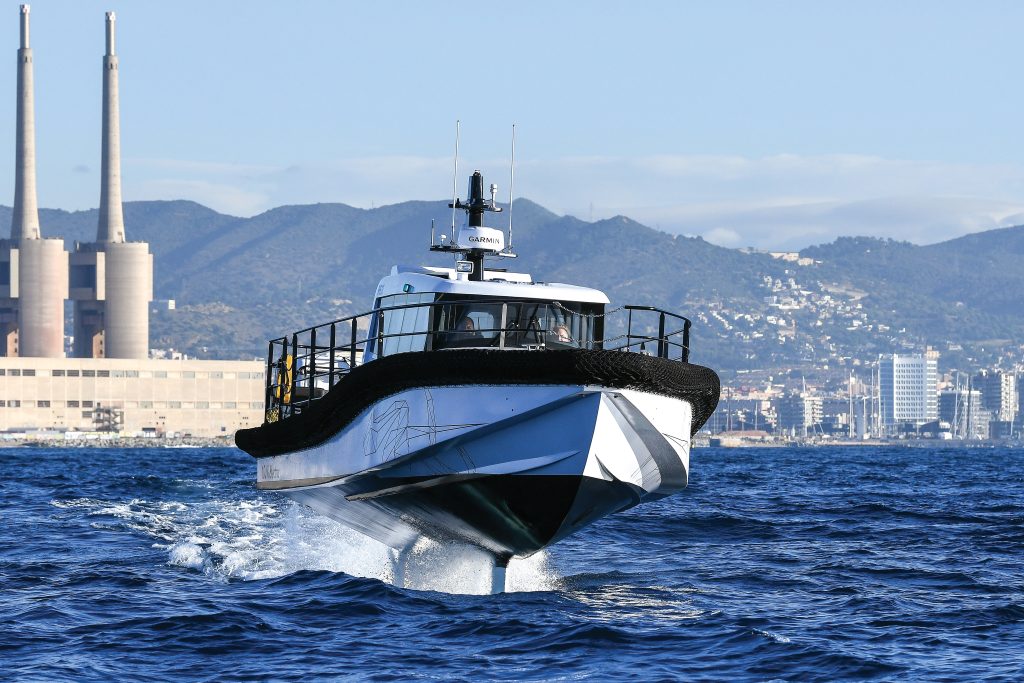
His company Artemis Technologies has developed an electric propulsion system known as the Artemis eFoiler to propel a high-speed electric ferry. When the ferry picks up the pace, the vessel lifts out of the water so that only the hydrofoils have contact with the water – ensuring a smoother ride, while also reducing drag and the amount of power needed for propulsion in rough seas.
“Under this boat is basically an aeroplane wing fixed to a strut,” he explained from the deck of a small workboat, moored on the River Thames during London International Shipping Week. “As the boat accelerates – just as with an aeroplane on a runway – it eventually has enough speed to take off” – or in this case, rise out of the water.
Dr Iain Percy describes the technology on board the workboat on the Thames
“Fine control of height is achieved by flaps at the back of the wing, which make decisions thousands of times a second to keep the boat on a nice smooth line,” he added. “By reducing drag through choppy seas, the energy requirement of the boat is greatly reduced, and higher speeds can be achieved on battery electric power alone.”
Iain explained that using a hydrofoil to lift the boat out of the water “makes a small boat behave like a super tanker, and become much smoother as it flies above the waves”.
Next step Cornwall
Now the team at Artemis Technologies is exploring the introduction of its Artemis eFoiler technology to a ferry with capacity for 120 passengers on a route between the Isles of Scilly and Cornwall, to allow services to run in rough seas.
It has started working with ferry operator FRS Group, Connected Places Catapult, and the Council of the Isles of Scilly to develop a feasibility study to create a new green shipping corridor between St Mary’s on the islands and Newlyn on the mainland, and hopes to better understand the economic, business and social cases of using the system. The project is funded by the Department for Transport’s Clean Maritime Demonstration Competition; part of the UK Shipping Office for Reducing Emissions (UK SHORE) programme.
The feasibility study will see whether the Artemis EF-24 Passenger ferry using the technology could be deployed every single day, all year round, benefitting locals in the winter and tourists in summer.
“The current service has been going for many years and has served the islands very well,” Iain added. “The idea is for our new service to complement a much larger vessel that, over the winter, only travels every few days. We would be able to take a much smaller boat that offers added comfort.
“Connected Places Catapult offers expertise and knowledge of connecting different forms of transport with populations. One of the other great things about the Catapult Network is it offers an independent assessment of a piece of research, work or collaboration.”
Dr Iain Percy OBE, CEO of Artemis Technologies
Connected Places Catapult’s Transport Managing Director, Sameer Savani said: “Maritime is a really important sub sector of transport, which plays a key role in addressing the challenge of decarbonisation. So, it’s really important that we develop technologies like this in the UK. Boats like these are really at the vanguard of decarbonising maritime operations.
“The Catapult is working closely with Artemis Technologies and other partners to explore the feasibility of operating vehicles like this,” he added. “It’s really important that economic growth reaches all parts of the UK.”
We’re excited to partner with Fira Barcelona and join 25,000+ visitors from over 130 countries.
Connected Places Catapult will lead the UK Pavilion, joining 1,100+ exhibitors, 600+ speakers, and representatives from 850+ cities.
The event annually attracts a diverse audience of industry executives, government leaders, researchers, and entrepreneurs who come together to explore complex issues at the heart of a new model for cities and society.
Together with 31 partners from UK cities, regions, academia, freeports, and businesses, we will be showcasing smart and innovative solutions they have implemented to help deliver their city ambitions.
Our partners include:
Meet us in person in Hall 3, Stand D131 to share information and extend your network.
Join Us at the UK Pavilion!
Tuesday 4 November | 11:00–12:00 Kick off your day with the Launch of the UK’s Modern Industrial Strategy and our Meet the UK Partners Business Brunch. We’ll begin at 11:00 with a Welcome Address from Erika Lewis, CEO and UK Government Representative, followed by a networking brunch – a great chance to connect with UK cities, regions, and innovators.
Wednesday 5 November | 17:00–18:00 Join us for Networking Drinks hosted by our UK partners. Meet the UK delegation and hear how they’re driving innovation and international collaboration to build better, more sustainable communities.
No registration needed – just drop by the UK Pavilion. We’d be delighted to see you there!
To find out how to arrange a business meeting with us and our UK partners, contact us at events@cp.catapult.org.uk or search for Connected Places Catapult on the SCEWC event app.
From local to global: smart city collaboration across the UK and beyond
11:00 – 11:20
The UK’s Modern Industrial Strategy
Led by the Department for Business and Trade (DBT), the UK’s Industrial Strategy is a bold 10-year plan launched in 2025 to drive long-term economic growth, boost business investment, and position the UK as a global leader in future-focused industries. Hear directly from the UK Government on how the strategy is progressing since its launch – and what’s next for innovation, investment, and international collaboration.
Guest speaker: Helen Creighton, Head of Place – Industrial Strategy Unit, Department for Business and Trade
11:20 – 12:00
Networking Brunch: Meet the UK Partners supported by the Department for Business and Trade
Kick-start your Congress experience with our Networking Brunch! Connect with 20 UK partner organisations – including cities, regions, academia, freeports, and innovative SMEs – all showcasing their smart solutions at the UK Pavilion and have some delicious food and freshly brewed coffee.
12:00 – 12:35
How Can the UK’s Modern Industrial Strategy and the AI Growth Plan help Drive Towards a More Digital Future?
This panel explores how AI, data infrastructure, and digital twin technologies – central to the UK’s Industrial Strategy -can drive sustainable growth. It highlights how smart cities, Freeports, and innovation clusters are harnessing digital transformation to build inclusive, resilient economies ready for future challenges.
Tiffany St James, Chief AI Officer, Liverpool City Region Combined Authority
Freyja Lockwood, Programme Manager- Digital Office, West of England Mayoral Combined Authority
Alison Young, Director of Trade & Investment, Thames Freeport
Helen Creighton, Head of Place – Industrial Strategy Unit, Department for Business and Trade
13:00 – 13:35
Innovation at Scale: Public-Private collaboration for smart infrastructure
Explore how cities and tech innovators co-develop infrastructure pilots, investment zones, and innovation districts. This session highlights scalable models for collaboration, procurement, and deployment, with insights on clusters, accelerators, SME involvement, and procurement reform. Learn from UK innovation zones and their global relevance in accelerating smart urban transformation.
Chair: Councillor Stephen Cowan, Leader of the Council, London Borough of Hammersmith and Fulham
Naomi Hutchinson Yes Chief Innovation Growth Officer Sunderland City Council
Oana Beattie, Vice President, Kyndryl
Michael Quane, Chief Commercial Officer, Terminus Technologies
Theresa Searle, Telecoms Unit Manager, Glasgow City Council
14:00 – 14:35
From Sandbox to Scale: How are Testbeds Accelerating Innovation Adoption Across UK Regions
Testbeds enable place-based innovation by trialing emerging technologies in real-world settings. Applied to local challenges like transport or public health, they offer controlled environments for experimentation. This helps de-risk investment through validation, user insights, and measurable impact -informing smarter procurement and accelerating adoption across regions.
Chair: Marcos Kauffman, Research Centre Director, Coventry University
Mike Dawson, People and Digital Transformation Director, Belfast Harbour
Shah Zeb, Technical Specialist, Smart Internet Lab Bristol, University of Bristol
Miles Blagden, Inward Investment Manager – Sustainability, London & Partners
Alison Young, Director of Trade & Investment, Thames Freeport
15:00 – 15:35
How the advancements in data architectures and generative AI are providing ‘game changing’ opportunities for public sector reform.
This session explores how advances in data architecture and generative AI are transforming public services. With practical examples from local authorities, it highlights opportunities for reform and addresses key ethical and security considerations in deploying these technologies.
Chair: Justin Anderson, Data and Digital Managing Director, Connected Places Catapult
Liz St Louis, Director of Smart Cities and Enabling Services, Sunderland City Council
Freyja Lockwood, Programme Manager- Digital Office, West of England Mayoral Combined Authority
Dan Wysocki, Head of IoT and Smart Places, Makutu
Dr Colin Birchenall, Chief Digital Officer, Glasgow City Council
16:00 – 16:35
How Places Lead with Data: From Policy to Practice
This session explores how UK Government investment and legislation are reshaping the data landscape. It highlights how cities are implementing national strategies through data sharing, digital twins, and interoperable platforms -building resilience, driving growth, and showcasing why cities are uniquely positioned to lead digital transformation.
Chair: Lloyd Broad, Head of European and International Affairs, Birmingham City Council
Dr Amit Bhave, CEO & Founder, CMCL
Tiffany St James, Chief AI Officer, Liverpool City Region Combined Authority
Liz Davidson, Chief Marketing Officer, QRoutes
Phil Swan, Director for Digital, Greater Manchester Combined Authority
Agora Stage
17:50 – 18:35
Building Resilient Places with Data Sharing Infrastructure Agora Stage: Infrastructure & Building
UK Cities today are grappling with a perfect storm of infrastructure challenges: ageing buildings, costly maintenance, increased flooding, and rising temperatures are straining systems that were never designed for today’s climate changes and extremes. Failing infrastructure leads to cascading impacts on people, places and transport systems. This panel explores how Data Sharing Infrastructure (DSI) can support national goals like net zero, public service reform, and economic growth across our regions. By aligning policy, technology and collaboration, we can build the frameworks that allow innovation to thrive and places to become more connected and sustainable.
Dr Adrian Johnston MBE, Innovation Commissioner, Belfast
Tiffany St James, Chief Artificial Intelligence Officer, Liverpool City Region Combined Authority
Dr Amit Bhave, CEO & Founder, CMCL
Abdul Rahim, Chief Innovation Officer, London Legacy Development Corporation / Queen Elizabeth Olympic Park
Unlocking economic growth through AI, data and digital twins
10:00 – 10:35
How Can Technology Improve the Efficiency of the UK Transport Landscape
Technology is making UK transport smarter and greener, with AI, data, and automation powering seamless journeys and faster, cleaner logistics. These innovations are building connected cities where efficient, sustainable movement, benefits everyone.
Chair: Sameer Savani, Transport Managing Director, Connected Places Catapult
Mike Dawson, People and Transformation Director, Belfast Harbour
Liz Davidson, Chief Marketing Officer, QRoutes
David Cronin, Inward Investment Manager – Sustainability, London & Partners
Hannah Tune, ITS Development Manager, Transport for Greater Manchester
11:00 – 11:35
Driving a More Inclusive Future for the UK
This panel explores how inclusive innovation, policy, and place-based strategies can shape a fairer future for communities across the UK. Speakers will share insights on unlocking opportunity through collaboration, investment, and inclusive design – ensuring no one is left behind in the UK’s transformation journey.
Chair: Freyja Lockwood, Programme Manager- Digital Office, West of England Mayoral Combined Authority
Dr Adrian Johnston, Innovation Commissioner, Innovation City Belfast
Liz Davidson, Chief Marketing Officer, QRoutes
Angela Harrington, Director of Inclusive Economy, Manchester City Council
Cllr Paul Leinster, Chair of the Digital Glasgow Board, Glasgow City Council
12:00 – 12:35
Leading Urban Transformation for the Future. Lessons from the Lesser-known: A Capstone project for the EIT Urban Mobility Emerging Leaders Programme
This session would provide an opportunity to explore how cities can collaborate to strengthen urban leadership, building on the experiences of the Emerging Leaders programme and its previous editions.
Chair: Olev Parts, Deputy Head of Talinn Transport Department, Tallinn Transport Department, Estonia
Mihai Ionut, Consultant to the Mayor of Bacau, Primaria Municipiului Bacau, Romania
Cllr Stephen Cowan, Leader of the London Borough of Hammersmith & Fulham, United Kingdom
Juan Carlos Escudero, Head of Mobility and Data Science Unit, Centre for Environmental Studies, Vitoria-Gasteiz City Council, Spain
Emma Court, Walking & Cycling Officer Fingal County Council, Republic of Ireland
13:00 – 14:00
The Small Business Takeover: The Power of Small: SMEs Driving the IoT Revolution
Join us at The SME Takeover, a casual and relaxed event spotlighting the innovation, agility, and impact of small and medium-sized enterprises across key sectors. Designed to amplify the voices of emerging businesses, the takeover provides a platform for SMEs to showcase their solutions, connect with industry leaders, and contribute to shaping future policy and market trends.
Modelling Success: Digital Twins as Policy Outcome Accelerators
Digital twins are evolving from concept to impact. This panel explores how governments and stakeholders are using digital twin simulations to anticipate challenges, test scenarios, and deliver measurable outcomes in infrastructure, climate resilience, mobility, and public services. Panellists will share real-world applications, lessons learned, and the potential for smarter, faster, and more effective policy-making.
Chair: Alanna Gluck, Senior Consultant – Data and Digital Products, Connected Places Catapult
Amit Bhave, CEO & Founder, CMCL
Liz Davidson, Chief Marketing Officer, QRoutes
Sam Li, Head of Digital Innovation, Transport for Greater Manchester
Joanna Birch, Director, Growthinnk
15:00 – 15:35
Beyond Readiness – Integrating Society and Technology Through Digital Twins
The launch of the Nexus Digital Twin and its integration into the STRIDE Test-Bed marks a pivotal moment in the evolution of smart city innovation. These platforms serve as dynamic environments for testing, validating, and scaling digital twin technologies across sectors, enabling real-time simulation, predictive analytics, and collaborative problem-solving.
Chair: Dan Isaacs, Chief Technology Officer, Digital Twin Consortium
Sian Purvey, National Operations Manager, Crysp
David McKee, CEO & Founder, Counterpoint Technologies
Dennis Dokter, Smart Cities Lead, Manager Data and Insights, Nexus, University of Leeds
17:00 – 18:00
Networking Drinks Reception: Meet the UK Partners
Join us for an informal evening of conversation and connection with leading UK organisations driving smart city innovation. This reception offers a unique opportunity to meet UK partners across government, industry, and academia, explore collaboration opportunities, and celebrate shared ambitions for sustainable urban transformation. Enjoy drinks, light refreshments, and engaging dialogue in a relaxed setting.
Creating an innovative, sustainable and better connected urban future
10:00 – 10:35
Seeding and Scaling Innovation Places: International Perspectives on Policy, Partnerships, Placemaking and Infrastructure
This panel brings together international perspectives from Australasia, Europe and the UK to explore what it means to seed and scale innovation districts. Drawing on global experience, speakers will share practical insights into building resilient, future-ready places that unlock inclusive growth, investment, and long-term value.
Chair: Councillor Stephen Cowan, Leader of the Council, London Borough of Hammersmith & Fulham
Abdul Rahim, Chief Innovation Officer, Queen Elizabeth Olympic Park
Ronan Herron, Co-Founder, the European Association of Business Innovation Districts
Dr. Sunil Dubey, Professor of City Strategy, UNSW City Institute
0:05 – 0:13
Today, it’s a great opportunity to celebrate the success of Trig, share ideas and experiences and to make the connections for new opportunities.
0:15 – 0:51
The real value of Trig is how it offers some of UK’s most innovative companies the chance to help tackle genuine transport challenges. It really is so, so impressive how much we deliver to UK growth, to innovation generally within the UK and international through this program. And you’ve seen the impact it’s had on people’s lives, on transport settings and on your own companies and the way in which they’ve been able to grow. We started Trig as an idea on a PowerPoint slide and we ended the program having technology in Southend on Sea. So it’s been transformational for our business.
0:51 – 1:20
Trig has helped us scale our solution by being able to interact with stakeholders from Department of Transport and test it with users and get some concrete results and to really see your problem as part of a wider transportation system and meet the broader demands of transport. I think that was a very important aspect of the Trig program. Being a small team might be daunting, especially if the scale of the problem is very large. But you can create solutions for almost anything and that attitude is scalable. Even a one person team can deliver impact.
1:34 – 1:43
I’d like to say thank you to all of you for your continued brilliant work and I look forward to hearing of all the great ideas that come out in trig 2020.
Artemis Technologies showcase their flying boat
The company has developed an electric propulsion system known as the Artemis eFoiler to propel a high-speed electric ferry, which promises cleaner and smoother passenger journeys.
So this is the Hydro Shunter. It’s a hydrogen and battery drivetrain solution for heavy duty rail. It’s been applied to a shunting vehicle which will get sites used to having hydrogen and hydrogen technology. At Unitrove, we’re actually looking to build the world’s first zero emission multi fuel station. And the idea is it kind of stores liquid hydrogen as a fuel and is able to deliver multiple fuels from that liquid hydrogen.
0:52 – 1:13
We’ve developed a wind propulsion system for commercial shipping. So effectively it produces thrust to the vessel. It’s a rigid wing that sits on the deck of the vessel, reducing that thrust from a differential in pressure to reduce fuel consumption and carbon emissions. So the original Trig program was for us to develop a piece of software to allow us to optimise drivetrains, especially hydrogen and battery drivetrains. That’s been instrumental in Vanguard growing.
1:13 – 1:35
It’s allowed us to offer new products and new services to commercial partners. Trigg has actually been extremely helpful for us in getting approval in principle with a classification body bureau Veritas. We’re now installing the first wing on a ship in November this year. So that’s extremely exciting, a huge milestone for the company. We’ve also secured 1.25 million from Innovate UK and 1.25 million seed investment rounds earlier this year.
1:35 – 2:14
The TRIG23 program has given us something tangible in the form of a feasibility study that we can take out there into the market and show how our refueler can be applied to aviation. And in fact, through the Trig program, we met one of our major partners in the maritime space, allowing us to commercialise the technology that we’re looking to develop. So over the next few months, we’re looking to verify the technology, to make sure that it works the way that we know that it does and to prove that to the world. We can then go to full commercialization where we sell these units to the global fleet to help decarbonize shipping around the world. So the big thing for us is getting this demonstrator out on the railway, working in real world environments, hopefully in January.
2:14 – 2:51
We then want to build on the technology, we want to grow the drivetrain, scale it up to being for larger locomotives for passenger applications and actually start getting it being used by commercial operators. The road ahead is us being able to implement the technology in its first stage next year, so in the next coming years we can refuel hydrogen aircraft. The Trig programme has brought a lot of benefits, obviously funding is one of them, but it’s not the only thing. We’ve had a huge amount of support, coaching and guidance throughout the whole process. It’s a fantastic springboard for SMEs to really foster collaborations, partnerships, having the connections to investors, having the connection to industry.
2:51 – 2:59
Their approach is so SME friendly. Go for it. Don’t hold back. They’re there to support you. So I couldn’t recommend it enough.
2:59 – 3:11
As a small business, you’ve got to explore all avenues of funding, all avenues of support. It’s allowed us to move from that initial R and D phase through to having a product that’s almost ready for commercialization. And the Trig program has been absolutely perfect for helping Vanguard move forwards.
Artemis Technologies showcase their flying boat
The company has developed an electric propulsion system known as the Artemis eFoiler to propel a high-speed electric ferry, which promises cleaner and smoother passenger journeys.