Automated Pavement Inspection and Monitoring trial: Connected Airport Living Lab
This project brought together a diverse group of collaborators, technologies, and methodologies to evaluate the impact that next-generation pavement monitoring solutions can create in a live airport environment.
Connected Places Catapult and Glasgow Airport have been in collaboration since 2023 to create the Connected Airport Living Lab, based at the airport, which is designed to be a collaborative R&D asset used to showcase UK-developed innovations, attract investment, and act as an innovation catalyst for the aviation sector. It is also used for testing and demonstrations of a diverse range of innovations aimed at addressing challenges facing the aviation sector, notably the decarbonisation of ground and air operations, the adoption of hydrogen, automation, data analytics and to enhance passenger experience.
In 2025, the Living Lab partnership focussed on the inspection of paved airside surfaces and how innovation might make this process more efficient. Pavements and associated infrastructure are a critical asset to the safe and performant operation of commercial airports. Traditionally, airports have relied on long-established manual inspection routines to monitor pavement health, safeguard operational reliability, and ensure full compliance with prescribed aviation safety standards.
This project brought together a diverse group of collaborators, technologies, and methodologies to evaluate the impact that next-generation pavement monitoring solutions can create in a live airport environment. With a comprehensive approach, it aimed to:
Evaluate different automated inspection technologies.
Compare these methods against traditional manual inspections.
Assess their operational feasibility, data accuracy, and cost-effectiveness.
Generate insights that can inform wider adoption.
As the aviation sector evolves, traditional pavement inspection methods are increasingly challenged by operational, regulatory, and environmental pressures. Airports must now manage higher traffic volumes, tighter turnaround times, and stricter requirements for safety and compliance, all while contending with limited resources, budgets and accelerating pavement wear. Despite their widespread use, the approach of inspecting pavements manually has notable drawbacks and are difficult to scale for frequent or large-area assessments. Maintenance often remains reactive, triggered by visible damage rather than early warning signs. Furthermore, the infrequency of inspections limits visibility into upcoming maintenance needs, making it challenging to plan proactive interventions.
This report summarises the learnings from the project as well as the key points from the individual supplier trial reports.
Automated Pavement Inspection and Monitoring trial: Connected Airport Living Lab
Multi-year contract for firm behind new airport digital assistant
Hello Lamp Post – an SME supported on four Connected Places Catapult programmes – has successfully expanded its focus from cities to railways and now aviation, by landing a multi-year contract with a trio of airports (Aberdeen, Glasgow and Southampton) owned and operated by AGS Airports.
Over 50,000 passenger queries made every year to staff at Glasgow Airport represented a time consuming challenge for staff; as many questions were repetitive in nature, and could have been answered without human intervention.
Step forward Hello Lamp Post, a software developer whose AI-enabled passenger assistance technology was introduced at Glasgow Airport last year through the Connected Airport Living Lab demonstrator; initially as an aid to help passengers with reduced mobility.
This year, the product was developed further as a digital assistant for all passengers and staff, and was rolled out to both Aberdeen and Southampton airports too; with the service branded either ‘Hello GLA’, ‘Hello ABZ’ or ‘Hello SOU’ to align with the appropriate airport location identifier.
Hello Lamp Post, which is now in profit, has increased its turnover by over a third year on year for the last two years. It first received support from Connected Places Catapult on the Intelligent Mobility Accelerator in 2022, when the company developed a product to provide cultural insights for people about their local towns and cities using AI. This was followed by participation in the Station Innovation Zone at Bristol Temple Meads in 2023 to trial an accessible wayfinding service.
Two years ago, Hello Lamp Post was welcomed on to the Future of Air Mobility accelerator to develop a digital assistant to help people navigate airports, which led to its participation in the Connected Airport Living Lab which is a partnership between AGS Airports and Connected Places Catapult at Glasgow Airport.
“The Connected Airport Living Lab acted as a ‘safe space’ for Glasgow Airport and us to work together. That led to the partnership growing, and the success of the trial led to a multi-year contract to supply the service across all three airports in the AGS Airports group.”
Tiernan Mines, Chief Executive, Hello Lamp Post
Growing into a new sector
In the last year, Hello Lamp Post’s headcount has increased from 10 to 17. “But the most tangible thing is we went from having no airports as clients in that time – a sector we wanted to get into – to seven under contract,” says Tiernan. The company has also now started operations at Birmingham Airport, and three sites in America: Atlantic City International in New Jersey, Brownsville in Texas, and Cincinnati / Northern Kentucky.
“Connected Places Catapult allowed us to explore use cases, physical environments and sectors that were new for our platform, and take forward trials through avenues that were trusted by the partners involved,” he adds. “The programmes acted as a soft landing into new markets for us, while minimising risk for partners, as products offered by SMEs are pre-vetted.
Making places better for people
Tiernan says Hello Lamp Post’s passenger assistance platform is underpinned by the company’s mission to make places better for people. “We strongly believe that our service could become a useful digital assistant for any public location in the world, and have broadened our horizons to go beyond serving passengers with reduced mobility or limiting ourselves to one sector.
“We’ve always had a strong conviction that our platform is well suited to airports, where lots of people have time pressures and are moving between several different areas, and staff cannot be everywhere 24/7,” he adds.
“Our trial at Glasgow allowed us to really drive a wedge into that market; one which can be understandably cautious when dealing with companies who don’t have a track record in that sector.”
During the Glasgow trial, use of the digital assistant led to a 50% reduction in queries received by customer service staff, and an 86% satisfaction rate with the service among users.
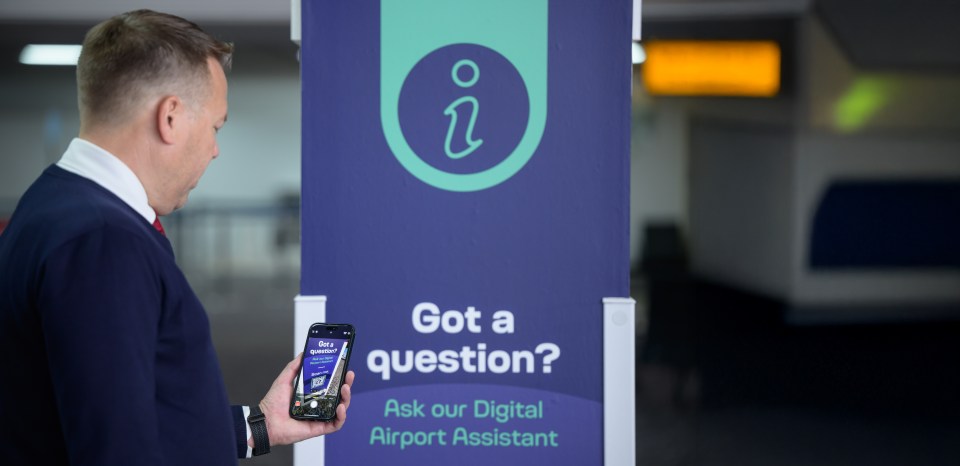
Passengers at all three AGS airports now use the digital assistant – accessed via QR codes – to navigate the terminals, and receive personalised travel assistance in real-time; accessing automated responses to routine enquiries – typically around onward travel, airport facilities and check in and bag drop – allowing operational teams to focus on more complex tasks.
“Our system knows where passengers are located in the airport, and can alert a member of staff to provide assistance if necessary,” Tiernan adds.
Allowing all passengers to use the service – and not just those with accessibility needs – now allows staff to devote more time to focusing on passengers with assisted travel needs. Hello Lamp Post says the trial at Glasgow gave back 347 working days for staff in a year to focus on other tasks. The airport has now extended the digital assistant service to staff to help those on the front line report incidents such as spillages; whereby an SMS alert is automatically sent to a duty manager.
Glasgow is also about to begin tracking the location of baggage trolleys as well as shuttle buses around the airport site, providing passengers and staff with real-time departure information to help customers plan their onward journeys, and staff to know with greater certainty if they will make their next work shift on time.
“The goal is to see where we can help improve customer service, how we can we support more efficient operations, and ultimately how we might drive more revenue for the airport,” Tiernan says.
Continued growth for the platform
“We are constantly developing the system, and our product roadmap is almost exclusively driven by our customers. We make a conscious effort to continuously listen to their pain points to see how we could be helping them.”
Tiernan says Connected Places Catapult has also provided useful industry insight into how airports operate and their attitudes to certain technologies. “It comes back to that soft landing: we’re not going into an industry blind. We have useful advice before we even speak to a customer.
“They also helped to open doors for us: it’s far better for airports to get an introduction from a mutual and trusted party than receiving a random call from a company.”
Connected Places Catapult’s Head of Aviation, Michael Laski says: “Funding innovative SMEs like Hello Lamp Post is not just an investment in their growth, it’s an investment in the future of connected communities. Such support enables SMEs to scale, innovate and thrive. Connected Places Catapult plays a pivotal role in helping great thinkers such as Hello Lamp Post to explore diverse markets and sectors, turning great ideas into impactful solutions.”
AGS Airports’ Group Head of Operational Solutions, Jamie Louden says: “Analysis revealed that most passenger inquiries were either referrals or requests for information. These requests are often perceived as unique to the customer about their journey, such as ‘Can I travel with a particular medication?’ for example.
“Establishing this service enabled access for all to a single source of truth, readily accessible to both customers and staff, ensuring accurate airport and airline information is delivered consistently to the right person at the right time.”
Connected Places Catapult and Glasgow Airport have collaborated to create the Connected Airport Living Lab, a collaborative R&D asset used to showcase UK-developed innovations, attract investment, and act as an innovation catalyst for the aviation sector. It is also used for testing and demonstrations of a diverse range of innovations aimed at addressing challenges facing the aviation sector, notably the decarbonisation of ground and air operations, the adoption of hydrogen, automation, data analytics and to enhance passenger experience.
We are launching a new project to trial technologies to enhance the provision of special assistance at airports to make air travel more inclusive and accessible to all, with a particular focus on neurodiverse passengers. We have conducted a period of discovery, including desk research, stakeholder interviews and airport observations and interviews at Glasgow Airport with relevant staff. Using this research, and in collaboration with Glasgow Airport, we have identified two key challenges which would improve customer service at the airport as well as support the Catapult’s aim of supporting UK businesses to scale and grow. These challenges also align with specific recommendations in the Aviation Accessibility Task and Finish Group Report which was commissioned by Department for Transport and published in July 2025.
The project comprises two distinct challenges with a separate RFQ process being conducted for each challenge.
Application deadline is noon on 18 November 2025.
Trials will need to be delivered by 31 March 2026.
Challenge A: We are seeking solutions that would increase independence and confidence of disabled passengers, by providing personalised information about the airport, their journey, airport amenities and means to contact assistance staff prior to and/or post arrival at the airport.
Challenge B: We are seeking solutions that would enable disabled passengers to better inform airport staff how, where, and when they need assistance in the airport reflecting their personal experience.
Airfield survey specialists trial systems at Glasgow Airport
Four emerging technology companies have demonstrated new approaches to airport pavement inspection through the Connected Airport Living Lab programme.
SatSense measures ground movement from the sky
“There’s always a better way to do things; you just have to have an open mind,” says Paul Froes of technology SME SatSense, reflecting on a recent trial of automated pavement monitoring and inspection techniques at Glasgow Airport.
“Technology is constantly changing, so new approaches have to be tried; and this is where innovation comes in. Just because something has been done a certain way for many years doesn’t mean you should always do it that way.”
Paul’s firm was one of four taking part in a Connected Airport Living Lab demonstration over three days in June, delivered by Connected Places Catapult in partnership with AGS Airports, to present new ways to deliver speedy and effective infrastructure maintenance airside.
Another trial participant was John Hill of Atlas Geoinformatics.
“The only way you learn is by doing things for real, so these programmes are fantastic. They smooth the way and let you try untested technology, so you can decide if a commercial proposition is worth developing.”
John Hill of Atlas Geoinformatics
John adds that small companies trying to sell technology into a regulated space like aviation can face a bias towards incumbent suppliers. But the Catapult has helped, he adds, to “connect us to the right people, and talk about new ways of doing things.”
Elijah Hoole of Roadgauge – a third SME on the trial – said the Connected Airport Living Lab represented the first time his company had got to work in an airport environment, rather than roads, to detect surface defects. Without the programme, he adds, “it would have been very difficult to get a footing at Glasgow, start trialling so early and to be able to talk about our product.”
A fourth participant, Martyn Stonecliffe-Jones of software supplier Xais-Pts, says that innovating can be a slow process in the aviation sector due to regulations. But he adds that some airports still prefer to carry out manual inspections and walk the airfield looking for defects, rather than use modern methods of assessment.
“Airports need innovation, but there is also a need for airport owners to embrace innovation,” he says.
Surveys from the ground and sky
Three of the four trials at Glasgow Airport involved taking vehicles airside, with a fourth surveying the scene from the sky.
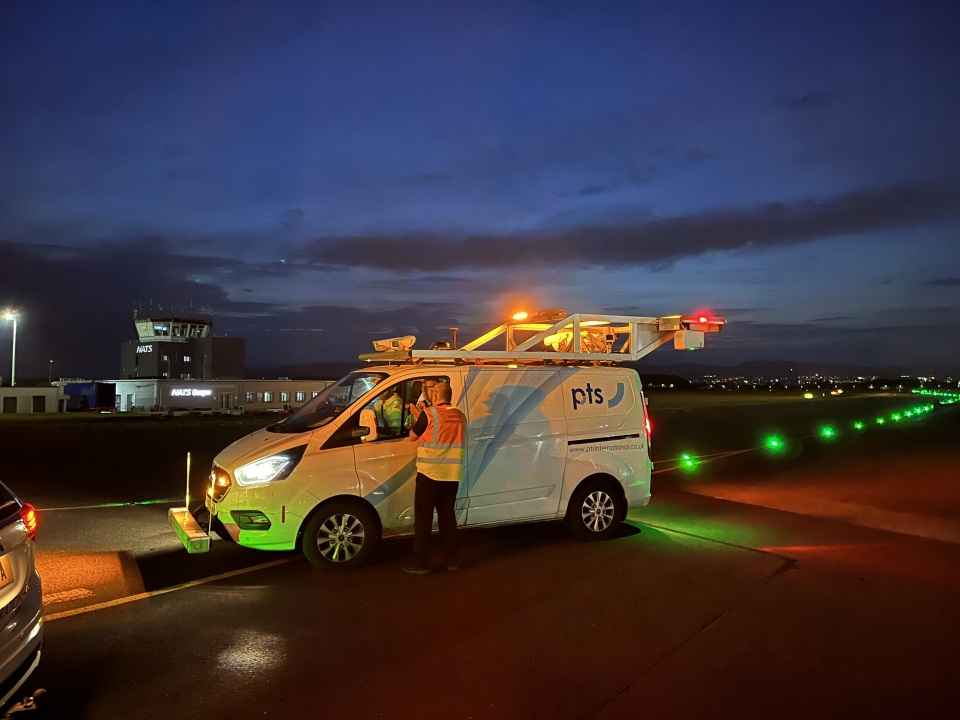
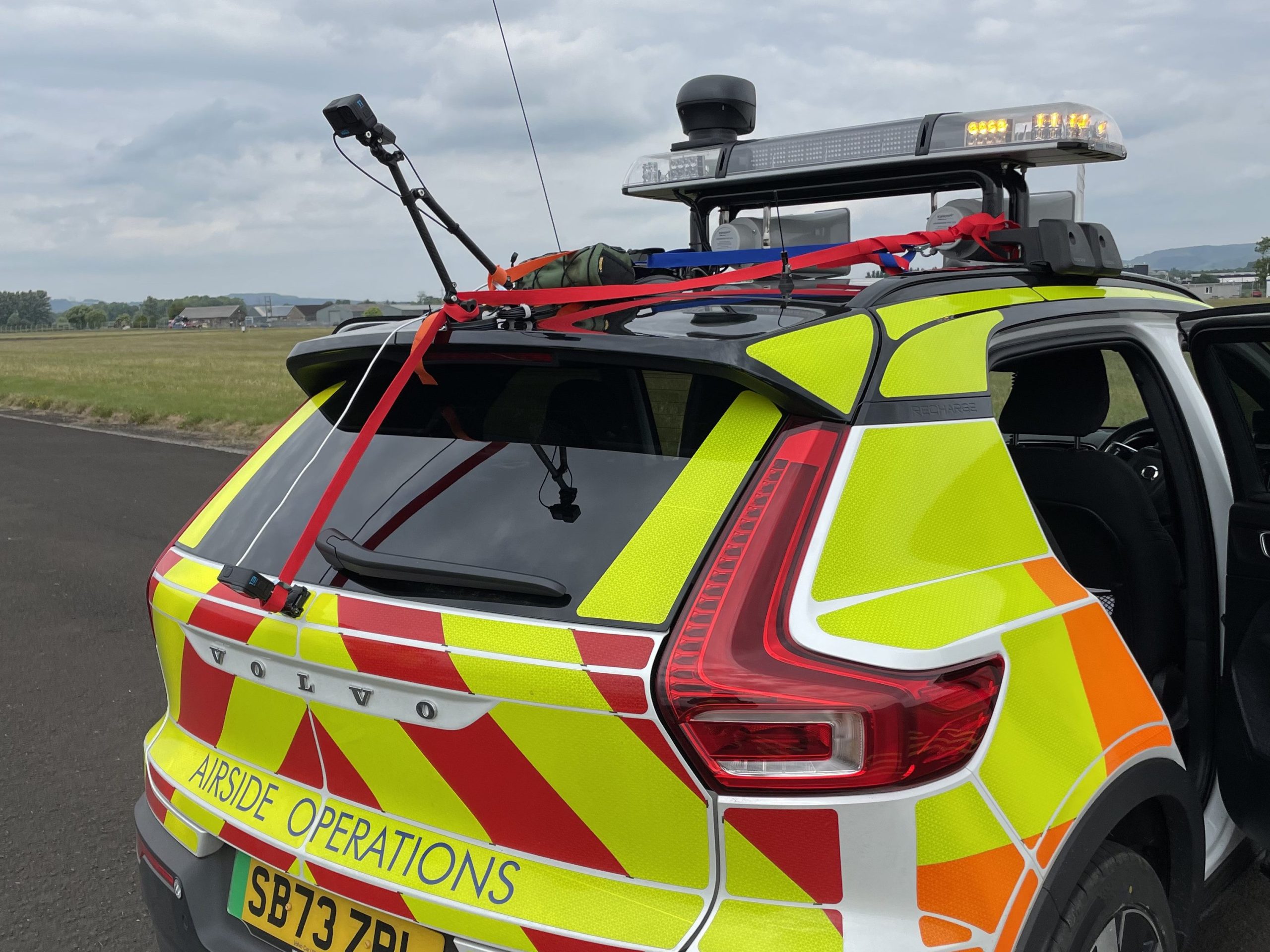
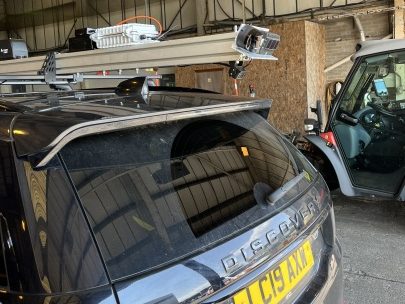
Atlas Geoinformatics used a vehicle-mounted sensor platform to accommodate kit including a laser scanner and cameras, and developed software that creates 3D models of an airfield. From this model, measurements can be carried out to identify defects, which could be used to predict the rate of degradation of a surface.
“We learnt from the Glasgow surveys that there are lots of different surfaces across an airport,” says John. “Each is constructed in a different way and has their own challenges and types of defect.”
Xais-Pts has developed a crack measurement system using lasers that can generate 56,000 scans every second, and provide results to an accuracy of 0.1mm. A 3D representation is created, and software identifies distresses to help populate a pavement condition index.
Martyn says surface conditions can vary significantly between airports, and that being proactive about monitoring can reduce large bills.
“It can cost several million pounds to resurface a runway. I’m surprised at the lack of detail that some airport owners have as to what their pavements are doing.”
Roadgauge creates 3D measurements of surfaces by using compact Go-Pro cameras, typically used by sports enthusiasts to record footage of themselves cycling or running.
Roadgauge uses Go-Pro cameras to measure surfaces
“Data that we generate from the video recorded can produce actionable insights and measurements of cracks of only a few millimetres in depth,” says Elijah.
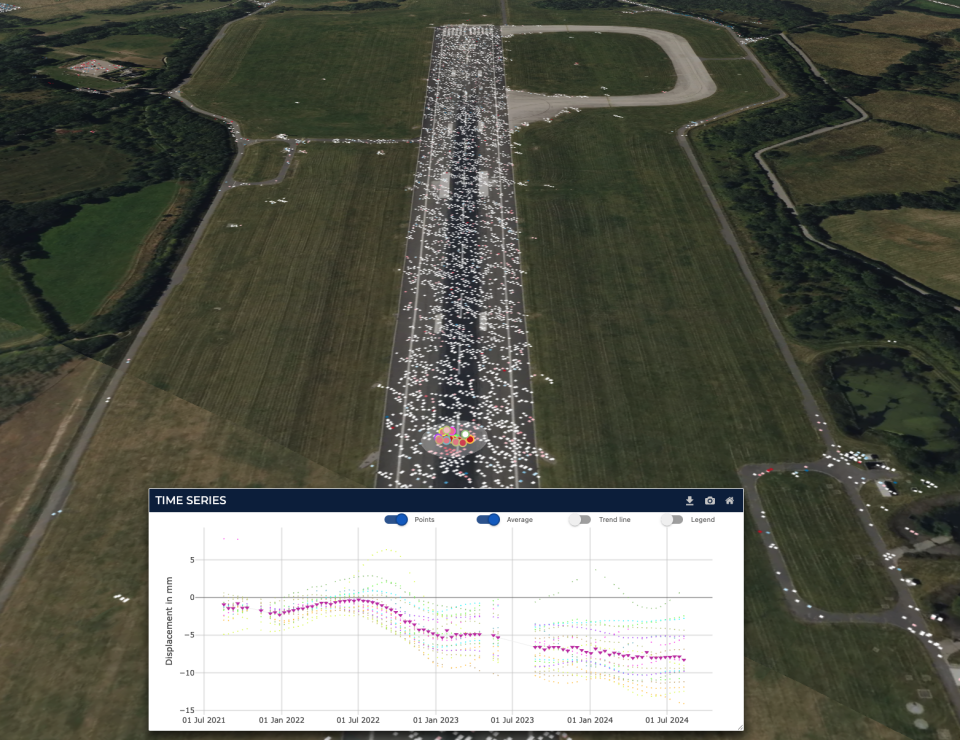
SatSense uses satellites to measure ground movement from the sky. Its system – more commonly used to monitor railways, roads, bridges, tunnels and buildings – can detect movement to within a few millimetres.
“We can start to identify ground movement risks before they manifest as structural failure affecting the runway, aprons or taxiways; as well as buildings beyond the boundary fence,” says Paul.
Catapult helps the conversation
A vehicle-mounted sensor platform from Atlas Geoinformatics
Paul adds that getting technology into aviation can be hard, but Connected Places Catapult helped them to “get in there and talk to the right people. The natural progression is to form part of the ‘business as usual’ in providing smarter, predictive maintenance. The technology is there; it’s about applying it to new industries and use cases.”
John from Atlas Geoinformatics adds: “We’ve got to sweat the infrastructure harder, not just in airports, but all across the infrastructure space. The way you’re going to do that is by using smarter technology to offer predictive maintenance.
“We are developing both our hardware and software off the back of the Glasgow trial, and hope to come back and collect some more data to show what progress we have made.”
Connected Places Catapult’s Head of Aviation, Michael Laski says: “The automated pavement monitoring trials at Glasgow this summer have been a great opportunity to bring together a range of differing and complementary technologies that have previously been developed outside of aviation, and to test them within a live airport environment.
“We look forward to seeing the results of these different approaches to better understand their relative merits for potential use in a range of UK airport scenarios in the future.”
Read about further progress with the Connected Airport Living Lab: Entopy developing a digital twin at Glasgow, and accessibility trials for deaf passengers.
articles
Airport technology trial monitors passenger movements at Glasgow
Entopy introduced a digital twin to aviation after proving its worth in maritime
Demonstration of a digital twin at Glasgow Airport designed to aid passenger flows and reduce traffic congestion has led to discussions about a possible future trial at another airport.
The digital twin created by technology firm Entopy provides predictive intelligence as to how many people will pass through an airport and at what times, and their likely behaviours between arriving on site and the check-in desk.
Providing this sort of advanced analytics is designed to help airport operators plan how best to manage the influx of passengers in the most effective way to ensure their journeys remain smooth.
Use of the digital twin also provides a chance to test the likely impact of any planned upgrades to infrastructure in a virtual environment.
Entopy introduced and trialled its technology for six months at Glasgow after winning a technology competition for small to medium sized companies as part of the Connected Airport Living Lab programme, run by Connected Places Catapult in association with airport operator AGS.
The contest was held to help the operator understand how it might use digital technology to accommodate a large growth in customer numbers – with throughput at the airport expected to double within 15 years.
“One of the major challenges facing the aviation industry is a rising number of passengers each year. Our target objective for the trial was to build a digital twin of passenger movement so the airport could see how passenger growth affected its infrastructure.”
Company founder Toby Mills
“This trial provided us with a great opportunity to enter the aviation space and test technology that we previously used to monitor traffic flows in the maritime sector, on the approaches to Dover and Felixstowe.”
Focusing on private car arrivals
Glasgow Airport’s digital twin focused on the 70% of passengers who arrive by road, either in a private car (50%) or taxi (20%). It featured a series of AI micromodels that followed customers through the terminal and considered how many passengers are likely to check-in luggage, before passing through security.
Using historic data, Entopy’s technology predicted the occupancy levels of airport car parks and how many vehicles were about to pass through each car park by hour. The models also showed the time taken to check-in bags and walk through security in 15-minute intervals based on live flight data.
The six-month trial, which was completed in March, aimed to create a ‘baseline’ digital twin model from which simulation capabilities could be developed.
Staff at the airport were provided with access to the software to test the accuracy of the intelligence and provide feedback. A dashboard provided users with information around car park arrivals, passenger check-in numbers and volumes at the security gates each hour.
Users of the software could also adjust the future time intervals on view to provide a snapshot what is likely to happen over the course of the day; with a ‘red, amber, green’ status displaying likely pinch points on a map of key zones across the airport. For the trial, it was found that road traffic time predictions were 94% accurate.
Challenges and an opportunity identified
The trial was not without its challenges, though. The availability of data was identified as a risk to the accuracy of the models – such as from airlines – and access to real-time data was not possible for tracking the arrival of vehicles to the airport, the number of passengers checking-in and passing through security.
Where there was limited data available to train AI micro models, Entopy expanded those datasets with synthetic data, leveraging proprietary technology that it has developed in partnership with the University of Essex. From an operational point of view, engagement with airport staff did not take place until the final month of the trial.
But following meetings with AGS, representatives from another UK airport decided to look at how digital twins could help to monitor passenger flows.
Both Entopy and the airport have found there to be multiple systems already in place to forecast passenger movement at the airport, which could benefit from streamlining into one digital twin. The next step could be a six-month deployment at the second location, subject to trial costs and development of a business case.
Assessment predicts improvements
An impact assessment of the Glasgow trial by Connected Places Catapult found that the digital twin proved to be useful in terms of predicting check-in volumes and processing times through security. If rolled out, it said the digital twin would “contribute to improvements for increased passenger volumes whilst maintaining processing times, increased airside dwell time and retail revenues, and optimised infrastructure expansion”.
Connected Places Catapult’s Senior Technical Consultant, Jonathan Wilson said: “Entopy previously worked with us in maritime and has now demonstrated it can transfer a digital twin model from one industry to another.
“Use of the digital twin and AI micro models allow for a better understanding of passenger movement and for operators to make informed decisions about service provision based on evidence.
Connected Places Catapult’s Senior Technical Consultant, Jonathan Wilson
“I was very impressed with the accuracy of their models and how they became more accurate over time. I am pleased we were able to give an SME an opportunity with an airport that they may not otherwise have had.”
Jon Matthews, Transformation Director at AGS Airports, said: “Glasgow Airport’s partnering with Entopy has been a great experience. They understood the specific outcome desires we were seeking to address via their digital twin modelling; to better predict when and where passengers would be arriving and travelling throughout the airport.”
He adds that the trial resulted in some good learning which it is looking to embed into its operation and growth model going forward. “We are highly appreciative of the co-ordination by Connected Places Catapult, who helped select Entopy through an open market review, bringing a number of impressive SMEs to our awareness that we would otherwise not have encountered.”
Read a Meet the Innovator profile from last year about Toby Mills of Entopy.
page
Air Mobility Ecosystem Consortium (AMEC)
The Air Mobility Ecosystem Consortium (AMEC) project formed the third phase of the Government Future of Flight challenge, which ran from 2022 through to 2025.
The Innovate UK funded project consortium involved: AtkinsRealis, Skyports Instructure Ltd, NATS, Cranfield University, Heathrow Airport, London City Airport, Bristol Airport, University of Warwick, Vertical Aerospace and Connected Place Catapult.
The aim of the AMEC project was to demonstrate the commercial and operational viability of Advance Aerial Mobility (AAM) in the UK. This is an efficient, electric model of aerial transport complementary to existing transport infrastructure, helping to deliver both increased connectivity and net zero emission targets.
AMEC will demonstrate the first-of-kind air mobility services using Vertical Aerospace’s emission-free VA-X4 eVTOL aircraft, later in 2025. The mission will take place between Kemble Airport and Bicester Vertiport.
This mission will explore and prove all aspects of the passenger journey, vehicle operation, airspace navigation, security provision, advanced air traffic management with UAS Traffic Management (UTM) and local stakeholder management.
Vertical Aerospace is exploring novel means of compliance with civil aviation regulators as it prepares an airworthy vehicle for demonstration.
Skyports Infrastructure has built a “living lab” vertiport at Bicester to allow UK AAM stakeholders to trial technologies and operational concepts, facilitating commercial operations.
NATS and Atkins are deploying novel digital infrastructure to modernise airspace and ensure compliance with national aviation safety regulations and border security.
Connected Places Catapult were responsible for the day-to-day project management of the consortium & administrative functions; and have led and delivered the benefits and impacts analysis activity.
Transport accessibility tech thrives following Catapult testbeds
Several innovators to have developed passenger assistance systems with the support of Connected Places Catapult have gone on to secure further trials or commercial success; among them Hello Lamp Post and Jnction.
Air passengers requiring support at Glasgow Airport can now make use of a digital assistant developed by Hello Lamp Post, an SME supported by Connected Places Catapult.
The AI-enabled tool has been introduced at the airport to improve navigation through the terminal for all passengers, which has been branded ‘Hello Glasgow’ around the site. Location specific signage with QR codes placed around the airport can be scanned to share real-time flight information, request passenger assistance and support with airport navigation.
Earlier this year, the technology was tested at Glasgow Airport as part of the Connected Airport Living Lab accessibility trial, focused on passengers with accessibility needs.
“Hello Lamp Post has two benefits: it provides instant support for passengers in that specific location, and eases the strain on airport staff”
Hello Lamp Post, Chief Executive, Tiernan Mines
“Nine million people go through Glasgow Airport every year, with around 5,000 queries coming into the team every month. But most of those questions are about where to catch a bus, where to get coffee, and where the toilets are located.
“All of those different questions are very repetitive for a human to have to handle,” he adds. “Answering many questions also risks taking attention away from someone who might be trying to get in touch to request a wheelchair, for instance.”
Trial of the system led to a 50% reduction in queries being received by customer services teams and those looking after passengers with restricted mobility at the airport; giving over 250 days a year of staff time back to other customer duties. The company also says that over 12,300 more passengers could be supported every year thanks to the service, and that it had an 86% satisfaction rate with users during the trial.
Hello Lamp Post uses AI to understand what someone interacting with the service is requesting, and respond with the most relevant and personalised information based on the user’s location. If human assistance is required, the system will direct passengers to where they should go.
“Our commercial model is not about monetising the end user. Instead, the airport is our customer, which means the focus is on helping the airport provide better support to more passengers.”
The company began a decade ago as a ‘playable’ digital art installation in Bristol to improve people’s experiences of the urban realm, and was previously shortlisted for the Connected Places Catapult Station Innovation Zone competition to help rail passengers navigate Bristol Temple Meads.
“Connected Places Catapult helped to join the dots for us with clients and was instrumental in setting up user testing; getting people in need of special assistance in front of the technology.
“At Glasgow Airport, we want to support as many people as possible coming through their doors, and we’ll soon be supporting more airports across the UK, and beyond including in the US. The opportunity is really exciting.”
“It is tremendous to see Hello Lamp Post launch its AI-enabled digital assistant service. This development follows a trial of the technology at Glasgow Airport as part of the Connected Airport Living Lab project, where innovative new systems were funded by the Catapult to address challenges facing the airport sector.”
Connected Places Catapult’s Ecosystem Director for Air Mobility & Airports, Andrew Chadwick
Glasgow Airport’s Group Head of Operational Solutions, Jamie Loudon said: “Working with Connected Places Catapult on a trial earlier this year proved invaluable in helping us roll out this cutting-edge technology across the airport for all passengers.
“Technological advancements, particularly in artificial intelligence, are transforming how we deliver vital services. This AI-powered assistant will further enhance the customer experience, ensuring smoother and more personalised journeys for all who pass through Glasgow Airport.”
Helping neurodiversetravellers in the South West
Rail stations throughout Devon and Cornwall will soon begin hosting a large trial of a new digital travel companion, to support neurodiverse passengers in need of help navigating unfamiliar environments.
The technology, called Aubin, from specialist technology firm Jnction provides turn-by-turn directions on a smartphone to users with conditions such as autism, to help make their journeys around stations less stressful.
Aubin was trialled at Bristol Temple Meads just over a year ago as part of the Station Innovation Zone testbed run by Network Rail and delivered by Connected Places Catapult. Now, an enhanced version of the system will be tested by passengers at stations throughout the South West as part of a trial hosted by Innovate UK.
“Our focus will be around Exeter St Davids, but include other stations in the local area too, some of which are not staffed,” explains Jnction’s Chief Executive, Mike Lloyd. “We have focus groups, the support of local councils and Great Western Railway and will be recruiting users to try out the system with us.”
Following this latest trial of the technology, the company aims to launch a product to market next spring.
“Our system is providing practical support to help people navigate, reduce their stress levels and have more comfortable journeys. We want to work with the rail industry to roll this out more widely across the UK.”
Jnction’s Chief Executive, Mike Lloyd
The latest version of the technology includes real-time information to provide alerts to users on the whereabouts of a train before they embark on their journeys, rather than relying on timetable data.
Also in the last year, Aubin has been on show at the National Railway Museum in York as part of a rail futures exhibition. “This has flowed directly on from the work we did with the Catapult last year, and the relationships they helped us to build,” Mike says.
He adds that staff trained to help neurodiverse passengers on the new trial will be wearing a special badge with the company logo, to make members of the public feel more comfortable should they need to make an approach.
He adds that the support of Connected Places Catapult has been crucial in helping to develop his company’s system. “They were very helpful from several points of view. The funding was critical to keep the project going and allowed us to work closely with people on the ground, understand their needs and work out what we needed to do differently.
“They also helped us to build relationships with Network Rail and Great Western Railway. We now have a clear plan for what we need to do.”
“It is fantastic to see progression of the technology trialled in the Station Innovation Zone. Stations can be very complex environments to navigate, and anything that improves accessibility for passengers is important for the rail sector.”
Connected Places Catapult’s Ecosystem Director for Rail and Stations, Dr Alan Peters