Connected and Autonomous Vehicles
Connected Places Catapult has collaborated with government, industry and academia on various projects to position the UK at the forefront of the Connected Autonomous Vehicle (CAV) revolution.

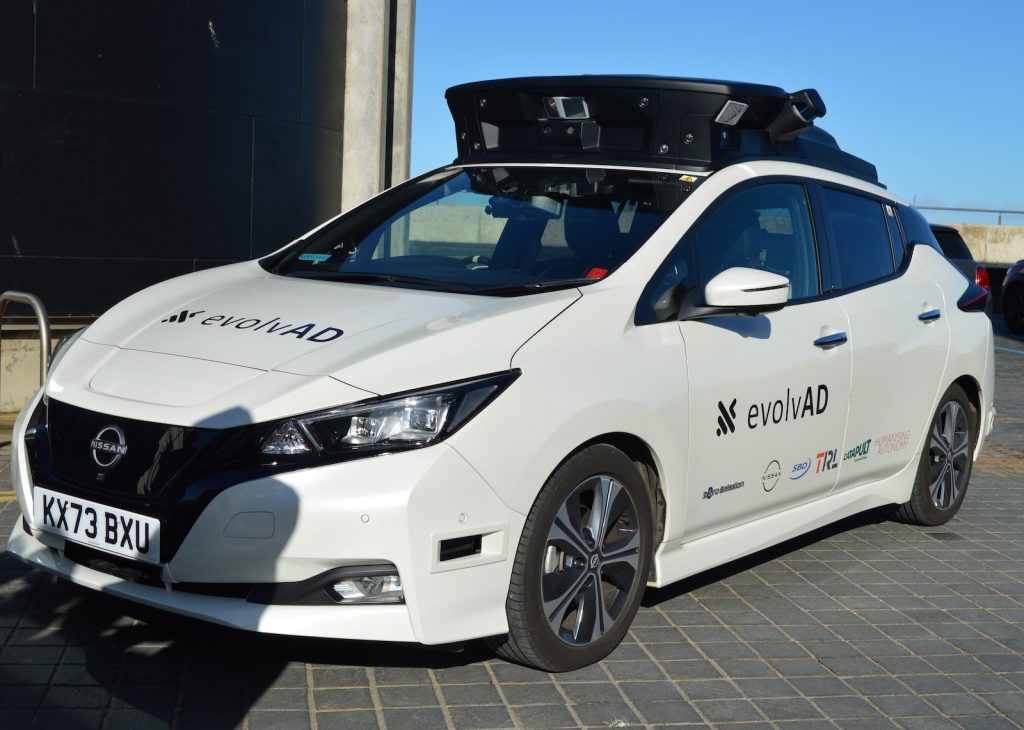
On Friday 24 October 2025, the Self Driving Industry awards took place in Margate, celebrating excellence in automated mobility in the UK and internationally.
The 2025 Project of the Year award was awarded to evolvAD, which was led by Nissan alongside a consortium of partners including Connected Places Catapult. The project was recognised for demonstrating the aptitude of autonomous driving (AD) technology in dealing with speed bumps, mini-roundabouts, width restrictions and oncoming traffic, as well as rural lanes with extreme cambers and blind bends.
During the project, Connected and Autonomous Vehicles (CAVs) were tested in various simulators and on private test-tracks before being introduced onto the Smart Mobility Living Lab (SMLL) network. Here, the vehicle experienced challenging and narrow urban, residential, and rural roads for the most rigorous test of AD technology ever in the UK.
Over 21 months, evolvAD was delivered by a consortium of partners, each contributing specialist expertise:
Working in collaboration with these partners, the Catapult’s geospatial specialists developed an AI tool to extract road features from satellite imagery for use in the high-definition maps that underpin AD systems. Validating the outputs with Nissan, the tool can be used for a range of AD-related applications where detailed information about road features are needed.
“It’s fantastic to see evolvAD awarded Project of the Year at the Self Driving Awards 2025. There is a huge opportunity for the UK to realise the economic benefits of being a pioneer in the connected autonomous vehicle market. At Connected Places Catapult we’re proud to have been working in this space for over a decade to support businesses of all sizes to innovate and grow.”Sameer Savani, Managing Director for Transport at Connected Places Catapult
Cars of the Future editor, Neil Kennett, on behalf of the 2025 Self-Driving Industry Awards judging panel, said:
“We were delighted to present our Self-Driving Project of the Year Award to evolvAD by Nissan, in collaboration with Connected Places Catapult, SBD Automotive and TRL.
“Their vision was ambitious: To deliver connected and autonomous vehicles capable of driving in a wide range of environments, and to nurture a domestic supply chain capable of sustaining solutions for both the UK and for export.
“This project involved dealing with speed bumps, mini-roundabouts, width restrictions and oncoming traffic, as well as rural lanes with extreme cambers and blind bends. The results are so impressive, demonstrating exactly why Nissan continues to choose the UK for its most advanced self-driving testing.”
The Catapult has been working for over ten years to support the development of the Connected Autonomous Vehicle (CAV) market. It has been involved in 20 programmes including HumanDrive, the single longest and most complex journey by an autonomous vehicle on UK roads, and ServCity, a project to support cities in understanding how they can harness the autonomous vehicle technologies and incorporate them into complex urban environments.
Other programmes have focussed on the societal impact of the technology, like FLOURISH in Bristol, which looked at the potential of CAVs to support an aging population. On the regulatory and safety side, experts from the Catapult helped inform the Automated Vehicle Act 2024.
A number of UK companies looking to capitalise on this emerging market have been supported by the Catapult, including Aurrigo and the University of Oxford spin-out Oxa.
Aligning with our mission to make UK transport more efficient, inclusive and safe, we are supporting increasing levels of autonomy by contributing to improved adoption, and accelerating new technologies and systems from pioneering SMEs in their route to market.
Find out more about our impact on the CAV market: https://cp.catapult.org.uk/case-study/connected-autonomous-vehicles/
To discover more about our work in transport, visit our transport hub.




As a boy, Oliver Leisten built transistor radios so his family could listen to the BBC World Service from their home in Malawi. His interest in electronics led to a career manufacturing antennas that communicate with satellites, allowing data to be transmitted around the globe and for mobile devices to provide navigation for people out and about.
Now, Oliver and his company Helix Geospace are creating advanced antennas that support global navigation satellite systems (GNSS) to help guide unmanned aircraft. He was involved in a recent Future Flight Challenge project – supported by UK Research & Innovation and Innovate UK – to introduce technology for autonomous planes used to transfer mail between islands in Shetland.
He is also taking this technology down to ground level to help ensure that future connected autonomous vehicles can communicate their positions with one another with sufficient accuracy to ensure they avoid collision. To help with this aim, Helix Geospace joined an Intelligent Mobility Accelerator in 2020, delivered by Connected Places Catapult and Wayra UK, the innovation arm of Telefonica.
Helix has since been working alongside a major telecommunications network provider to develop the technology and the Society of Motor Manufacturers & Traders to help shape future thinking. Oliver’s company now has close to 30 staff including software programmers and procurement specialists and has an ambitious growth plan for the next three years.
Over the last few decades, single large antennas in fixed locations have begun to be supplemented with multiple small antennas in mobile devices – such as smartphones and tablet computers – to send and receive data.
Transferring large amounts of information requires many antennas to support different data types, Oliver explains. “These antennas have to work independently of each other and not cause interference by jamming each other’s signals.”
“We are all addicted to information and this trend is not going to relent,” he continues. “The best and most efficient societies have more information available to them, and we need to allow it to flow safety, cheaply and in a way that is power efficient.”
Now with the prospect of connected autonomous vehicles coming to our roads, there will need to be many millions – if not billions – of tiny antennas placed on the vehicles to communicate their precise positions quickly and accurately. The market potential is huge.
Oliver says creating strong ties between stakeholders is key to ensuring that future technologies deliver maximum benefit for the transport sector.
“Connected Places Catapult creates leadership for the UK market and allows for the exchange of ideas among stakeholders.”Oliver Leisten, Helix Geospace
He adds that Satellite Applications Catapult has also been helpful in providing his company with access to a far-field antenna test range at Harwell in Oxfordshire to help with product development. “Developing this technology involves a great diversity of skills, organisations, technologies and policies so it is right that the Catapult Network can help to create efficiencies by co-ordinating effective collaborations.”
Oliver started his career as an apprentice with manufacturer Plessey in Essex while studying radio frequency communications at Loughborough University in the 1970s. He later enrolled on a post-graduate course on the subject of solid-state microwave electronics, sponsored by Philips, and entered the emerging field of GPS – or global positioning satellites.
“I was involved with GPS right at the start in 1989 and my first challenge was to make it work as part of a navigation system for the Panavia Tornado fighter aircraft used by the Royal Air Force during the Gulf War.”

He later joined Navstar Systems in Daventry; a location known to him as it was the Daventry Transmitter which his early wireless radios used to seek out. “This was an absolutely fascinating field of work and there was a lot of intellectual property being developed in GPS at the time to create very accurate measurements.” The company first used GPS to create navigation devices used by fishermen to locate favoured stretches of river.
The company was bought by an American firm and Oliver found himself designing an instrument known as the ‘mushroom’ that was fixed to the top of many of the world’s tallest buildings. The antennas were used to synchronise time and GPS and ended up being used by around three quarters of the world’s major telecommunication systems.
“The idea is to allow bit streams of data to be sent around the world very fast, and both GNSS and GPS allow you to find your position and find accurate time,” Oliver explains. “When data is transmitted and received, a system needs to know exactly what the time is.
“Telecommunication networks are now regarded as part of a nation’s critical infrastructure; if they are not synchronised, countries can lose communications and it could be disastrous for an economy.”
“I have always been convinced that antennas would become a popular theme of intellectual property development as they used to be very large. Now you have the technology in a watch, so things have certainly moved on,” he says. “This transition to smaller devices really interested me and in the year 2000 I helped form a company called Sarantel to develop tiny antennas that made accurate position measurements.”
After 13 years, Oliver joined a Japanese firm to learn more about advanced manufacturing processes and went on to launch another company focused on designing tiny antennas that could be fitted to connected autonomous vehicles.
He teamed up with a business partner to form a company that became Helix Geospace, of which Oliver is now Chief Technology Officer, and won a grant to create an accurate GNSS antenna to operate with signals from the Galileo constellation of spacecraft.
Oliver acknowledges that the widespread use of connected autonomous vehicles in the UK is still some way off, but says work must be done now to prepare for future applications.
“The technology has to reach a threshold of acceptability where the insurance industry believes that connected autonomous vehicles are delivering greater safety than the incumbent, manually driven fleet of vehicles,” he explains. “It also has to be 100 times better than people, and we are working to show a vehicle’s position in a city to an accuracy of 10cm.”
Alongside its work on connected autonomous vehicles, the company continues to develop technology for unmanned aerial vehicles used to carry parcels. “We are also now developing systems that protect GNSS from being spoofed; by measuring the direction in which a signal arrives and checking its veracity against the known position of a satellite.
“We think that GNSS is going to be the primary navigation system for connected and autonomous vehicles in future, but it is important that it is accurate and dependable when used in a busy cityscape,” he adds.
The antennas being developed for the cars are very small: as little as 3 or 4mm in diameter and 6mm tall. But the scope of opportunity could, Oliver says, “be absolutely enormous”. When it comes to transmitting and receiving data, he adds, “small antennas could be the modern day equivalent of lightbulbs”.

Henry is involved with the University of Southampton through his role as the Chair of the UKRI Trustworthy Autonomous Systems (TAS) Hub’s Strategic Advisory Network. The TAS Hub is housed within the University’s School of Electronics & Computer Science as part of the Agents, Interactions and Complexity group.

The TAS Hub’s vision is to enable the development of socially beneficial autonomous systems that are both trustworthy in principle and trusted in practice by the public, government, and industry.
As Chair of the TAS Hub’s Strategic Advisory Network, Henry is facilitating research impact, mentoring TAS Hub researchers, and promoting knowledge transfer activities. His new position as Adjunct Professor will allow him to expand on this work through closer ties with the university and its world-class researchers.
Henry provides a wealth of experience from working in both industry and academia. He is a technology strategist, systems engineer, and engineering & programme manager. He is experienced in leading teams to design and develop innovative solutions to meet complex challenges, setting strategic direction and investment priorities, and launching strategic initiatives to develop key technical discriminators to drive future growth.
“As automation technology develops at pace and continually challenges the way society operates, it is vital that we ensure we are building systems that are trustworthy by design. By taking up this appointment at the University of Southampton I hope to be able to connect colleagues across academia and industry to work together on delivering trustworthy autonomous systems that provide real benefits to our society.”Prof. Henry Tse
Find out more about Connected Places Catapult’s work on autonomous systems on our connected intelligence page.
Register now to attend the TAS Hub’s upcoming event on 18 October: TAS Hub Pump Priming Round 3 | Briefing & Elevator Pitches

