
CAT_2501_AW-0023-HiRes
post
Connected Places Catapult responds to Industrial Strategy consultation
The Connected Places Catapult welcomes the Government’s consultation on a new Industrial Strategy. As the UK’s innovation accelerator for transport, cities and place leadership we are excited about the opportunity this represents.

The Connected Places Catapult welcomes the Government’s consultation on a new Industrial Strategy. As the UK’s innovation accelerator for transport, cities and place leadership we are excited about the opportunity this represents. We are encouraged by the strong focus on the importance of unlocking the complexities of place, as well as the role that data and digital technologies have to play in raising the economic productivity of our cities and regions.
As the Resolution Foundation and others have demonstrated, the UK struggles with the dual challenges of low growth and high inequality, which has left us lagging our European peers in terms of living standards and productivity. Closing that productivity gap would yield incredible returns – an additional £100 billion in gross value added (GVA) per year. According to the Centre for Cities, hundreds of thousands of new jobs would be created if UK core cities achieved productivity levels equivalent to their European counterparts.
An Industrial Strategy that recognises the importance of place, connectivity and innovation is critical to that endeavour.
Place as a driver for successful sectors and clusters
We welcome the fact that the Green Paper articulates the important role of place. It is also encouraging to see cities explicitly referenced as places that require focus given the important role that they can play in driving economic growth.
We recognise the Government’s need to focus the outputs of the Industrial Strategy around sectors to maximise the potential for long-term sustainable growth. But the economy is a matrix of both places and sectors. We would encourage the Government to ensure that there is no disconnect between the Green Paper’s recognition of the importance of place and the focus on sectors.
A strictly sectoral focus does not allow for challenge-based emerging sectors to occur. In our experience ‘emerging sectors’ occur where technological capabilities with place-based applications are applied across sectors. This often happens as opportunities to work with government and industry create new commercial propositions that respond to place-based challenges.
We also support the focus on clusters and basing investments on robust analysis of strengths and opportunities. We caution against an overreliance on single sectors in any given area, noting the huge opportunity for innovation when diverse sectors intersect and ideas share between one industry/cluster to another. Places which fixate on a single cluster also lack resilience and agility. There is a risk in emphasising clusters that we create unhealthy competition between regions.
Through our work with place leaders across the UK (e.g. the Innovation Places Leadership Academy, the UK Innovation Districts Group, the Freeport Innovation Network), we are also well placed to provide practical support to those seeking to deliver innovation-led local growth.
Innovation & Local Growth Plans
We see an opportunity for the Industrial Strategy, complemented by robust Local Growth Plans, to promote nationwide collaboration between places and clusters which make up different parts of our innovation value chains. This will promote mutually beneficial flows of talent, investment and knowledge across all parts of the chain. We see this as an opportunity to apply a market-driven focus to cluster development, emphasising access to emerging markets and creating tangible business opportunities, as companies join clusters to grow their bottom line.
Capacity to deliver innovation-led local growth is unevenly distributed across combined and local authorities as they face multiple competing fiscal and other pressures. This requires new thinking and resourcing approaches to capacity development and new strategic thinking. Without building innovation capability, there is a danger that the gap between innovation rich and experienced regions, and those regions with untapped potential, will grow. Without broader coordination, Local Growth Plans risk unnecessary fragmentation, competition or duplication.
Investments in high-productivity sectors will deliver a weak return if the places in which they are based are not optimised. Local Growth Plans need to not only describe how places will deliver sectoral improvements in support of the national growth mission, but also place-based transformations in the physical, digital and civic fabric of the place to support a flourishing innovation economy.
We can help unlock innovation in local growth planning and delivery, strengthen regional digital capability and capacity, and align local plans into national activity and vice versa providing a consistent approach across the UK.
Digital & data leadership
We welcome the Green Paper’s focus on the role of data in supporting the Industrial Strategy, as well as the role of Government in removing the barriers to sharing data to improve business operations and decision making.
It is important that Government plays a leading role in reusing public sector data by adopting the principle of “collect once, use many times,” treating data as essential infrastructure. It should incentivise data sharing to unlock regional and sectoral potential while aligning policies with global best practices and market standards. Public sector data, including the proposed National Data Library, should be prioritised as a driver of innovation and growth.
We welcome the provisions in the Data (Use and Access) Bill – mandatory sharing, funding mechanisms, and enforcement—extend across sectors. A cross-sector Smart Data framework should promote secure, standardised sharing, enhancing productivity and innovation. Clear governance, pro-innovation regulation, and alignment with international frameworks, such as the Interoperable Europe Act, are essential.
Improving data literacy and capabilities within businesses will enhance their use of data across supply chains, foster collaboration, and strengthen competition in data-driven markets. These efforts will ensure the UK’s public and private sectors thrive in an increasingly data-driven economy.
It is also important to adopt a standardised approach across Government, industry, academia and Catapults. A decentralised approach to data sharing infrastructure is vital for unifying fragmented systems across transport, energy, and water, reducing costs and boosting productivity.
This will:
- Establish transparent governance
- Identify critical cross sector uses-cases and route maps
- Inform legislation, policy and investment in demonstrators
- Inform the development of a framework of future-proof components (technical and socio-technical) building on existing digital assets and legacy technology
- Share strategic insights to guide the market to implement this infrastructure effectively, fostering innovation and resilience across industries.
Innovation-friendly procurement
Thanks to technical advances we are seeing incredible innovations being unlocked in the UK by new suppliers from academic spinouts, small and medium sized businesses (including start-ups), scale-ups, venture capitalists, accelerators, corporate innovation teams and many others. These diverse suppliers are helping to achieve better, cheaper and quicker outcomes and create more value from the £400bn the public purse spend per annum on third party suppliers.
If just 5% of public sector contracts were brought to market in this way, it would transform £19bn of existing spend into innovation fuel annually. There is an opportunity to nurture this approach further and reform how the public sector shapes markets by not only effectively delivering public policy outcomes, but also by creating new businesses that could be exporting services across the world. To achieve this, we must go beyond Research and Development and use procurement to realise more value by scaling solutions.
- Being more open with the market on the challenges the public sector is facing;
- Applying effective procurement routes to market;
- Creating the right culture and environment for innovation in the public sector to thrive;
- Using experimentation to test, iterate and build evidence on where innovation can add value, and scouting the market for those hard-to-find companies that can solve key problems;
- Upskilling on the buyer and seller side on how public and private partners can co-create, work together and create a more entrepreneurial approach to solving public policy agencies.
post
Catapult convenes smart city leaders at global congress in Barcelona
Twenty-five organisations from Great Britain including some of our largest metropolitan authorities gathered at the UK Pavilion.

Twenty-five organisations from Great Britain including some of our largest metropolitan authorities gathered at the UK Pavilion – hosted by Connected Places Catapult – inside Barcelona’s Gran Via conference centre between 5 and 7 November.
They were there for three days of networking and to discuss the latest technologies and thinking designed to improve transport, housing and communications in and around cities.
25,000 attendees representing over 800 cities from across the globe were in Barcelona for the event; looking to better understand what is new and emerging in urban innovation.
“It’s great to be in Barcelona. Three years ago, I was here as part of a UK Government delegation and there was no UK stand at all. We said we really need to be here, and here we are. For us it’s about bringing together UK cities to showcase what they’re doing in terms of innovation and data in the UK.”Connected Places Catapult’s Chief Executive, Erika Lewis
Making the trip out to Barcelona allowed attendees from the UK, she added, to “get to see what all of the other countries around the world are doing, understand how they’re approaching innovation, and how they’re using data.”

Erika added that the Government has committed to invest in the UK’s infrastructure over the coming years; around new towns, roads and new ways of thinking about transport. “With that brings lots of opportunities about how we can think about innovation and how it is used to build places and spaces.”
She added there is a lot that can be done very quickly to better understand how data can be harnessed for the common good, such as through the Digital Twin Hub, and how procurement can be used to encourage innovation.
“We can’t have growth without innovation – the world is moving through a fourth Industrial Revolution and the cities that harness innovation the best will achieve growth.”Ben Russell, the Head of Investment Zones at the Department for Business and Trade
He explained that Investment Zones – where clusters of companies can work collaboratively on innovations in multiple locations – help bring people together to generate growth and opportunity.
“It has been fantastic pulling everyone together under one stand here in Barcelona, and seeing lots of friendly faces from around the regions,” he later said. “Creating spaces for innovation is where success lies.”
During the event, Connected Places Catapult hosted 15 partners, 25 organisations and welcomed over 650 visitors to the UK Pavilion. Twenty panel sessions were held at the UK Pavilion, featuring over 70 speakers; plus there were two networking events.
Among the sessions was a focus on smart cities as a driver for international collaboration, featuring a look at Belfast’s innovation twinning collaboration with Sejong in the Republic of Korea; which is supported by the Catapult.
“Having a smart cities programme allows innovators to foster relationships, and we have been bombarded by requests to engage,” said Belfast Innovation Commissioner, Dr Adrian Johnston MBE during a panel discussion.
Deirdre Ferguson of Belfast City Council added that the Catapult helped Belfast to understand what it has in common with Sejong, and develop a positive international relationship that has “escalated at a pace we have never seen before”.
“It’s been really positive working with the Catapult and showcasing Manchester to the world. And it’s really good for us to be here as part of all the UK cities to really show off what we’re doing well; but also to learn from other cities. Connected Places Catapult enables us to know who’s doing what, and to share that best practise.”Manchester City Council’s Digital Strategy Lead, Sherelle Fairweather
Read about the work of the DT Hub.
Read more about the thoughts of some of the cities and regions at the UK Pavilion.
post
Smart procurement is key to support Government growth plans
Britain is set to enter an exciting period for public services.

Britain is set to enter an exciting period for public services. Not only did last week’s King’s Speech set out 39 new Bills – several of which will have profound implications for investment in our towns, cities and for transport – but the new Procurement Act, which comes into effect this autumn, equips public sector managers to turn their everyday spending into fuel for innovation.
The UK public sector already spends more than £380bn with the private sector annually. The way that these public contracts are brought to market has the power to generate new ideas and ways of working which improve operational productivity, service outcomes and other policy priorities like the net zero transition.
Far from being a barrier to innovation, procurement is a lever to boost the delivery of the Government’s ambitious programme for growth and transformation.
Opportunities to inspire and integrate new solutions through smarter spending abound across the Government’s programme. New public agencies like Great British Railways, Great British Energy and the National Infrastructure and Service Transformation Authority will be huge customers of goods and services, with power to shape markets.
They should each be ambitious in using their significant purchasing powers to inspire and integrate innovative products or solutions into the delivery and operations of infrastructure. Firms which engage these public bodies in solving the challenges of UK infrastructure by trialling and solving will be well placed to export their services overseas, generating wealth for UK Plc.
Not all the opportunities are in central Government and its agencies, however. Local authorities are also already major buyers of goods and services and have a strong track record in harnessing procurement to stimulate innovation in local services. Here are some examples:
- Transport for London rapidly tested nine potential suppliers using a flexible process to identify suppliers with credible solutions to reducing adverse economic impact of roadworks. Two companies emerged from the process with commercial contracts.
- Liverpool City Council used procurement to identify and introduce a new household waste collection service which saw recycling rise by 270%, reduced the cost of collection by 57% and reduced the service’s carbon footprint by 60%.
- Belfast City Council (with help from Connected Places Catapult) identified and validated a new supplier to maximise the collection of business rates, resulting in more than £1 million in annual revenues for the city.
- We are seeing many regions from Sunderland, Dorset to Glasgow using procurement as a strategic lever to bring in innovative solutions
With further devolution of powers and resources promised, all local and combined authorities should be integrating innovation-focused early market engagement mechanisms into their delivery plans which mobilise suppliers to come up with solutions to priority challenges.
Tackling the cultural barrier which limits the potential benefits of public procurement should be a priority for the new Government. A recent survey showed that only 43% of public sector workers were somewhat aware of procurement practices designed to foster innovation, while a similar number only (46%) believed that procurement can be an enabler of innovation. 10% firmly hold the opposite opinion.
Connected Places Catapult, through its initiative the Innovation Procurement Empowerment Centre (IPEC), stands ready to support the new Government’s ambitions, and to help public authorities make the most of their purchasing power.
Since 2019, we have been working with councils and research teams across the UK to raise awareness of the art of the possible in public procurement, challenge risk averse organisational culture, and empower more public authorities to be confident, articulate customers of innovation and realise the benefits.
With public sector funding under pressure, how we spend public money is more important than ever. Embracing procurement as a tool for generating new solutions can transform existing funds into fuel for innovation; to drive better, cheaper and quicker outcomes, operational productivity and policy goals such as net zero.
Putting the right procurement practices in place means bringing more innovation forward from the market, co-developing creative solutions, and using data to make intelligent decisions.
More flexible and open procedures challenge monopolies and create opportunities for new entrants to deliver disruptive solutions. Of 235 large contracts recorded on Find a Tender between January 2021 and January 2023, 20% of contracts using open competition received only one bid. Through IPEC we are determined to equip the public sector to be a more intelligent client, with more inclusive and intentional procurement practices which provide better access for providers with creative solutions, delivering in turn better outcomes for service users and better value for money for taxpayers.
Driving the agenda forwards
The availability and quality of data available to suppliers about the performance and cost of existing services is also a barrier to innovation, as is the general lack of information about pipelines of future opportunities which help suppliers to plan. Good quality information about future commercial opportunities helps suppliers to invest with confidence in developing novel solutions, while data on the performance of existing delivery helps prospective suppliers to benchmark their offerings and identify opportunities to compete.
Improvements to data transparency are included in the Procurement Act. We strongly encourage the new Government to explore ways to accelerate and extend data transparency across the public sector, thus equipping suppliers with the information they require to compete for contracts of today and to invest in solving the challenges of tomorrow.
The new administration has already made strides towards this transparency with its clear commitment to be a mission-led Government. This approach aligns well with Connected Places Catapult’s own championing of outcome, or challenge-based procurement. When engaging the market, the public sector has a tendency to prescribe how they want a contract delivered, rather than what outcome the contract is designed to achieve.
Being more outcome focused creates space for a wider range of suppliers to engage in the opportunity – including those who may never have responded to a public tender before. A flexible process then allows for validation and sifting of solutions before the final contract is awarded. Mission-led Government must be accompanied by an equal commitment to outcomes in procurement practices.
Connected Places Catapult is ready and eager to work with more senior leaders from the public sector and industry to accelerate the development and adoption of innovation in the delivery of the Government’s ambitious programme. We have the capability and experience needed to drive change, and a fast-growing community of allies.
We are keen to connect with public sector professionals who are having difficulties with navigating procurement to introduce new solutions, so we can help to unblock the problem.
Equally we want to hear about successes too, so we can amplify them to a wider audience and inspire others. Please do get in touch at ipec@cp.catapult.org.uk.
Sam Markey is Director of Place Leadership at Connected Places Catapult, and Rikesh Shah is Head of the Innovation Procurement Empowerment Centre.
Join the IPEC network.
Read: Sparking Innovation Through the Market: A Review of Pioneering Practice
Listen to Rikesh Shah discuss the future of innovation procurement on the most recent Connected Places podcast.
post
Current Sentiment in the Procurement World
In recent years, the procurement landscape has been undergoing significant transformations, driven by the push towards innovation.

Growing Awareness but Limited Understanding
The Role of IPEC
Barriers to Innovation
Embedding Innovation
Benefits Realised
post
Encouraging regional leaders to take risks and reap rewards with innovative firms
Public sector leaders spend as much as £300 Billion on third party suppliers every year in the UK. But if just 5% of that money was spent on innovative products and services it could unlock £15 Billion to support some of our most creative companies.

Public sector leaders spend as much as £300 Billion on third party suppliers every year in the UK. But if just 5% of that money was spent on innovative products and services it could unlock £15 Billion to support some of our most creative companies.
One region exploring how procuring new solutions could unlock value for local businesses and people is the West Midlands, where Connected Places Catapult is leading the DIATOMIC Accelerator, bringing together nine innovative firms with Birmingham City Council.
At a showcase event to promote the programme at the STEAMhouse in Birmingham in April, Principal Place Development Lead, Catherine Hadfield explained: “DIATOMIC is all about digital innovation, and the programme is supporting SMEs in the region with innovative solutions to some of the region’s biggest challenges around housing and waste management.”
Catherine chaired a panel session, and asked those alongside her for their thoughts on how best to create frameworks that allow innovation to thrive.
“For me, it’s about leadership,” replied Rikesh Shah, the Head of the Innovation Procurement Empowerment Centre. “It means senior professionals saying to their teams they have permission to experiment with new ideas offered by the market, not to worry if they get something wrong, but to learn – and to have the right guardrails in place.
“We have to take a few more risks and create more of an entrepreneurial environment, rather than playing it safe and not achieving our desired outcomes in the long run.”Rikesh Shah, Head of the Innovation Procurement Empowerment Centre at Connected Places Catapult
Rikesh added that the aftermath of Covid showed how it was possible for large firms to be more innovative in their engagement with the market, “but suddenly all this red tape came back, and the problem-solving spirit was lost”.
Alongside him on the panel was Emily Stubbs, the Head of Policy at the Greater Birmingham Chambers of Commerce. “Covid proved to be an incredible mass exercise in showing that innovation was possible,” she said. “Small companies have to dedicate a lot of time and resources to tender for public sector contracts, and particularly high value ones. Programmes such as DIATOMIC help provide useful support to help them to navigate the challenges.”
Emily also said it can be very difficult for local businesses to connect with the public sector and interact with large organisations, but that companies who do well often “put themselves out there” and try to start a conversation. “Use the connections you have to identify where the opportunities are,” she advised.

Diversity in focus
Catherine Hadfield – who recently chaired a podcast on inclusive innovation in the West Midlands – asked how leaders in the West Midlands should best reach out to businesses run by women and professionals from minority ethnic backgrounds in order to help address the region’s housing and waste management issues.
“We need to get better at bringing in businesses run by people from diverse backgrounds into public sector supply chains, and we can do that by working better with those organisations that are already offering them advice and support,”suggested Conrad Parke, the Co-ordinator from the Birmingham Anchor Network which supports local businesses and creates employment opportunities for local disadvantaged communities
He added that the new Procurement Act coming later this year promises to help remove barriers to small businesses accessing the public sector supply chain, but commented that there needs to be a collective response from a region to agree on what those barriers to entry are, in order to reduce the amount of red tape they face.
Pia van Antwerpen, Community and Engagement Lead for SuperTech West Midlands – a cluster body for professional services technology and innovation – said the public sector must look to better educate and support founders looking to bid, if wanting to reduce their entry barriers. “The tendering process for accessing public sector projects and opportunities is complex, and in some ways like a game; one where each move requires significant time and resources. With little to no guarantee of winning or even support to ‘learn the ropes’ this something many early-stage entrepreneurs can’t afford to do.”
She added that companies looking to choose the right accelerator programme to work with must identify which business goals they need help with, and whether the mentors and benefits offered are aligned to their success needs. “Don’t just follow those around you,” she noted. “Go to where you need to be”.
Fostering a culture of innovation
Earlier during the showcase, Connected Places Catapult’s Executive Director of SME Development and Academic Engagement, Alex Weedon described the DIATOMIC Accelerator programme as fostering a “culture of innovation” that aims to create demand for new ideas to solve market challenges.
“If we can focus more local authority spend on supporting local supply chains and more specifically innovation, we can make a real difference,” he said.
The DIATOMIC Accelerator is being led by Connected Places Catapult in collaboration with Birmingham City Council, STEAMhouse and the Greater Birmingham Chambers of Commerce. It is part of the wider West Midlands Innovation Accelerator, which is designed to bolster the region’s innovation and R&D capability and spark commercial growth and investment.
The West Midlands Innovation Accelerator is delivered in partnership with the Department for Science, Innovation and Technology, Innovate UK and the West Midlands Combined Authority.
Find out more about the nine SMEs in the first cohort of the DIATOMIC programme.
Listen to Catherine Hadfield chair a panel discussion on the Connected Places Podcast around inclusive innovation in the West Midlands.
post
Procurement specialists urge public authorities to push forward with innovation
Council leaders, contractors and consultants were among over 200 guests to gather at the House of Lords in January for the launch of ‘The Art of the Possible in Public Procurement’ from the Innovation Procurement Empowerment Centre at Connected Places Catapult.
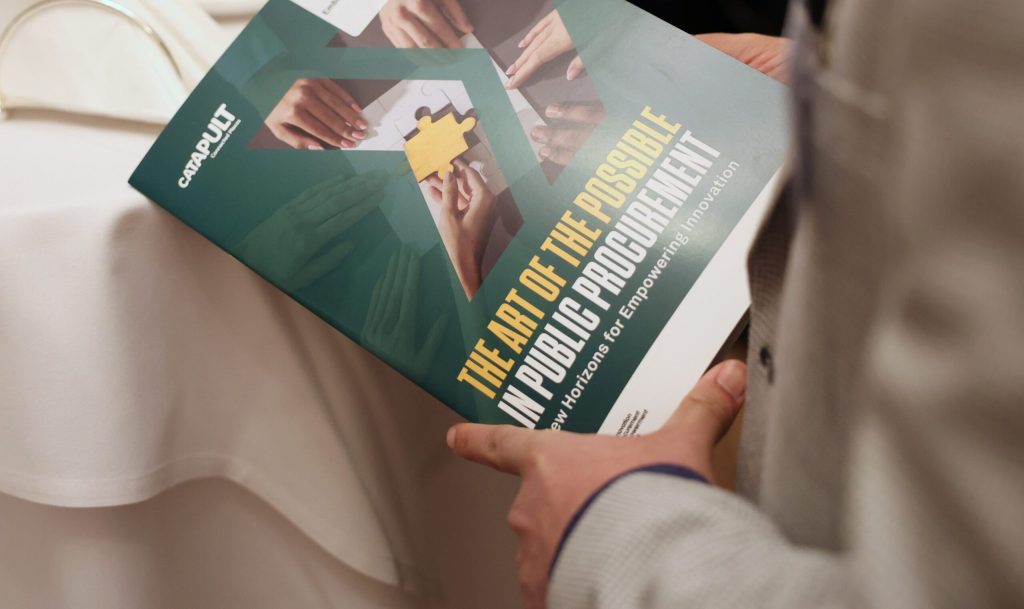
Council leaders, contractors and consultants were among over 200 guests to gather at the House of Lords in January for the launch of ‘The Art of the Possible in Public Procurement’ from the Innovation Procurement Empowerment Centre at Connected Places Catapult.
Here, four procurement specialists closely involved in compiling and promoting the report explain why it makes for essential reading.
Rikesh Shah, Head of the Innovation Procurement Empowerment Centre
“Around £70bn is spent by local authorities each year. The new Procurement Act reinforces the ability for councils to get better value for money with smarter spending.
Every procurement has the potential to generate ideas and economic activity.
By further empowering authorities to understand procurement more fully, we can support more diverse and localised suppliers.
Local authorities face many pressing challenges: from addressing the climate emergency, to social care, security and health. The new Procurement Act builds public sector confidence and know-how, encouraging entrepreneurial approaches to shape and build markets.
Procuring innovation can deliver better, cheaper, quicker and greener outcomes and create new innovative businesses to strengthen UK plc. It can also bring diversity of thought and creativity to solve some of our problems.
Now is an opportunity to build on the progress of recent years and continue to reimagine what public procurement can do to further turn UK to competitive advantage, and be a strategic lever for growth.”
Rebecca Rees, Head of Public Procurement, Trowers & Hamlins and report co-author
“All too often, procurement is seen as a barrier to value, innovation and sometimes common sense. The Art of the Possible sees procurement as a launchpad for innovation, ideas and transformative conversation.
It has been very exciting to help write the report, which focuses on the possibilities that transforming public procurement reforms present to the public sector.
We understand that clients are busy, cash strapped and often nervous about exploring new frontiers; be they new methods of delivery, technologies or even engaging with new market players. The report emphasis a need for clients to undertake key procurement activities whenever possible, including taking sufficient time to plan and prepare for their procurement; exploiting the benefits accrued through intelligent and focused engagement, and demanding challenging outcomes from bidders.
The report also recognises the huge contribution and energy in the innovation agenda provided by small and medium-sized enterprises; who are often most at risk of procurement done badly.”
Julian Blake, Public Benefit Lawyer, Stone King and report co-author
“Problems with procuring innovation can be characterised very simply: many practices demonstrate ‘process’ over ‘purpose’. Focusing too closely on processes can distort the aims and objectives of what an authority is trying to achieve; and the beneficial outcomes of procuring innovation are no longer at the fore. Risk aversion with trying anything new is another issue.
When it comes to procuring innovation, there can be an assumption that the public authority or commissioner knows exactly what they are purchasing. But this is not always the case. The procurement mechanism needs to adapt to inform the public authority what a design might look like – and that means engaging with experts.
When you look at the principles of objectivity that procurement is supposed to realise, you need to think about how you can involve innovation experts at the earliest possible stage, and on a continuing basis. There is nothing in the law that stops authorities from doing this.”
Malcolm Harbour CBE, Associate Director, Connected Places Catapult and report co-author
“Public procurement is a powerful instrument in driving innovation, and is something that many professionals accept – so why has it not been adopted more fully?
This report intends to break some of the myths of procurement, and encourage everyone who is investing public money in a contract to really think about what they want from it. Given the challenges local government is dealing with – constrained budgets, problems in meeting public expectations, dealing with zero carbon transitions, making places more resilient and efficient – we cannot continue doing the same things.
We need to test the market, find people who can solve problems and construct projects in such a way as to bring more innovative businesses on board. This is all about attitude and leadership – and we need political leadership to move forward and deliver this innovation ambition. We cannot allow old perceptions about procurement to continue. Please read the report first before issuing your next tender.”
Rikesh Shah will be speaking at the Connected Places Summit on 20 March asking ‘What does the UK’s Procurement Bill mean for local innovation?’
post
Public spending holds untapped potential to unleash innovation
PRESS RELEASE: Experts explain how new procurement legislation can help public authorities leverage their purchasing power to drive innovation.

Connected Places Catapult, the UK’s innovation accelerator for cities, transport, and place leadership, today published ‘The Art of the Possible in Public Procurement’ – a new report from the Innovation Procurement Empowerment Centre (IPEC).
The report is co-authored by an expert team with experience in innovative legal and procurement processes and was unveiled at a House of Lords reception. It encourages council leaders, innovative teams in public authorities and ambitious businesses to take advantage of the new possibilities – reinforced by the Procurement Act 2023 – that can be used to drive innovation.
With approximately £300bn a year being spent on UK public procurement, public sector organisations have an indispensable role in fostering innovation and supporting ambitious small businesses. Local Government alone accounts for approximately £70bn of that spending which has huge potential to level-up economic growth and productivity in the UK.
The Procurement Act 2023 received royal assent on 26 October. In November, the Cabinet Office produced a guidance note ‘Transforming public procurement: our innovation ambition’ which outlined the intent that, ‘over time these developments will make public procurement into one of the most powerful levers to drive innovation nationally’. The authors of ‘The Art of the Possible’ set out ways in which this ambition can be achieved and how the new rules encourage more ways of engaging innovative companies during procurement processes. They highlight the importance of attracting innovative suppliers; cementing partnerships; ensuring transparency and value sharing; and transformative collaboration.
The report brings principles to life through case studies of procurement best practice, including:
- how TfL developed and incentivised a three-way partnership between carriers, innovators and themselves to reduce the adverse impact of freight with Freightlab;
- how Leicestershire Children’s Services used an innovative two-tier contractual framework to procure solutions that helped to achieve ambitious social and environmental goals;
- and how Staffordshire County Council used a joint tendering arrangement with neighbouring councils to increase their purchasing power and overcome their struggle securing a new sexual health service provider.
The report points to the introduction of the ‘competitive flexible procedure’ as the single biggest change implemented through the 2023 Act. The new procedure gives creative contractors a ‘wider palette of colours’ with which they can design procurement solutions. The authors also highlight the importance of assessment criteria favouring the ‘most advantageous tender’.
They point to wording from the National Procurement Policy Statement, which is included in the Act. ‘All contracting authorities should consider the following national priority outcomes alongside any additional local priorities in their procurement activities:
- creating new businesses, new jobs, and new skills.
- tackling climate change and reducing waste, and
- improving supplier diversity, innovation, and resilience.
Speaking at a reception at the House of Lords to mark the publication of the report, Rikesh Shah, Head of the Innovation Procurement Empowerment Centre at Connected Places Catapult said:
The Procurement Act 2023 reinforces the ability of public authorities to get better value for money by getting smarter with their spending. In recent years, technology has changed at such a rapid rate that new types of innovators are emerging. This is creating a huge opportunity for public authorities to unlock value. Every procurement made has the potential to support a new idea and generate new economic activity. By further empowering public authorities as they get smarter with spending, we can support more diverse suppliers and find more cost-effective, sometimes more localised, solutions to our biggest challenges.
Malcolm Harbour CBE, Associate Director at Connected Places Catapult and former Chair of the powerful European Parliament Internal Market Committee, said:
We all want public money to be well spent. But to maximise the power of every pound we need everyone involved in public procurement to show relentless ambition to enhance the impact of what they spend. We also need to have the courage to try new ways of doing things, and challenge suppliers to respond to procurement processes with fresh thinking.
Mr Harbour, who was awarded the CBE for services to the British economy, continued,
The very best procurement processes set challenging delivery targets, responding to national and regional priorities and stretching the innovative capability of suppliers.
post
Leverage purchase power
PRESS RELEASE: Local authorities spend £60bn a year; they can now apply for fully-funded support to leverage their purchasing power in a way that supports new, innovative ideas.

IPEC is offering fully-funded and tailored innovation procurement support for up to five local authorities. The selected cohort will also benefit from the opportunity to network with and learn from each other as they progress along their innovation procurement journeys together.
The support package will provide expertise from design thinking, market scouting and shaping to running trials, managing change and designing the right procurement processes to help take innovative ideas from the market, successfully scale them and add value.
In addition, the support will consider: how to improve stakeholder relations; SME engagement approaches; ways to overcome organisational and strategic problems; how to discover and shape challenges; attracting innovation; trial support; and risk management techniques.
IPEC is headed by newly appointed Rikesh Shah who was previously Head of Open Innovation at Transport for London for many years where his award-winning Innovation Hub applied different procurement routes to bring in innovation at scale from the market.
Rikesh Shah, Head of the Innovation Procurement Empowerment Centre, said:
UK local government procurement accounts for £60bn of spending each year. Local authorities have a huge opportunity to use this purchasing power to support new and innovative ideas in their regions. By bringing in new ideas from the diverse range of innovators from start-ups, SMEs, scale-ups, academia, corporates and others, it will enable local authorities to deliver faster, better and cheaper outcomes and create new value.
IPEC will help raise local authorities’ confidence and abilities, providing proactive support throughout a live end-to-end procurement process. If you have a desire to procure innovation, resources or sponsorship to speed up a culture shift in your council, and a buying budget to address an innovation challenge – then we would like to hear from you!”
Local authorities have until 15 December to register their interest.

