articles
Show us your demonstrations in the field; investors advise freight innovators
Venture capital and angel investors gave advice to SMEs developing technology as part of the Freight Innovation Fund.

Freight technology specialists seeking investment must make concerted efforts to demonstrate how their solutions work in both the laboratory and the real world, a Connected Places Catapult event heard in February.
Roderick Beer, the Managing Director of the UK Business Angels Association (pictured holding the microphone), told the ‘Showcasing Freight Innovation & Unlocking Business Growth’ seminar that investors “need to see demonstrations operating in the field” so that when it comes to technology, they can “touch it, and get a feel for it”.
Asked what more freight technology SMEs could do to secure investment; he replied they should help the “average angel investor who knows nothing about freight” by “demonstrating the clear problem they're solving” and to “get across to investors the size of the market opportunity”.
Technology is changing many industries, and there are many good opportunities for money to be made in freight tech, Roderick added – but founders need to communicate that well to investors.
“Most early-stage investors are sector agnostic,” he continued.
“The UK is very well supported by angel investors, with about 50,000 individuals deploying over £2 billion each year. But this is an army of generalists; a very small percentage has deep-domain expertise in the areas that founders operate in.”Roderick Beer, Managing Director of the UK Business Angels Association
Panel chair Arnold du Toit, the Founder of investment firm WeSprint and a Connected Places Catapult advisor, concurred that freight technology specialists must “seize the opportunity of getting investors into their labs, into their spaces and provide proximity to real stuff happening”.
He added that from his experience, “this is one sure-fire way to convince investors” to agree a deal.
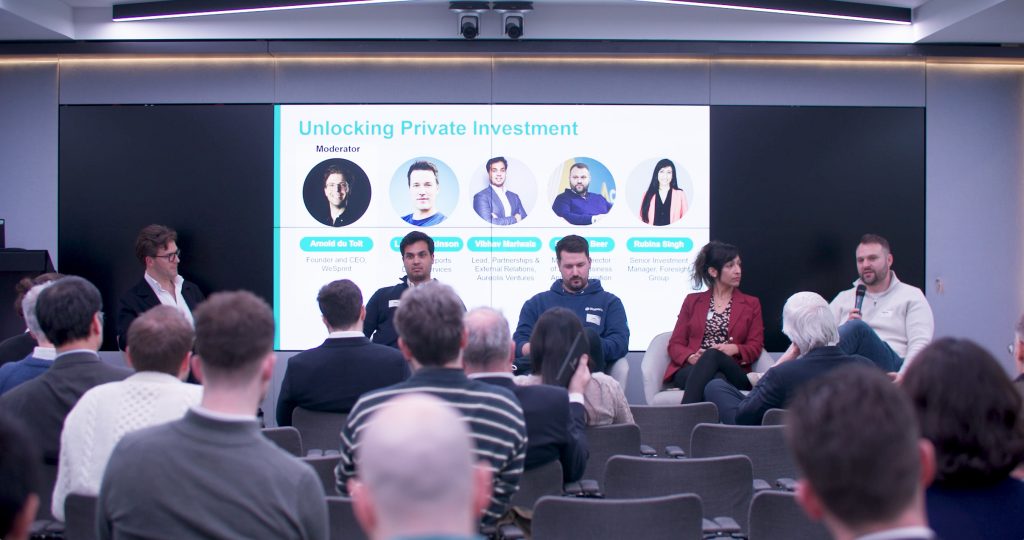
Lewis Dickinson, the Director of Operations of Skyports Drone Services – an alumnus of the Freight Innovation Fund accelerator, delivered by the Catapult on behalf of the Department for Transport – spoke about his company’s experience as an SME seeking funding.
“Investors look for three things: revenue growth, a credible pathway to profitability and an ability to demonstrate long term commercial viability. This is where the role of innovation funding comes in; it allowed us to deploy and mobilise proof of concepts and test them.”
Skyports used a Freight Innovation Fund grant of £150,000 to launch a middle-mile drone delivery service with Royal Mail in the Orkney Islands which, he added, “enabled us to have conversations with investors”.
“The most powerful way forward with investors is showing them real-world stuff,” added Lewis. “We have shown we have started to learn a credible pathway to profitability and demonstrate year-on-year revenue growth. Hopefully, some of that proof of concept will turn into long term commercial viability.”
Also on the panel was Vibhav Mariwala, the Partnerships and External Relations Lead at Aureolis Ventures – an early-stage venture capital firm investing in deep-tech, climate and health in India, the US and the UK.
He said there is much about the UK economy which makes supporting SMEs operating in the freight technology space attractive to investors.
“There are a lot of good accelerator programmes, universities and organisations like Connected Places Catapult who help de-risk investment”.Vibhav Mariwala, the Partnerships and External Relations Lead at Aureolis Ventures
Vibhav remarked that the UK has a healthy pool of start-ups, and “a lot of the climate innovations are shifting towards the UK”. Asked what could increase his appetite for investing in this country, he replied: “One would be opening up the economy more to foreign start-ups” by allowing founders to more easily relocate, and for investors to setup entities with less hassle.
Rubina Singh, a Senior Investment Manager at Foresight Group told the event that technology developments "at the intersection of energy and AI” can be particularly compelling when these convergence points unlock step-changes in efficiency, resilience or cost reduction.
“But at the same time, we are seeing opportunities in optimisation – whether that’s improving energy efficiency, digitising legacy processes, enhancing productivity or reducing carbon intensity.”
She explained that investors often want to understand the key problem(s) that the technology is solving – if there is a compelling need and a large and growing market.

Beyond the technology itself, investors assess the credibility of the team, evidence of customer traction, route-to-market strategy and capital efficiency to help decide, she added, if they want to be part of an SME’s journey.
The panel was speaking at the end of a day featuring showcase sessions from SMEs working with Connected Places Catapult as part of the fourth cohort of the Freight Innovation Fund Accelerator.
Find out more about the Freight Innovation Fund.