

articles
Regional cluster leads discuss what it takes to scale local economies
Ambitions to accelerate local growth were outlined at the Connected Places Summit.
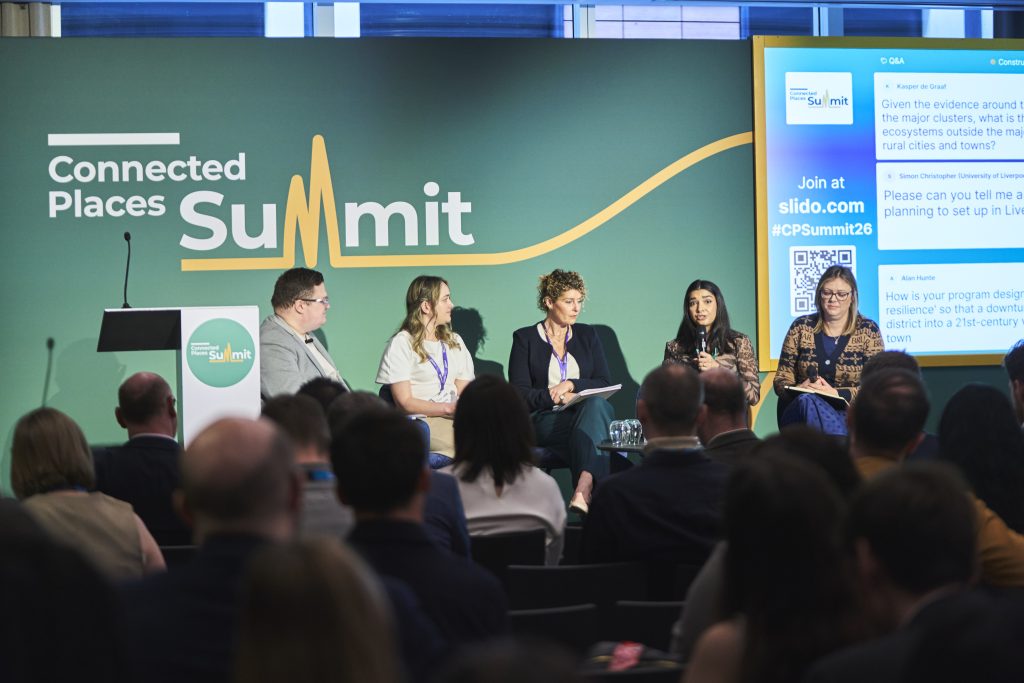
Innovation Districts work because they make the best of a region’s distinct qualities to stimulate business and economic opportunities, delegates to a local growth session heard at the Summit.
But as Emma Frost, the Chair of the UK Innovation Districts Group, remarked “there is no point just labelling somewhere an Innovation District, and no point in thinking you can force one on somewhere”.
She said that Innovation Districts have a clear mission and purpose, good governance, the “right mix of spaces and places”, engaged anchor tenants, and a “deliberate, connective tissue” of shared ambition.
“Innovation Districts have to be built on the qualities and the assets you have: both the physical, hard infrastructure as well as soft infrastructure assets too,” she remarked.

Emily Robson (pictured above) the Assistant Chief Executive of Knowledge Quarter Liverpool – the Innovation District in Liverpool City Region – agreed. “It’s about building on your strengths and delivering a shared vision. The Innovation District we have in Liverpool today is a result of hundreds of years of innovation; it didn't happen overnight.”
She added that successful Innovation Districts have carefully considered which local assets make them attractive as a place to invest and do business, and how that can be developed. The inferior alternative would be to “try to invent something that seems like a good idea, but it won't work in practice; because the ingredients aren't quite right”.
Feeding future opportunities
Sarah Windrum, the Head of Cluster Development for HORIBA MIRA in the West Midlands said the Innovation District she is associated with is not only famed for automotive technology, but is feeding future opportunities.
“Success breeds success. We have a start-up who came to us in 2018 with two people after being introduced through a networking event, and they are now a full-scale manufacturer.”Sarah Windrum, the Head of Cluster Development for HORIBA MIRA
Sarah added that Innovation Districts should also look to collaborate together in the interests of developing sovereign technical capabilities.
“What we do at a national level is important too,” she said. “One of my current pieces of work is developing how best to ensure battery safety – primarily for the automotive industry – but batteries are noted as critical infrastructure in the Government’s Industrial Strategy, so this work is relevant across sectors. Collaboration is how we drive opportunity for UK PLC through innovation.”
Connected Places Catapult’s Head of Regional Delivery, Prabs Johal spoke of the success of the Diatomic and Clean Futures innovation accelerators in the West Midlands, and how the programmes made an effort to reach out to businesses based outside of central Birmingham.
“We lent in to the West Midlands Innovation Board’s priorities, which included supporting the Black Country, and made an active effort to go into those areas where traditionally there's not been much innovation funding.
“We designed inclusion into the programme for year three. Implementing it was tough, but we learnt quickly these businesses need to hear language they understand; not innovation jargon, to support them in scaling their businesses quicker. The impact speaks for itself – not only did the businesses we work with benefit, but the places grew in their capacity to navigate innovation funding themselves.
Prabs added that ambitious Innovation Districts should increasingly focus on scale-up rather than start-up firms, which means tough regional decisions have to be made as to which industry sectors to prioritise.

Prabs (pictured above) added that many Innovation Districts are increasingly focusing on scale-up rather than start-up firms, which means tough decisions have to be made as to which companies to back, and “who we are prepared to stand behind and champion on a global stage”.
Session chair Matt Mason, the Head of Innovation and Skills at The Crown Estate said that regional clusters can help to drive lasting and shared prosperity for the UK. “That purpose requires us to think about broader value than just financial return, and about longer timescales than just the next three-year business plan.
“The science and innovation sector is full of like-minded people and organisations,” he added. “It is a rich community for exploring initiatives and projects that can unlock long-term shared prosperity.”Matt Mason, the Head of Innovation and Skills at The Crown Estate
Read a post event report from the Connected Places Summit.