
articles
Meet the innovator helping construction sites understand nature better
Serial entrepreneur Dimple Patel is leading a successful nature tech business previously supported by Connected Places Catapult and recognised by the Prince of Wales.
Forensic technology commonly associated with solving crime is being deployed on construction sites to map the ecological quality of habitats.
Guildford-based scale-up NatureMetrics is selling environmental DNA (eDNA) kits in 120 countries to clients including Unilever and nature groups WWF and Conservation International. The kits are used to collect samples of soil or water for analysis in a laboratory. The aim is to determine habitat health and receive suggested nature-based interventions, such as conservation or reforestation.
NatureMetrics saw its turnover double to £6.5m after participating in the HS2 Innovation Accelerator, delivered by Connected Places Catapult; and raised £51m of investment in six years, including £20m in 2025. In that time, staff numbers grew from 10 to 133.
Now the company’s Chief Executive, Dimple Patel, is focused on expanding the business in construction, transport, energy and mining; and repeating her earlier successes leading two other start-ups. “Nature decline is happening rapidly, so we need to translate data into action to create positive impact,” she says.
“We're here to make biodiversity measurable at scale, and show infrastructure clients how to work alongside nature. We appreciate that projects have to happen, but want organisations to understand that with the right insights, they can deliver them better and more sustainably.”Dimple Patel, Chief Executive, NatureMetrics
NatureMetrics claims to have the largest eDNA database in the world, covering billions of data points for a huge variety of species. Dimple also says its work can allow environmental interventions to be targeted where required, rather than being introduced across large swathes of land.
HS2 project points the way
For its HS2 trial back in 2021, NatureMetrics measured and compared soil from ancient woodland against soil from a reforestation site to identify the right microbial-rich topsoil to translocate. This approach helped ensure the soil moved from the ancient woodland to the new reforestation site would give it the best chance to thrive.
“Five years ago, biodiversity was somewhat overlooked, so our HS2 project put this issue on people's radar,” says Dimple. “It gave us early validation of the application of eDNA technology in soil, allowed us to develop a soil condition metric, and helped us identify infrastructure as a key focus area.
“Connected Places Catapult was hugely valuable to NatureMetrics when we were first trying to establish ourselves as a serious player in the nature and environmental monitoring space – their work with us gave us the credibility to secure many contracts.”
Two years ago, the company was a finalist in the Earthshot Prize celebrating environmental innovations. NatureMetrics welcomed its founder Prince William to its eDNA laboratory in Surrey to hear about its latest plans around geospatial data, remote sensing and predictive analysis.
Determined to succeed
Dimple grew up on a council estate near Barnsley in West Yorkshire that was largely bulldozed 25 years ago due to high levels of deprivation. Her parents ran a corner shop, the family was targeted by racism and their house was burnt down. English was not her parents’ first language, so Dimple managed the household admin.
She remembers being “the kid that took things apart to put them back together” and “broke many things”. She loved reading, played cricket in the back garden, secured a scholarship to attend a more academic school and studied economics at Cambridge.
Initially, she “never felt more out of place in my life”, before realising the experience “taught me new ways to think” and set her up for continuing her studies at Yale and Harvard.
Dimple wanted to become an engineer, although her dad insisted that engineers fixed cars. She became a trader at Goldman Sachs in 2008, “walking in as people were walking out with their brown boxes”. She was instructed to ‘Go trade, but don’t lose too much money’ but admits to having “little idea what I was supposed to do”.
“I loved the busyness of it all: taking on information, building a plan, managing risk and dealing with the consequences of decisions you've made. But then it calmed down, and I got bored.”
Dimple and her husband left their jobs and – despite not being a fan of the drink – founded Love Coffee, a chain of cafes which acquired cheap space in abandoned town centre buildings.
“This was 2010 and there wasn't a Costa or Starbucks on every street corner. It was a sector you could see was going to grow, especially in a recession where people saved for micro treats rather than going to restaurants.” The chain grew to 37 stores and was sold to a private equity firm just before Covid. While she won’t divulge how much they made, “it got us the house!”
Dimple’s second entrepreneurial venture was an e-commerce marketplace platform called Trouva. She joined as an operations director, learnt how to code and worked with software engineers before becoming Chief Executive; later selling the company to a large online retailer.
She went on to direct a firm providing advice to start-ups, and joined a network advising British Asian entrepreneurs. “I want to support others from underprivileged backgrounds and share learnings I've picked up along the way. My background has always involved hard work, scrappiness and a need to work things out. It instilled in me a level of grit; to be able to dust yourself off and keep going,” she reflects.
Grounds for optimism
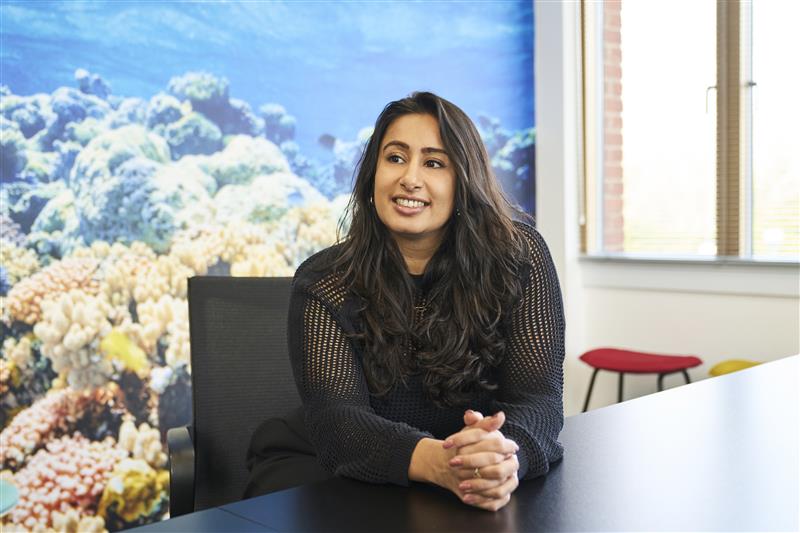
Three years ago, Dimple was headhunted for the role of Chief Executive at NatureMetrics. Her initial reaction was ‘I’m not a scientist’, but she accepted the role after learning she would be building and commercialising a technology platform sitting on top of the science. Plus, she also “fell in love with the product”.
“Growth is always our ambition, but what sits behind it are changing behaviours and creating a nature-positive economy. We would like to see nature-based insights being used to drive financial decisions,” she says.
What dystopia is she hoping to avoid? “If you look at the rate of decline in our wildlife populations over the last 50 years and roll that forward 50 years, we will have wiped out nearly 95% in the space of a century.”
But there are grounds for optimism. “Nature can recover if it’s given the opportunity,” Dimple says. “People also want to do the right thing, and understand how they can incorporate nature awareness into how their businesses operate.”
Find out more about the HS2 Innovation Accelerator and read about the progress of other entrepreneurs and SMEs on the programme.