
articles
Industrialised Construction championed to accelerate housing delivery
Standardising the manufacture and assembly of built environment infrastructure – including housing – is the premise of Industrialised Construction, an emerging approach supported by Connected Places Catapult and discussed at UKREiiF.
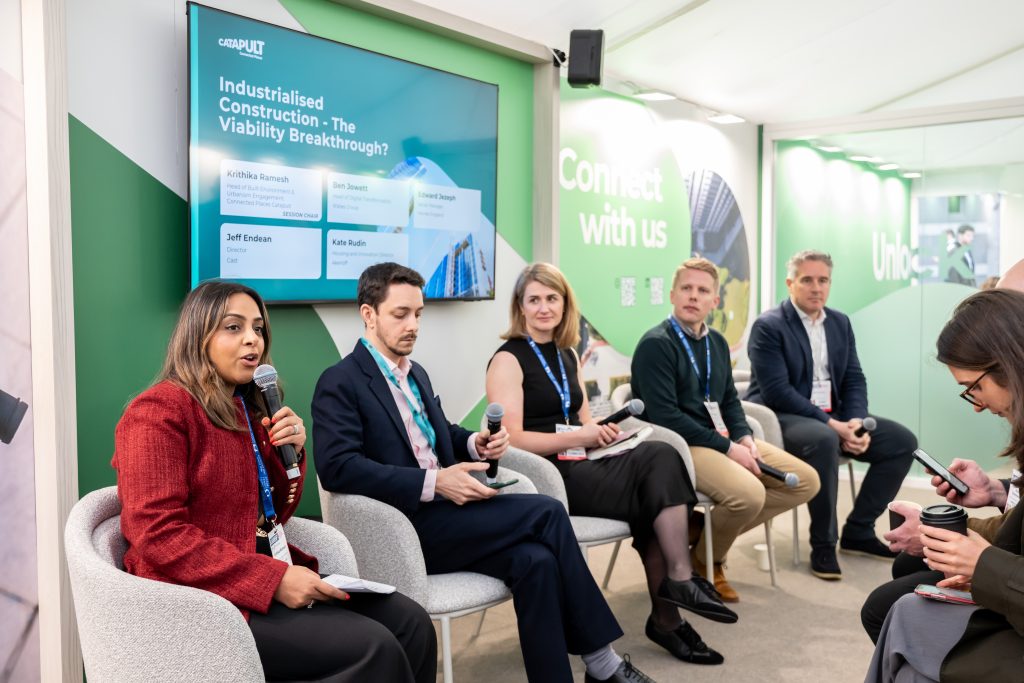
Developers, local authorities and contractors are encouraged to embrace Industrialised Construction when planning and building new homes, delegates to a session in the Catapult pavilion at UKREiiF heard.
The approach involves Modern Methods of Construction and is designed to improve build quality while enabling us to build more houses faster.
Industrialised Construction leverages the opportunities of advanced manufacturing and digital systems – with innovation at its core.
What success could look like
Head of Build Environment and Urbanism Engagement at the Catapult, Krithika Ramesh asked a panel of speakers at UKREiiF for their thoughts on the benefits of Industrialised Construction for housing.
“This is all about better and consistent housing outcomes, rather than simply focusing on off-site construction,” explained Homes England’s Senior Manager, Edward Jezeph. “It's about warm, comfortable homes that are high quality, look good, and are affordable.
“Growth in off-site delivery is a positive thing, and it would be nice to see that scale nationally. We've learned that manufacturing can deliver higher quality programmes more consistently, more sustainably – but previously hadn't found business models that make that work.”Homes England’s Senior Manager, Edward Jezeph
He added that housing innovations seen in the factory can be “very exciting” but that advances in off-site construction risk leaving those on-site behind, including ground workers, planners, building control officers, warranty providers and inspectors.
“They haven't always been closely enough involved as stakeholders in that process,” added Edward. “We've seen some impressive buildings use off-site construction, but we've got to bring everybody on this journey.”
Learning from previous mistakes
Supporters of Industrialised Construction are keen for it to avoid the pitfalls of previous off-site delivery models that have struggled with adoption.
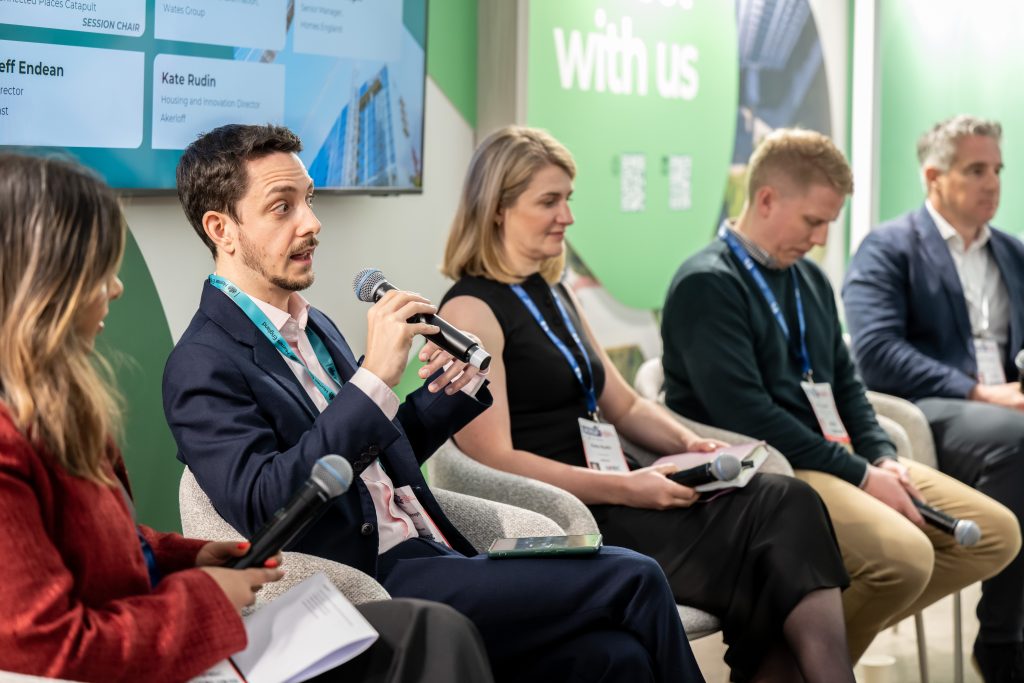
Krithika turned to consultant Akerlof’s Housing and Innovation Director, Katie Rudin to ask why she thought Modern Methods of Construction had failed in the past. “Some elements failed and cost a lot of money, but the sector has also had successes,” Katie replied. “However, those successes tended to be in pockets, and have not had the rules, structures or enabling conditions to help the market to scale.”
She pointed out that if an investor wants to back an Industrialised Construction project to deliver homes at scale, “there are a limited number of factories in the UK that could help right now.
“We need to look at what infrastructure is required to connect the system, to provide an investible pipeline, so that people have certainty and confidence in the demand coming through; not just in terms of numbers of houses, but the types of houses, and when they can expect the orders to be made.
“We've got the parts; it's just the parts aren't connected together in a way that enables the ecosystem to thrive. People are off doing great work, but in silos, and at a project, rather than an industry level.”Akerlof’s Housing and Innovation Director, Katie Rudin
Katie spoke of the £85 million investment by UKRI in the Industrialising and Digitalising Construction Challenge (IDCC) that will deliver its first pathfinder in Liverpool. The programme will deliver a digital marketplace for construction, starting with social housing delivery. This model could them be rolled out to other regions and sectors across the UK.
Digital maturity uplift
Building services engineering and technology company SES’s Head of Digital Transformation, Dr Ben Jowett was asked what needs to change for Industrialised Construction to be preferred over traditional construction.
“An uplift in digital maturity throughout the whole industry is what's going to make the change stick and be long lasting,” he replied. “It doesn't have to be a wholesale ‘let's build the whole thing in one factory’. Where the industry is headed is in the connectivity of things.”
Ben explained that this is already being seen on some projects; such as where a third-party supplier is delivering precast concrete, and both the supplier and main contractor databases are integrated together to provide near real-time manufacturing insights. “This seamless transfer of data means we know when something is leaving one factory and coming to another location, such as the construction site. This is about creating an environment where data and information can flow between participants in a value chain.”
Companies who are more digitally mature can innovate quicker, deliver quicker and be more predictable in their outcomes, he added. “And when you zoom out, what is Industrialised Construction aspiring to achieve? A reduction in risk and variability, increased predictability, and at a manageable cost. If we don't create the right conditions, we'll never reach this.”
But one thing is true of both industrialised and conventional construction, he added, and that is late engagement. “The sooner you engage with the delivery capability, the better the outcome.”
Incremental change predicted
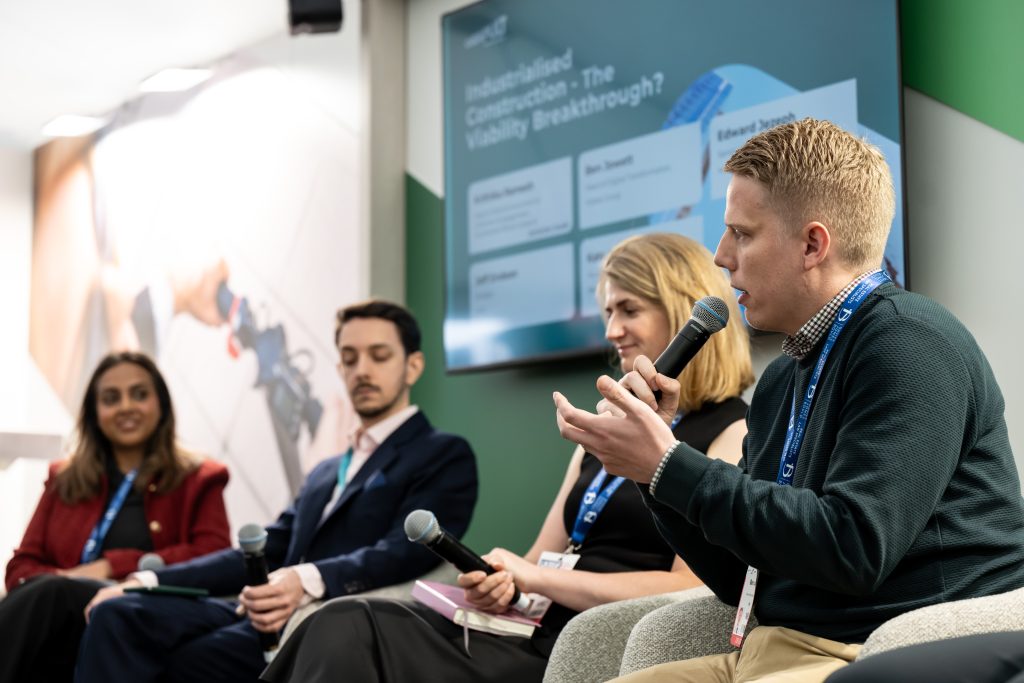
Jeff Endean, the Director of residential and construction consultant Cast, said adoption of Industrialised Construction is unlikely to arrive ‘with a big bang’ and is more likely to happen incrementally, with “more and more bits of buildings being made off-site – the bits that really add value.
“Then we need to work out how to make that efficient in a factory.” But, he added, “we're always going to have an on-site workforce”.
Jeff spoke of the West Midlands Advanced Construction Cluster involving five manufacturers of steel frame systems who work together to verify their products and approach clients through a regional supply chain.
“That’s how we are going to scale things. Our cluster has some large companies, but no single manufacturer can scale this alone, which is exactly why the cluster model works.”Jeff Endean, Director, Cast
Read more stories from Connected Places Catapult about Industrialised Construction.
A further story from inside the Catapult pavilion at UKREiiF can be read here.