
Local approaches to public procurement under the Procurement Act 2023
Public procurement is a powerful lever for shaping local economies, yet it is still too often treated as a compliance exercise rather than a strategic tool.
Public procurement is a powerful lever for shaping local economies, yet it is still too often treated as a compliance exercise rather than a strategic tool.
This two part research series from IPEC, authored by Conrad Parke of the Centre for Local Economic Strategy, explores how procurement can be used more deliberately to support SMEs and social enterprises, strengthen local supply chains, and deliver wider social, economic and environmental value.
The research is set against the introduction of the Procurement Act 2023, in force from February 2025, alongside the updated National Procurement Policy Statement. Together, these reforms create a stronger policy framework that encourages more proportionate, accessible and outcome focused procurement. However, the Act remains permissive rather than mandatory, creating a real risk that progress will be uneven and opportunities missed.
Part 1 Local approaches to public procurement – Birmingham Anchor Network revisited revisits earlier IPEC research on practising innovation in public sector procurement and examines how the Birmingham Anchor Network could take a shared, place-based approach to implementing the new legislation. Drawing on a cross institutional roundtable held in April 2025, it sets out the case for greater coordination across anchor institutions, including clearer definitions of barriers faced by SMEs and VCSEs, shared ambitions for local spend, and a more consistent understanding of what proportionate procurement means in practice.
Part 2 Local approaches to public procurement – evidence from local procurement practices complements this strategic perspective with a practical focus on what can be done now. It presents real world case studies that show what is lawful, workable and already delivering impact, including the use of reserved contracts, contract lots, and the direct embedding of social value into contract design. These examples demonstrate how targeted changes to procurement practice can reduce risk aversion, build confidence, and unlock immediate benefits for local economies.
Taken together, the two briefings show that meaningful change does not need to wait for system wide reform. How contracts are designed matters as much as how much is spent, and smarter procurement can play a central role in driving inclusive growth, strengthening local markets, and accelerating progress towards net zero.
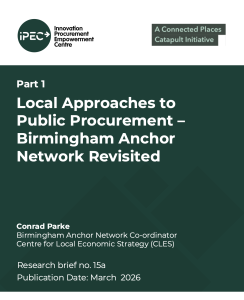
Local Approaches to Public Procurement – Birmingham Anchor Network Revisited
File type: pdf
File size: 2.07Mb
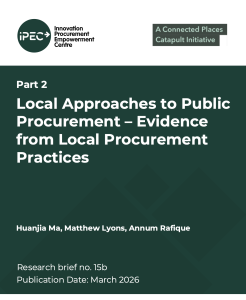
Local Approaches to Public Procurement – Evidence from Local Procurement Practices
File type: pdf
File size: 1.85Mb
Related articles