articles
Recycled materials firm set to 10x production
Plastics recycling specialist Circular11 is preparing to increase output by an order of magnitude, following support from a roads innovation accelerator delivered by the Catapult.

A materials innovation company that started five years ago inside an old bread delivery van has expanded enormously. The firm is now about to move into a large warehouse and employs 13 people.
Ben Gibbons and business partner Connor Winter are co-founders of Circular11, a waste plastics re-processing company based in Dorset, and expanding into Hampshire.
During the pandemic lockdown they shredded, washed and tested waste materials and created a small manufacturing line inside the bread van nicknamed Hovis.
Within two years, their operation moved to a workshop, and the pair introduced ‘advanced process controls’ – using machine learning to optimise output from the production line, which turns mixed plastics into valuable commodities.
This spring, the scale-up business will move into a 34,000ft2 warehouse – 11 times the size of its current facility – and look to increase its throughput six-fold over the next six months, and nine times by the end of the year.
Circular11 took part in National Highways Accelerating Low Carbon Innovation programme two years ago, delivered by Connected Places Catapult.
“The trial helped us to develop our team and capabilities, which led us to continue to grow,” says Ben.
“We wouldn’t have had the critical momentum with key customers without support from the Catapult. The programme made a big difference in terms of our survival as a company. We've had lots of support along our journey in terms of investor introductions and preparation, and the Catapult team has always been very proactive.”Ben Gibbons
Scaling up production
Circular11 works with recycling centres, councils and large businesses to receive waste plastic, and produces plastic ‘lumber’ (large planks and poles) for use in outdoor applications like furniture, as well as decking and fencing for clients such as National Highways and other infrastructure companies.
To meet demand, the company’s production line recently increased its operational hours from eight to 16 a day, and the firm is doubling its headcount.
“We are ready for a very significant scale up in production,” says Ben. “We decided to expand from producing end products made from our material, to producing and selling the material itself to other people who make products from it. By shifting up the supply chain, we changed our business model and entered high volume production.”
Ben adds that the company is in talks with several infrastructure providers about other kinds of outdoor applications its material could be used for as a replacement for timber.
He says his company’s plastic alternative has a similar texture to timber, but will likely last three to five times longer.
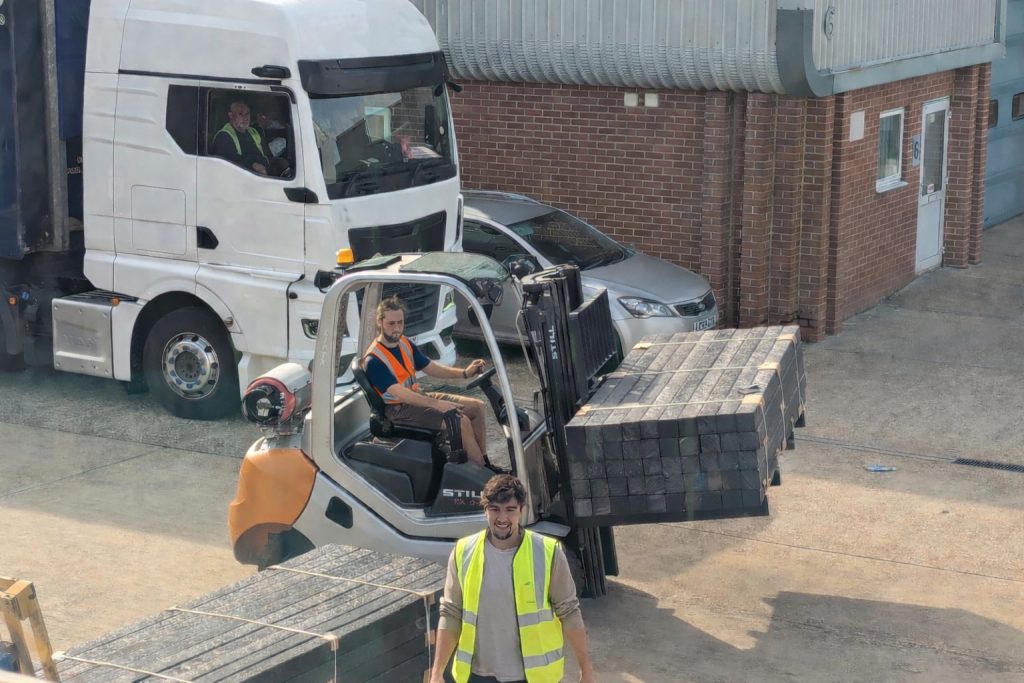
Making good use of waste plastic clearly reduces the quantity of the material being incinerated or buried in the ground. But it also helps to fill an expanding gap in the market to help keep pace with soaring demand for timber. Added to this, an overharvesting of timber is said to be degrading the quality of global stocks.
“We want recycled plastic to become the dominant material of choice for outdoor applications,” he adds.
Changing customer demand
Ben says last year was fairly pressured for the company to maintain cash flow and ramp up production. This year the focus is on scaling-up production and “having the resources to start executing on our plans. We're excited about the next nine months”.
Last year the company took part in a trade mission to Japan with Connected Places Catapult to understand how the country recycles its waste, identify opportunities for using new technology, and make connections to understand the scale of future applications.
“There's going to be an important requirement to find new ways to make plastic waste a critical feedstock to meet the resource challenges we're facing in the 21st Century. An important shift needs to happen in the way in which waste plastic is used.”
The end product needs to become “so sophisticated and technologically advanced”, he adds, that customers seek out plastic-based construction materials.
“We need to make products that are better than the incumbent materials, and that's a challenge. But we are helping to pave the way in how these low-grade plastics can be put to better use.”
From the archive: read more about Circular 11 and its work with the Catapult from two years ago.