Helping blind people navigate stations with technology
WeWALK is to showcase its Smart Cane and assistance system for visually impaired persons at InnoTrans in Germany, alongside Connected Places Catapult.
September 11, 2026
Tens of thousands of blind and partially sighted people in 60 countries already make use of an intelligent walking cane and interactive support service offered by WeWALK, to navigate transport hubs and public spaces with confidence.
Now, the technology specialist is making efforts to expand its global reach further after securing £660,000 of investment; bringing its total private equity raise to £3.5 million.
Later this month, the company will demonstrate its technology at the InnoTrans show in Berlin, alongside two other firms also supported by Connected Places Catapult.
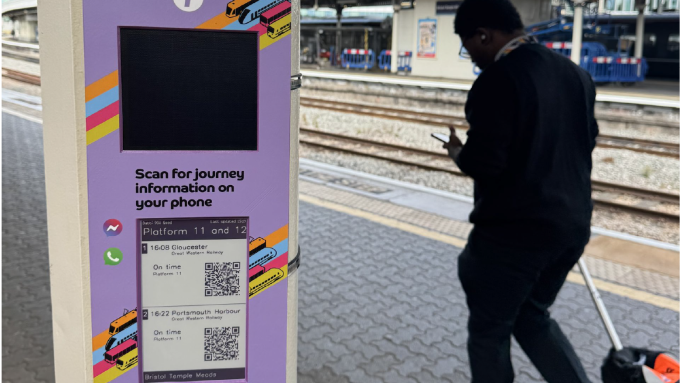
WeWALK took part in the Station Innovation Zone at Bristol Temple Meads, delivered by the Catapult in partnership with Network Rail and funded by Innovate UK, to test its systems in a live station environment. This summer, it joined the programme’s scale-up accelerator.
“The Station Innovation Zone helped us take a good idea from a user’s perspective and pair that with a transport operator’s requirements.”
Jean Marc Feghali, Chief Innovation Officer of WeWALK
“The programme gave us great learning, and provided the evidence we needed to approach Transport for London, who hosted trials with us in May 2025,” he adds. Twelve volunteers were invited by the Royal National Institute of Blind People (RNIB) to test the technology on their door-to-door journeys, while using one of two Underground lines.
“Visually impaired participants were able to traverse stations with just their smartphone and cane, offering them greater independence,” explains Jean Marc. “This trial came about thanks to our work with the Catapult.
“We now want to expand the business through the scale-up accelerator, and meet more international organisations to discuss further deployments.”
Smart Cane technology explained
WeWALK launched the second iteration of its Smart Cane at the start of last year. The cane features an obstacle detection sensor that causes the handle to vibrate and emit a beeping sound when a user gets close to surroundings including low hanging branches, revolving doors or bollards.
A smartphone app paired with the cane can be used to pre-programme a walking route, and connect to Google Gemini, so users can have questions answered about onward transport connections in 20 different languages. A flashlight can also be activated to provide added visibility to other road users.
A further aspect of the company’s offer is a service called WeASSIST, where users connect to a human agent trained by the RNIB to offer help through a video call; guiding users through a public environment.
Demonstration of the service in Japan
Connections with the Catapult
WeWALK first started working with Connected Places Catapult through the Future of Air Mobility accelerator. It tested its smart white cane at Gatwick airport, where volunteers were asked to navigate between the railway station and their check-in gate.
“The Gatwick trial was extremely helpful, allowed us to progress the technology and lay down the foundations for how agents should be trained.”
Jean Marc adds that the technology was named as a finalist in this summer’s McRobert Award for innovation from the Royal Academy of Engineering.
He explains that not all users will require the service all the time when travelling; customers can request assistance half way through their rail journeys. “Some users don't need a member of station staff to walk with them from the gate line all the way to the train; a lot of people only want to ask for help when they need it.
At present, all UK customers of WeWALK are individuals, but transport operators are able to enter commercial agreements. This would allow the service to be promoted widely, and be offered free of charge in specific locations – much like a public WiFi service.
Jean Marc adds that in Germany, the service is supported by a national healthcare insurance scheme; which pays for access to users prescribed the service by doctors.
He adds that several members of the company’s senior leadership team, including himself, have lived experience of visual impairment. “If the technology doesn't work for us, it's not going to work for the wider community.
“We want visually impaired people to have all the choice they need to travel independently, and inspire professionals to make public environments better for everyone.”
WeWALK and two other programme participants on the Station Innovation Zone scale-up accelerator – Createc and Journey Alerts – will be exhibiting in the UK Pavillion (stand 560G) at InnoTrans 2026 from 22 - 25 September.
Journey Alerts will showcase its passenger assistance technology at the InnoTrans event in Berlin, after joining a Station Innovation Zone scale-up accelerator programme delivered by Connected Places Catapult.