articles
Faster trains trial promotes freight switch from road to rail
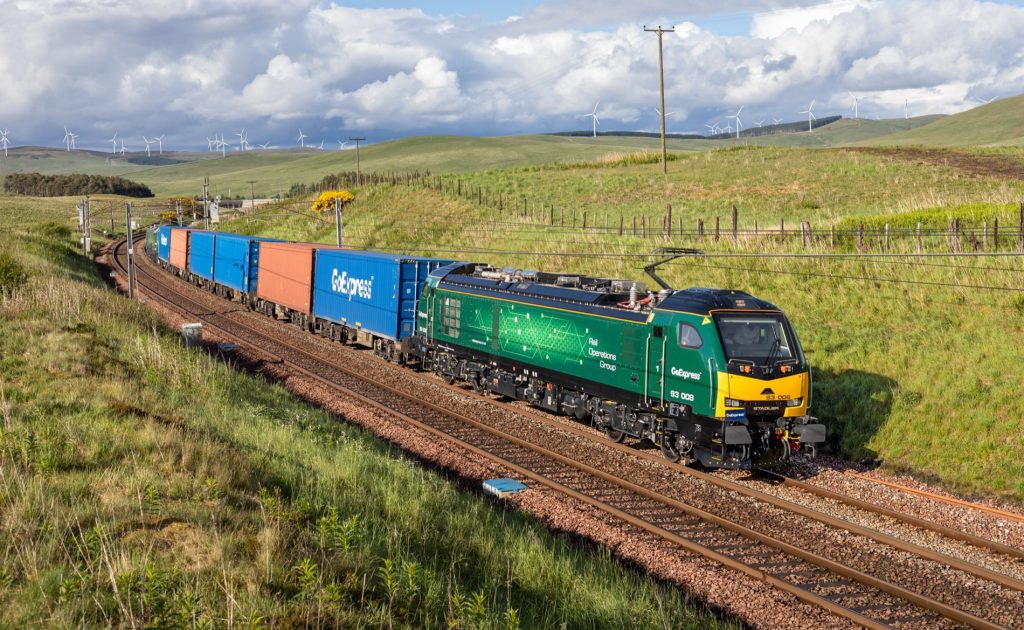
Freight train speeds were increased to 90mph on the West Coast Mainline in a pioneering carbon and time saving logistics demonstration earlier this year.
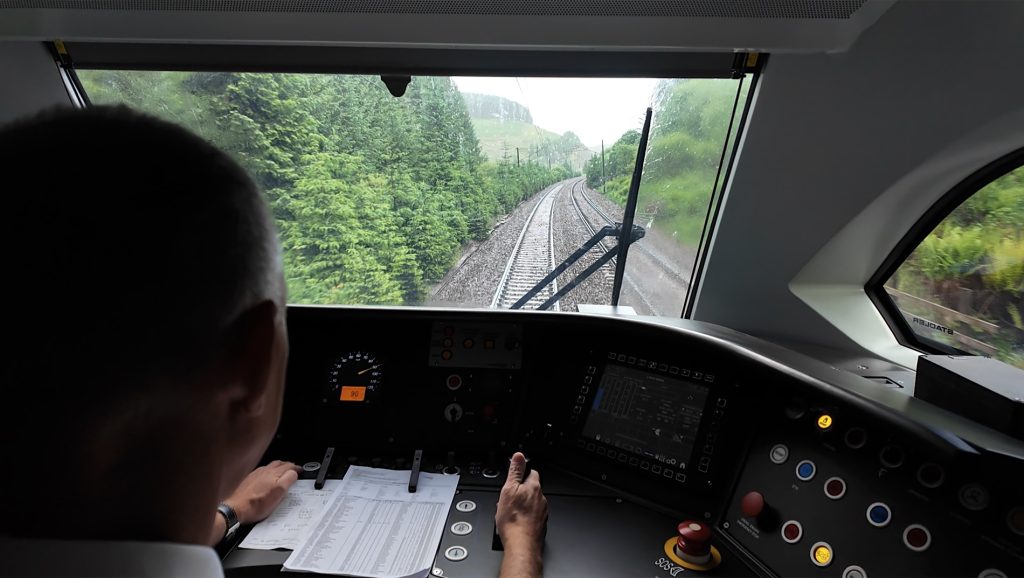
Rail freight journey times between the Midlands and Glasgow were slashed by half, in a four-week trial of a new high-speed service.
The demonstration on the West Coast Mainline (WCML) by logistics operator GoExpress saw 40ft high cubed intermodal containers travel at up to 90mph – up from the 75mph limit of conventional container trains – helping to reduce the rail transit time for the 315 mile journey from nine hours to just four hours and thirty minutes.
Carbon emissions associated with hauling goods using an electric locomotive compared to road for the so-called ‘middle mile’ of the journey were said to be 95% lower than conventional heavy goods vehicles (HGVs) using the motorways, and with 58% lower energy consumption than the cleanest electric trucks.
Over the course of a year, regular services could lead to a reduction of 3,120 HGV movements on the M6, with faster freight services leading to one additional train path every hour on the WCML.
The proof-of-concept operation saw 54 test trains run on dedicated high-speed paths provided by Network Rail and was supported by the Department for Transport (DfT) through the Freight Innovation Fund (FIF) programme, which is delivered by Connected Places Catapult.
The customer for the trial was parcel delivery firm DPD UK which operates hubs close to either end of the rail route at Hinckley in Leicestershire and Mossend Euroterminal in North Lanarkshire. Trial partners included the Rail Safety and Standards Board, Network Rail, Freightliner, Birmingham and Huddersfield universities, and Rail Operations Group.
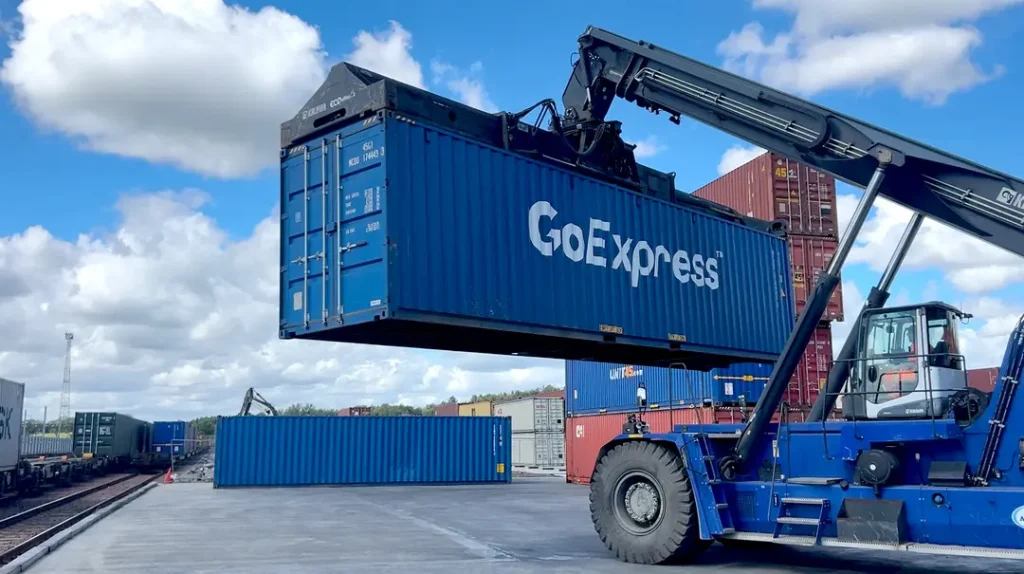
GoExpress has also created a digital system to allow simplified booking of slots on the service, and real-time container tracking across road and rail.
“Express logistics has always existed with a hard trade-off on the middle mile: speed, cost, or carbon,” says GoExpress Chief Executive, Adam Parkinson. “Our trial shows us that operators can rapidly optimise their middle-mile networks through the introduction of high-speed rail.
“For operators under pressure to take time, cost and carbon out of their networks, our high-speed containerised middle mile offer is now a proven, commercial option which can complement and speed up the rollout of electric HGVs.”Adam Parkinson, GoExpress Chief Executive
Connected Places Catapult’s Transport Managing Director, Sameer Savani said: “GoExpress is showing impressive traction in the rail freight sector and this trial helps to validate its commercial offering. This is a great example of how targeted support and funding from the Government's Freight Innovation Fund is helping businesses to succeed in bringing new solutions to the market, faster."
Earlier this year, the UK Government reaffirmed its support for at least a 75% increase in rail freight by 2050. According to official statistics, the railways currently moves around 8% of surface freight.
In September, the Government went further, announcing a new ambition for rail freight growth, targeting at least a 40% increase by 2040. “GoExpress has done what the sector has talked about for two decades – turned a faster logistics train into a real, repeatable commercial service,” says Network Rail’s Systems Operator, Anit Chandarana.
“These results give policymakers, infrastructure managers and customers the evidence they need to back high-speed logistics as a serious lever for both decarbonisation and growth.”Anit Chandarana, Network Rail Systems Operator
GoExpress is now working towards building regular 90mph middle-mile rail based transport network, in association with express logistics operators. The start-up company was founded in 2025 and aims to become a market leader in moving time-critical goods at speed using rail, and integrating with road-based networks and express logistics hubs.
Find out more about the Freight Innovation Fund accelerator