
articles
Energy storage firm sets its sights on success
Catapult-backed H2CHP is securing investment and growing its customer base for shore-side energy generators used in maritime applications.
It may have an “unconventional name” but a co-founder of fast growing clean energy specialist H2CHP has high hopes that his business can become a leader in renewable technology.
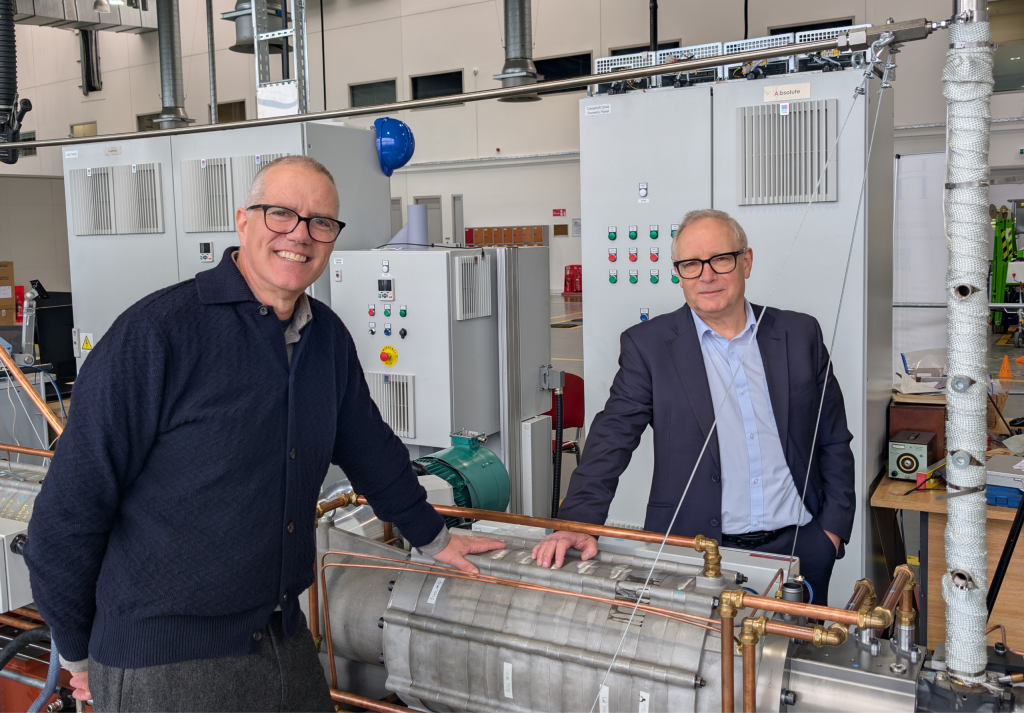
Stephen Hampson, pictured left with Professor Tony Roskilly from Durham University, says the business – which is currently trialling multi-fuel electricity generators for port applications – aims to identify customers who make repeat orders of high value units valued at around £1 million each.
Earlier this year, the company raised £1.5 million to develop operations including a £700,000 Innovate UK grant, and equity funding from investors including Blackfinch Ventures and the North East Spinout Inspire Fund, managed by NorthStar Ventures. Very soon, H2CHP will embark on an even larger investment raise.
The company recently took part in its third Connected Places Catapult-led programme called the Hydrogen Innovation Initiative to develop its offer; following participation in the Transport Research and Innovation Grants programme and the Clean Transport Accelerator: Maritime.
Within two years, the company took its product from a Technology Readiness Level of three (proof of concept) to seven (prototype demonstration in an operational environment).
“The three programmes helped us to build our networks and contacts, write a business plan and get through our latest funding round. Without the Catapult, it wouldn't be too much of a stretch to say the company may not be here.”Stephen Hampson, co-founder, H2CHP
“Now we want to build a unicorn company and employ thousands of people. Obviously, we've still got to pull that off, but we have seen a shift in our motivation and ambition.”
Much progress in a short time
H2CHP span-out from Durham and Newcastle universities four years ago to develop a hydrogen-to-electricity linear generator. The system provides an alternative source of heat and power for industrial and transport uses, such as clean energy port-side applications in the maritime sector that might suffer from grid capacity constraints.
Each generator can provide around one megawatt of energy, and make use of not only hydrogen as a fuel but ammonia or methanol too. “The real objective is to displace fossil fuel generation, but the added benefit is we're doing it in an incredibly highly efficient, low emission way,” adds Stephen.
Ships typically arriving into port have to keep their auxiliary engines running to provide electricity for cranes, ramps and lighting. But by using a series of shore-side generators, the vessels could switch off their engines and plug into the modular units to avoid generating emissions and pollution.
“H2CHP is such an unconventional name,” says Stephen. “It was the original name of our university project, and we just carried on with it. The H2 stands for hydrogen, and CHP stands for Combined Heat and Power. It’s not even easy to say!”
Within four years, the team created four prototypes of its linear generator. “Every time I visit the university and see the little machine we developed then and what we have now, I’m struck by the difference,” says Stephen.
“As you move from experimental test rig to building a commercial unit, there is more to it than just scaling up in size; you need to produce something that a customer wants. This is where the TRIG programme proved useful for us; allowing us to perfect the design and refine it based on market feedback.”
He explains that the Clean Transport Accelerator: Maritime provided helpful industry connections offering advice, and helped the company to develop the technology further. Following this, the Hydrogen Innovation Innovative (HII) programme led to a demonstration of its linear generator at CEME – the Centre for Engineering and Manufacturing Excellence – in east London.
“HII was transformational, because the demonstration led to interest from investors, and probably got us our first customer.”
Speaking up with authority
Stephen says the most valuable aspect of his engagement with the Catapult has been through the industry connections it has opened up. “We have spoken to people who we would have otherwise struggled to get in front of, and we can now speak with authority about how our generator will help with charging,” he says.
“The moral support has also been helpful, when we have been trying to raise money and engage with customers. The advisors involved in the programmes were superb; coming out of those conversations made us want to push harder.”
Stephen’s broad aims of developing the linear generator are to see efforts to decarbonise energy generation become more effective, show a better transition pathway for cleaner fuels, and to create an abundance of available renewable energy.
“There are plenty of natural gas generators available that do a really good job of creating electricity at low emissions. But we’re disruptive because we run on hydrogen, ammonia, methanol – all these other fuels that other people can’t run on very easily.
“I often describe my journey as both an academic founder's dream and nightmare in trying to change the world. I believe that if you've got the skill set, you should use that to make a difference for the benefit of society, and not just yourself.
“As engineers, we want to make a difference – and I want to make an impact.”
Find out more about the Hydrogen Innovation Initiative, visit the HII website, the Transport Research and Innovation Grants programme and the Clean Transport Accelerator: Maritime.