

articles
Electric vehicle app helps free-up bays for charging
Driver frustration over blocked charging bays can be eased with an app and client dashboard that were refined and taken to market with support from Connected Places Catapult.
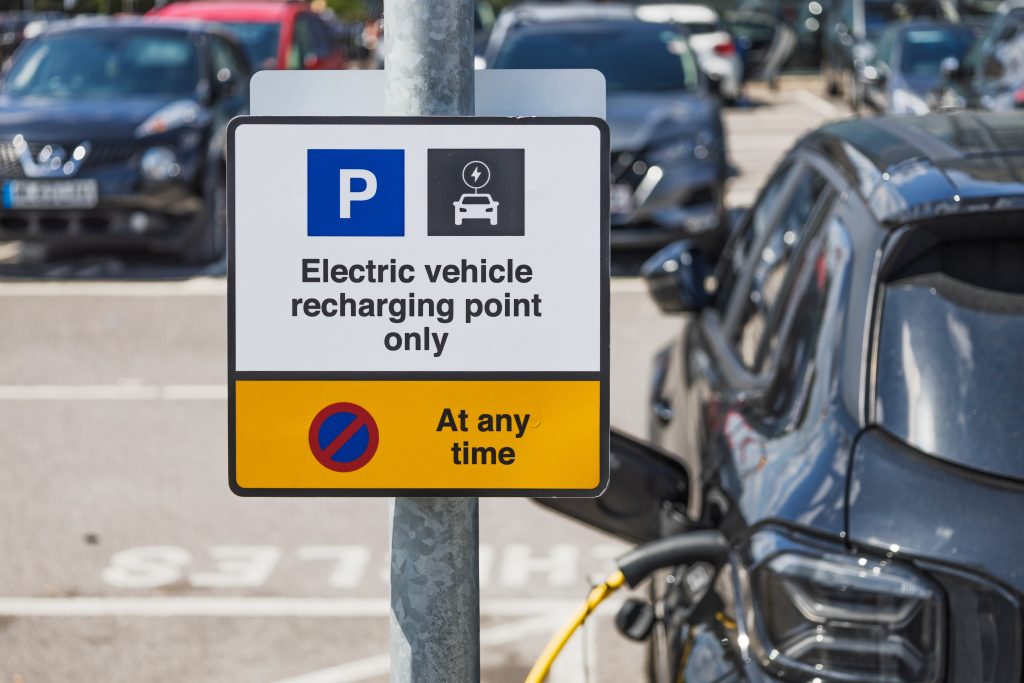
Many electric vehicle drivers know only too well the irritation of arriving at a public charger and for it to be occupied by a car or van not using the facility.
In the most extreme case seen by consultant battery chemist turned entrepreneur Dr Euan McTurk, one public charge point in south London was reportedly occupied by an abandoned vehicle for a whole year.
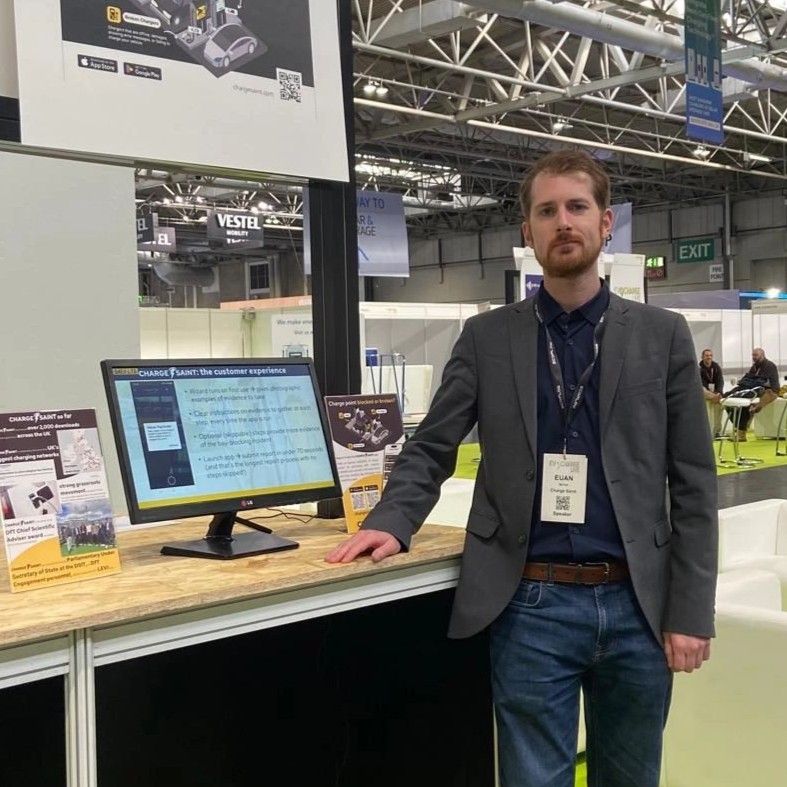
To help reduce the angst for electric vehicle drivers – and increase the use of chargers, making them more profitable for operators and local authorities – Euan co-founded tech firm S4EV three years ago and developed a smartphone app called Charge Saint.
In 2024, the company took part in the Transport Research and Innovation Grants (TRIG) programme, delivered by Connected Places Catapult on behalf of the Department for Transport to launch the product and conduct a four month trial. This was followed by S4EV receiving an award for the ‘Project with Best Growth Potential’ at a showcase event in Birmingham, celebrating the tenth anniversary of the funding programme.
As a result of the TRIG programme, the company’s app and client dashboard progressed on the nine-point Technology Readiness Levels scale from a four (basic validation in a laboratory) to a seven (prototype demonstration in an operational environment); and from a two (formulation of concept) to a four in terms of back office integration.
“Without the TRIG grant, we would not have been able to launch the app, spread the word and gain the success we've had so far,” says Euan.
“As a direct result of the programme, we've been able to gather data and useful insights, and held a very constructive trial with operator EZ-Charge in Oxfordshire.”Dr Euan McTurk, co-founder, Charge Saint
Following the trial, a second charge point operator – char.gy – agreed last year to make use of data from the app to monitor its network of over 3,600 on-street charge points in the UK. “It was 100% as a result of TRIG that we secured that second partnership,” Euan adds.
“The second trial allowed us to get out there and test the waters with a mainstream electric vehicle audience. The positive feedback we're getting from across the UK shows we are on to a winner. People are keen to use the app, and there are some prolific reporters of issues with charging bays – and rightly so.”
Easy reporting on a trio of issues
The Charge Saint app allows users to take photographs and log details of petrol or diesel vehicles parked beside an electric charger; something the company terms ‘ICE-ing’ as it involves cars or vans with an internal combustion engine.
Users are also encouraged to report instances of ‘bay-hogging’ by electric vehicles that are parked up but not plugged in, as well as chargers that are broken or not working properly. The app then sends images to a cloud server and provides them with geolocation details and timestamps. It also runs an AI algorithm to establish whether vehicles in the images are electric or not, and whether signage next to the chargers clearly state if the bays are for electric vehicle charging only.
Euan says the process of logging an issue and submitting a report takes no longer than 70 seconds – far quicker, he offers, than it would take phoning a customer help line.
The number of reports of bay blocking or faulty chargers received in the first three months of the char.gy trial was matched over the following three weeks; pointing towards, he says, the increased popularity of the Charge Saint app which has been downloaded thousands of times and created over 1000 reports.
Councils or owners of private land (such as supermarket car parks) who sign up to the service can then take appropriate action against vehicles blocking charging bays. Depending on the regulations governing a particular location, this could mean sending drivers a penalty charge notice in the post, or dispatching a traffic warden to site.
“We can instantly let parking managers or traffic wardens know of an issue, so they can redirect resources and catch a vehicle in the act,” says Euan who adds that its technology acts as an “extra pair of eyes on the ground”.
The focus now for the company is to encourage charge point operators, car park owners and local authorities to sign up in order to receive parking data automatically and fix issues faster. “Lots of them are singing our praises, and several discussions are ongoing about doing business with them.”
Born out of rural frustration
Euan has been driving electric cars since 2009 and has experienced first-hand the difficulties with public charging infrastructure in the UK, particularly in Scotland. He recalls a road trip to the Isle of Skye when he arrived at a remote rapid charging station but found both bays blocked: one by a petrol car and the other by an electric vehicle that was not charging and was overstaying its welcome.
“We just about made it back to our cottage with 6% left in the battery, which wasn't ideal,” he says. “I was aware this was an issue that electric vehicle drivers were having because they were constantly posting on social media groups; but nothing was being done about it. Officials who could do something about it weren't seeing it. So we came up with a far more discreet, anonymised and faster way to get this information through to the right people.”
Euan and co-founder Colin Balfour developed the app in conjunction with a team of developers but required funding and support from the TRIG programme to complete it. “There’s a risk we wouldn’t have launched the app without it; TRIG was crucial," says Euan.
“The speed and proficiency with which key personnel from Connected Places Catapult answered questions and helped us to engage with the wider market made sure we were doing things the right way, and not accidentally designing ourselves into a corner and doing something that couldn't be exploited fully.”
“Doors were opened within key Government organisations, including the Department for Transport, by TRIG that weren't previously open to us, and they remain open to this day.”
Read more about the Transport Research and Innovation Grants programme.