
articles
Concrete truck tech developer lays foundations for growth
Construction clients are embracing digital systems to monitor the condition of concrete arriving on site. One technology firm offering tools to keep concrete in spec is Cloud Cycle, which took part in the HS2 Innovation Accelerator.
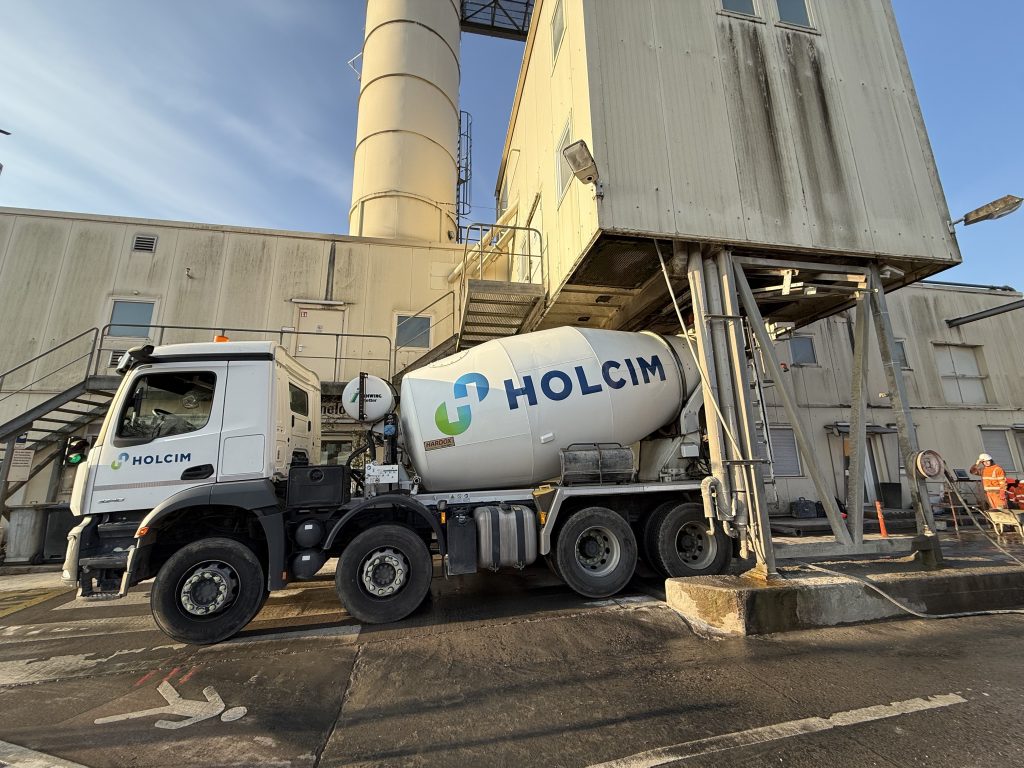
Over 500 ready-mix trucks in nine countries are now fitted with sensors and software developed by a UK firm supported by Connected Places Catapult; ensuring the concrete is in perfect condition when arriving on site.
Cloud Cycle, based in London, has seen turnover grow more than 10 times and headcount double in two years.
Last year, the company secured £4 million from venture capitalists and angel investors to scale the business, and by the end of 2026 expects to have 1000 sensor units fitted to concrete trucks around the world.
Monitoring concrete in transit between batching plant and site allows for adjustments to be made to individual deliveries – such as adding water to the mix to ensure it meets site requirements. But even more value is derived from using a dataset to identify mixes that can be optimised to reduce cement, cost and carbon.
“The world produces 4.4 billion cubic metres of concrete a year, and the material represents about 8% of the world's CO2 emissions; but around 5% of concrete arriving on site has to be turned away.”Russell Elfenbein, Founder of Cloud Cycle
“We built our product to eliminate waste and optimise mix designs, and that is only economically viable if you remove the need for expensive and time-consuming manual testing.”
Russell started Cloud Cycle six years ago after previously working in construction, engineering and project management. “One of the biggest problems I found was the massive time and effort required to manage the quality control of concrete properly.
“Without a product such as ours, there's a black hole of visibility; once concrete goes into the truck, the process control ends. But concrete is not a simple material; it changes over time and involves complex chemistry,” he adds.
“Our aim is to reduce global carbon emissions, and eliminate the over-dosing of cement; stopping excessive water additions on site which compromise structural integrity.”
Rail scheme trials its product
Cloud Cycle took part in the HS2 Innovation Accelerator, delivered by Connected Places Catapult, six years ago to test its technology and improve its digital flow measurement in the mixer, in order to reduce the volume of concrete required on a build site.
“We were pitching a very early version of Cloud Cycle at an event in the Catapult’s office in Farringdon in around 2020, and then joined the HS2 programme,” remembers Russell. “For the last six years, the Catapult has been helping us to make important connections with other companies in construction we otherwise wouldn't have had.”
He adds that the HS2 Innovation Accelerator gave his company access to a project that is renowned all over the world. “When I speak to people in Japan, they take us seriously because we have been involved in HS2. Working on a flagship national project is worth its weight in gold.”
Cloud Cycle commercialised its product in 2023 and now supplies its digital sensors and software to three of the four largest ready-mix concrete producers in the world.
Backing of major industry group
In the last few years, a British Standard and best practice guide from the Concrete Society have been published that endorse the use of digital technology for testing concrete.
Last year i3P (the Infrastructure Industry Innovation Partnership), hosted by the Catapult, helped to expand the market opportunity for technologies like Cloud Cycle’s by encouraging its infrastructure client members to adopt digital concrete testing.
Such technology has now broadly replaced a traditional and low-tech means of testing concrete – referred to as a ‘slump test’ – on major projects in the UK.
Infrastructure clients no longer have to pour, wait and test samples of fresh concrete arriving on site before a batch can be used; the digital monitoring and measurement tools allow the condition of concrete to be tracked in real-time. This development significantly reduces truck waiting times, manual handling and wastage.
Russell says his equipment is easy to fit to concrete trucks; typically taking under 30 minutes. Up to six sensors measure parameters such as slump, temperature, drum speed and water addition, along with a digital connectivity box that communicates with servers in the cloud in real-time.
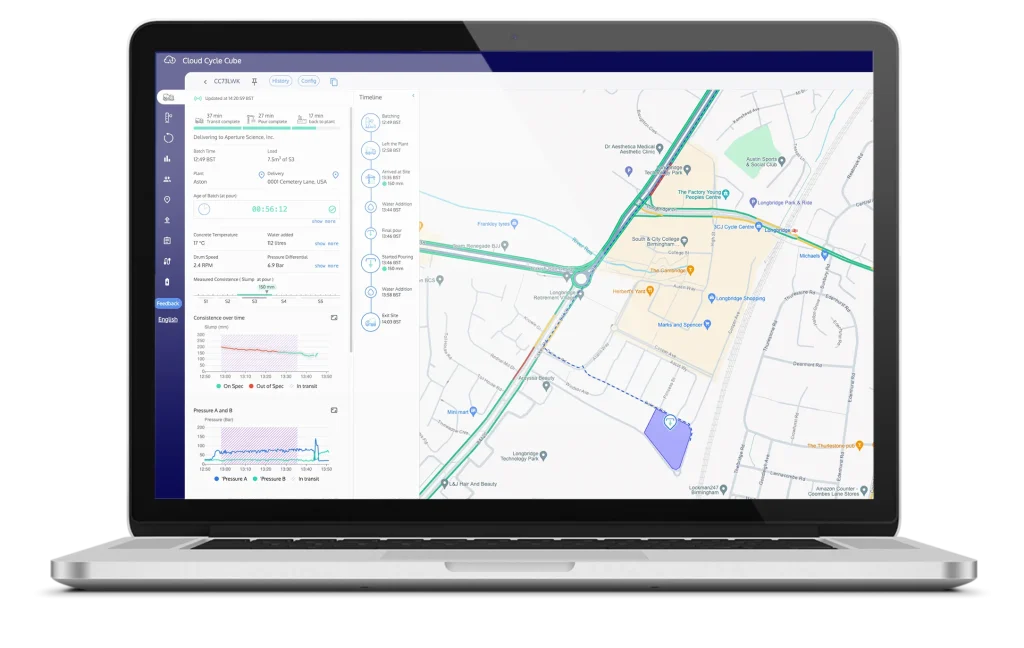
Cloud Cycle has also developed a software platform called Cube that allows clients to track and monitor a concrete delivery and any adjustments made to the material by the driver in real time; from batching and mixing, to transportation and pouring.
“We make concrete quality data cheap and available for clients, so they can optimise every single load by making any adjustments they need.”
But the company is not sticking to monitoring just concrete. Cloud Cycle is now exploring other applications, such as monitoring the production and laying of asphalt used to build and repair roads.
Read about the work of i3P in helping to develop the market for digital concrete testing.
Find out more about the HS2 Innovation Accelerator.